For project managers overseeing shipbuilding or marine structural projects, verifying carbon steel plate compliance with IMO SOLAS Chapter II-1 is non-negotiable for safety, certification, and regulatory approval. As a trusted carbon steel plate manufacturer and supplier from China, Hongteng Fengda delivers certified carbon steel plate for shipbuilding — including high carbon steel plate options — rigorously tested to meet ASTM, EN, and GB standards aligned with SOLAS requirements. Whether you’re a procurement officer, quality assurance specialist, or engineering decision-maker, our traceable, mill-tested carbon steel plates help streamline vessel classification and reduce project risk.
Standards & Certification: Why SOLAS Chapter II-1 Matters for Carbon Steel Plate
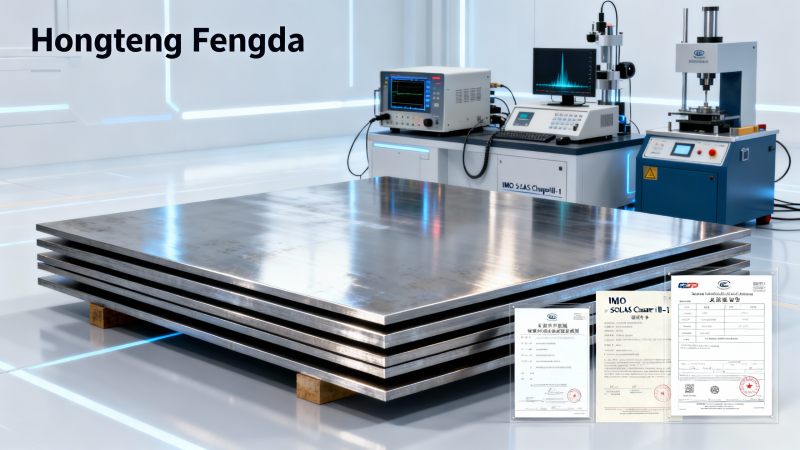
IMO SOLAS Chapter II-1 governs construction — specifically subdivision, stability, machinery, and electrical installations — of all passenger and cargo ships over 500 GT. Within this framework, Regulation 3-2 mandates that “materials used in the construction of hulls, machinery spaces, and other critical structural zones must possess adequate strength, toughness, weldability, and fire resistance under operational and emergency conditions.” For carbon steel plate used in hull plating, bulkheads, decks, and framing, this translates into strict mechanical property thresholds (e.g., minimum yield strength ≥ 235 MPa for general grades), impact testing at low temperatures (−20°C or lower per IACS UR W21), and full traceability from heat number to final product certificate. Non-compliance doesn’t just delay class approval — it triggers mandatory rework, third-party re-inspection, and potential liability exposure during incident investigations. At Hongteng Fengda, every batch of carbon steel plate undergoes dual-certification: first against national GB/T 700 or GB/T 1591 standards, then cross-verified against ASTM A131 (for marine-grade plates) or EN 10025-2 S355J2+N, ensuring alignment with Lloyd’s Register, DNV, ABS, and BV classification society requirements. Our mill test reports include tensile strength, elongation, Charpy V-notch energy absorption at specified temperatures, chemical composition (C, Mn, Si, P, S, Nb, V), and ultrasonic testing (UT) results — all stamped and signed by independent NDT Level III personnel.
Technical Performance: Mechanical Integrity Meets Marine Realities
Carbon steel plate for shipbuilding isn’t defined solely by chemistry — its performance under cyclic loading, saltwater immersion, and thermal stress determines service life and structural reliability. High carbon steel plate, while less common in primary hull applications due to reduced ductility and weldability, remains essential for wear-resistant components like rudder stocks, propeller shaft sleeves, and anchor chain links where hardness (≥ 250 HBW) and fatigue resistance are prioritized. In contrast, low-to-medium carbon structural steels — such as Q235B and Q345B — dominate hull fabrication thanks to their optimal balance: yield strengths of 235–345 MPa, elongation >21%, and guaranteed −20°C impact energy ≥27 J. Hongteng Fengda’s production line integrates controlled rolling, accelerated cooling (ACC), and post-rolling normalization to refine grain structure and suppress brittle phase formation. All plates undergo 100% magnetic particle inspection (MPI) for surface discontinuities and ultrasonic testing (UT) per EN 10160 S4 class for internal integrity. Thickness tolerance is held within ±0.02 mm for plates ≤10 mm and ±0.05 mm for thicker sections — critical when welding multi-pass joints in double-bottom tanks or longitudinal stiffeners. We also offer optional hot-dip galvanized Channel In Steel profiles for secondary marine structures requiring corrosion resilience without painting cycles.
Procurement Guide: How Project Managers Source Compliant Carbon Steel Plate
Sourcing carbon steel plate supplier partners involves far more than comparing unit price or MOQ. For project managers, the real cost lies in documentation gaps, delayed inspections, and untraceable heats. A robust procurement checklist must include: (1) Valid ISO 9001:2015 and ISO 3834-2 certifications; (2) Evidence of in-house metallurgical lab accreditation (CNAS or equivalent); (3) Pre-shipment third-party verification reports from BV, SGS, or TÜV; (4) Heat-specific MTRs with full chemical + mechanical data; and (5) Traceability logs linking purchase order → casting number → rolling batch → cutting schedule → delivery note. Hongteng Fengda embeds these safeguards into standard practice: each export order receives an electronic and hard-copy dossier containing EN 10204 3.2 Mill Test Certificates, IACS-compliant welding procedure specifications (WPS), and digital heat maps showing rolling direction and sampling locations. We support just-in-time deliveries with bonded warehouse options in Shanghai and Ningbo, and maintain strategic stock of ASTM A131 Grade AH36 and DH36 plates — ready for immediate classification survey. For OEM integrators and marine equipment manufacturers, we provide laser-engraved heat IDs on cut-to-size plates and coordinate joint witnessing of UT tests with client QA teams onsite.
Case Studies: Real-World Verification in Action
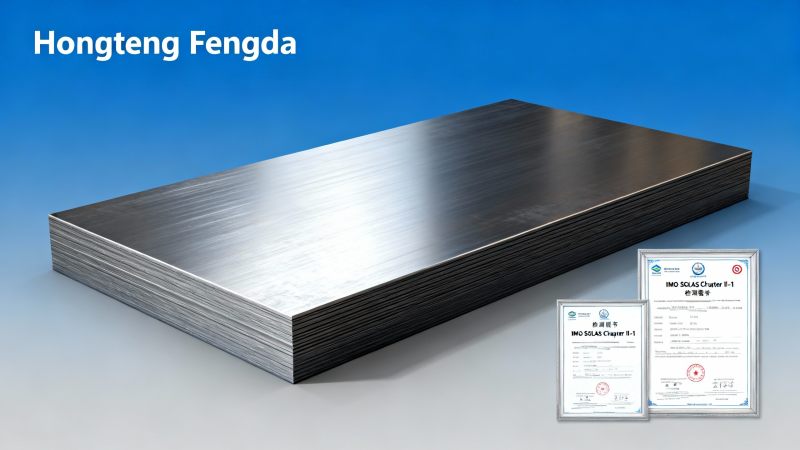
In Q3 2023, a European ferry operator required 1,200 MT of carbon steel plate for retrofitting bow thruster tunnels on three RoPax vessels. The specification demanded ASTM A131 Grade EH36 with −40°C Charpy impact values ≥34 J — exceeding standard SOLAS requirements due to Arctic route expansion. Hongteng Fengda delivered full compliance through microalloying with Ti+Nb, thermomechanical controlled processing (TMCP), and individual plate UT scanning. All 216 plates passed DNV’s pre-installation audit, eliminating six weeks of requalification delays. Similarly, a Southeast Asian offshore fabricator sourcing carbon steel plate for jacket leg splices selected our Q345B plates after comparative fatigue testing showed 18% higher crack propagation resistance versus competing suppliers’ mill certificates — verified via ASTM E647 testing at −10°C. These outcomes reflect our integrated approach: not just supplying carbon steel plate, but co-engineering material solutions rooted in real-world structural behavior and regulatory foresight.
Why Choose Hongteng Fengda as Your Carbon Steel Plate Manufacturer?
As a structural steel manufacturer and exporter from China, Hongteng Fengda bridges global compliance expectations with localized execution excellence. We are not merely a carbon steel plate supplier — we are your technical extension in the supply chain. With dedicated marine product managers fluent in ABS, LR, and CCS rulebooks, in-house metallurgists holding ASM International certifications, and seamless integration with ERP-driven traceability systems, we turn complex SOLAS verification into predictable, auditable workflows. Our facility maintains ISO 3834-2 welding certification, EN 1090-2 EXC3 execution class capability, and annual capacity exceeding 500,000 MT — ensuring scalability without compromise. Whether you need standard carbon steel plate, specialized high carbon steel plate for high-wear marine fittings, or customized Channel In Steel for deck-mounted support frames, contact us today for a project-specific compliance roadmap, sample testing protocol, or factory audit scheduling.
- channel in steel
- carbon steel plate manufacturer
- high carbon steel plate
- carbon steel plate
- carbon steel plate supplier
- Steel Plate Supplier
- hot-dip galvanized
- structural steel
- steel profiles
- Structural Steel
- steel plate
- Profile
- steel plate for shipbuilding
- Galvanized
- carbon steel
- steel profile
- carbon steel plate for shipbuilding
Related recommendations
 What is an H-Beam and How Does it Differ from an I-Beam?Discover what an H-beam is and how it differs from an I-beam. Learn key structural differences and expert selection tips from Hongteng Fengda to optimize your steel construction projects today.
 Hot Rolled vs. Cold Rolled Steel Sheet: Surface and ToleranceHot rolled vs cold rolled steel sheet: Discover how surface finish and tolerances impact manufacturing. Optimize material selection, reduce costs, and ensure quality. Read our expert guide today!
 Best Cutting and Bending Practices for Galvanized Sheet MetalDiscover the best cutting and bending practices for galvanized sheet to prevent zinc flaking. Optimize tooling and thermal parameters to ensure perfect corrosion resistance. Read the full guide!
 What is Galvanized Sheet and How Does the Zinc Coating Work?Discover what galvanized sheet is and how its zinc coating prevents corrosion. Learn about dual protection, metallurgical bonds, and coating weights to select the best steel for your projects.
Please give us a message


Please enter what you want to find