When selecting structural steel for construction projects, understanding the nuances between different beam profiles is crucial. An H-beam, characterized by its wider flanges and parallel inner surfaces, offers superior load-bearing capacity compared to traditional profiles. As a professional structural steel manufacturer, Hongteng Fengda helps global buyers navigate these technical differences to optimize material selection. Discover exactly what an H-beam is, how it fundamentally differs from an I-beam, and why choosing the right steel beam from a reliable supplier can significantly enhance your project's structural integrity and overall cost-efficiency.
The Anatomy of an H-Beam: Beyond the Name
To understand why engineers specify an H-beam, you have to look past the name and focus on the geometry. The cross-section of an H-beam literally looks like the capital letter "H". But it is the specific proportions of its three main components—the web and the two flanges—that give it distinct mechanical advantages.
The most defining feature of an H-beam is its flanges. Unlike other profiles, the flanges on an H-beam are significantly wider, and their inner and outer surfaces are completely parallel. Furthermore, the flange thickness remains consistent from the web to the outer edge. There is no tapering. This uniform thickness simplifies the manufacturing process and, more importantly, makes on-site connections much more straightforward.
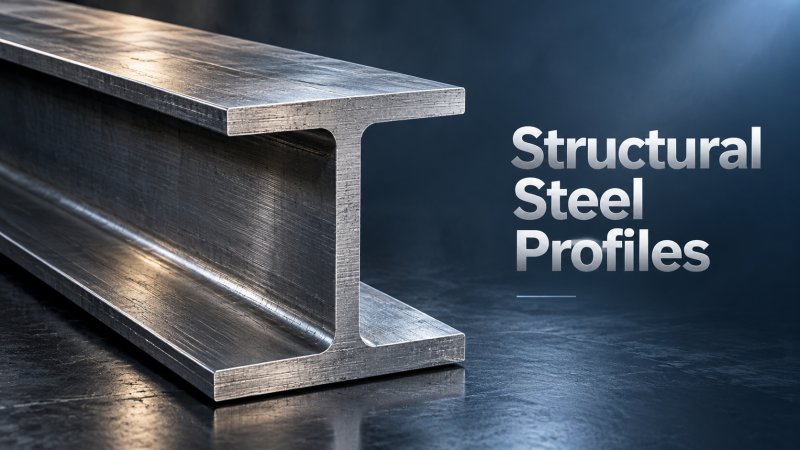
The web, which is the vertical section connecting the two flanges, is also generally thicker in an H-beam compared to traditional alternatives. This thicker web provides excellent resistance to shear forces. When you combine wide, parallel flanges with a thick web, you get a section that is highly efficient at handling heavy loads from multiple directions. It is not just about holding weight; it is about distributing that weight predictably and safely.
H-Beam vs. I-Beam: The Real Differences on the Job Site
The debate between the H-beam and the I-beam (often called a W-beam or wide flange beam in North America, and an S-beam or American Standard beam in older contexts) is a classic one. While they might look similar to the untrained eye at a glance, their structural behaviors are quite different. Let’s break down the practical differences you will actually encounter during design and construction.
Flange Geometry and Load Direction
The most critical difference lies in the flanges. An I-beam typically features tapered flanges, meaning they are thicker at the web and gradually become thinner toward the outer edges. The inner surfaces are not parallel. Because of this tapered design, an I-beam is highly optimized to handle loads in one specific direction—usually vertical bending. It is an excellent choice for horizontal beams where the primary stress is unidirectional.
An H-beam, with its parallel and uniformly thick flanges, distributes stress more evenly. This makes it capable of handling loads from multiple directions. Because of this multidirectional strength, H-beams are the go-to choice for vertical columns and load-bearing pillars where the structure needs to resist both vertical compression and lateral forces, such as wind or seismic activity.
Weight and Material Efficiency
Here is a common misconception: people often assume H-beams are always heavier. While it is true that an H-beam has more material per linear foot due to its wider flanges and thicker web, this extra weight translates directly to a higher load-bearing capacity. In many heavy-duty construction scenarios, using fewer, heavier H-beams can actually be more material-efficient and cost-effective than using a larger number of lighter I-beams. The key is to match the beam's weight to the actual load requirements of the specific structural node.
Fabrication and Welding
From a fabricator's perspective, the parallel inner surfaces of an H-beam flange are a massive advantage. When you need to weld a connection plate or splice two beams together, a flat, parallel surface ensures a perfect fit. Tapered flanges on an I-beam often require the use of specialized taper-cut washers or additional grinding to ensure a flush, secure connection. On a busy construction site, this ease of fabrication can save significant labor time and reduce the risk of connection failures.
Common Mistakes in Beam Selection
In our years of exporting structural steel globally, we have seen project delays caused by simple specification errors. One frequent mistake is using an I-beam for a vertical column in a high-rise or heavy industrial building. Because the I-beam's flanges are narrower and tapered, it lacks the lateral stability required for vertical compression, potentially leading to buckling under heavy loads.
Conversely, specifying an H-beam for a simple, light-duty horizontal span where an I-beam would suffice is a waste of budget. H-beams are more expensive per ton due to the higher material volume. If the engineering calculations only require unidirectional bending resistance, paying for the multidirectional capacity of an H-beam is an unnecessary expense. Always let the structural engineer's load calculations dictate the profile, not just the perceived "heaviness" of the steel.
Navigating Global Standards and Sourcing Realities
When you are sourcing steel beams internationally, the terminology can get confusing. What is called an H-beam in Asia and Europe might be referred to as a Wide Flange (W) shape in the United States under ASTM standards. The physical geometry might be similar, but the exact dimensional tolerances, steel grades, and testing requirements can vary significantly between ASTM, EN, JIS, and GB standards.
This is where partnering with an experienced manufacturer matters. At Hongteng Fengda, we supply standard specifications and OEM solutions across North America, Europe, the Middle East, and Southeast Asia. We understand that a buyer in the Middle East might require strict adherence to specific ASTM grades for a commercial complex, while a partner in Southeast Asia might need JIS-compliant sections for an industrial plant. Our modern manufacturing facilities and strict quality control ensure that whether you need angle steel, channel steel, or complex customized structural steel components, the dimensions and mechanical properties match your local building codes perfectly.
It is also worth noting that a complete construction project requires more than just primary structural beams. While heavy H-beams and I-beams form the skeleton, the building envelope requires different specifications. For industrial applications or the exterior of your house, high-quality corrosion-resistant steel like AZ50 Galvalume Steel Coil is frequently specified to protect the structure from environmental wear. A reliable supplier should be able to support both your heavy structural needs and your secondary material requirements, helping you control costs and streamline your procurement process.
Final Thoughts for Project Specifiers
Choosing between an H-beam and an I-beam is not about finding a universally "better" product; it is about finding the right tool for the specific structural job. H-beams offer superior multidirectional strength, easier fabrication, and excellent load distribution for columns and heavy frames. I-beams provide highly efficient, cost-effective unidirectional support for horizontal spans.
Before finalizing your material list, review the load paths with your structural engineer. Once the profiles are selected, ensure your steel supplier has the manufacturing capacity to meet the exact dimensional tolerances required by your local standards. Reducing sourcing risks and ensuring consistent quality from the mill to the job site is just as critical as the steel grade itself. By understanding these fundamental differences and working with a trusted partner, you can ensure your project stands strong for decades to come.
Please give us a message


Please enter what you want to find