The distinction between hot rolled and cold rolled steel sheet fundamentally lies in the thermal history of the material, which directly dictates surface characteristics and dimensional tolerances. Evaluations often stall when surface finish and thickness deviations are assessed without considering the manufacturing process limits. Understanding the metallurgical and mechanical boundaries of each rolling method prevents downstream processing failures and ensures structural integrity.
Surface Quality: Oxide Layers, Roughness, and Coating Interaction
Hot rolled steel sheet is processed at temperatures exceeding the recrystallization point, typically above 900°C. This high-temperature deformation results in the formation of an iron oxide layer, commonly known as mill scale. The surface texture is inherently rougher, characterized by micro-irregularities and a matte or bluish-gray appearance. While pickling and oiling can remove the bulk of the mill scale, the underlying surface retains a slightly etched profile. This profile is advantageous for paint adhesion in certain structural applications but poses challenges for processes requiring a flawless aesthetic finish or precise friction coefficients. The residual oxide pockets, if not fully eliminated during pickling, can act as initiation sites for localized corrosion, particularly in humid or marine environments.
In contrast, cold rolled steel sheet undergoes further reduction at room temperature after hot rolling and pickling. This process eliminates the oxide layer and compresses the surface grains, yielding a smooth, uniform finish with a characteristic metallic luster. The surface roughness is significantly lower, often ranging between 0.2 to 0.8 micrometers, compared to the 2.0 to 5.0 micrometers typical of hot rolled equivalents. Selecting cold rolled material is mandatory when the final component requires direct exposure without coating, or when precise friction is critical during automated stamping and deep drawing operations.
However, the interaction between surface finish and protective coatings requires careful analysis. The smooth surface of cold rolled steel can sometimes lead to reduced mechanical interlocking for certain paint systems, necessitating proper surface preparation or the use of specialized primers. Conversely, when galvanizing, the slightly rougher profile of a properly cleaned hot rolled sheet can provide excellent adhesion for the zinc layer. An overly smooth cold rolled surface might require additional mechanical roughening or specific fluxing adjustments to ensure a uniform zinc coating without skimming defects.
Surface Inspection and Micro-Defects
Beyond general roughness, the nature of surface defects differs markedly between the two processes. Hot rolled steel sheet is susceptible to rolled-in scale, where fragments of the oxide layer are pressed into the base metal during rolling. These inclusions are often difficult to detect visually and only become apparent after pickling or machining, appearing as dark, irregular patches. Such defects can compromise the fatigue life of dynamically loaded components and must be strictly limited in critical structural applications.
Cold rolled steel, having been pickled prior to the final reduction, is largely free of rolled-in scale. However, the cold rolling process can introduce other surface anomalies, such as roll marks, chatter marks, or edge scratches, if the mill rolls are not properly maintained or if the tension control is inadequate. Inspection protocols must define acceptable defect limits based on the specific application. A component subjected to high cyclic loading requires a stringent limit on surface discontinuities, regardless of whether it is hot or cold rolled, but the nature of the defects to look for during incoming inspection will differ.
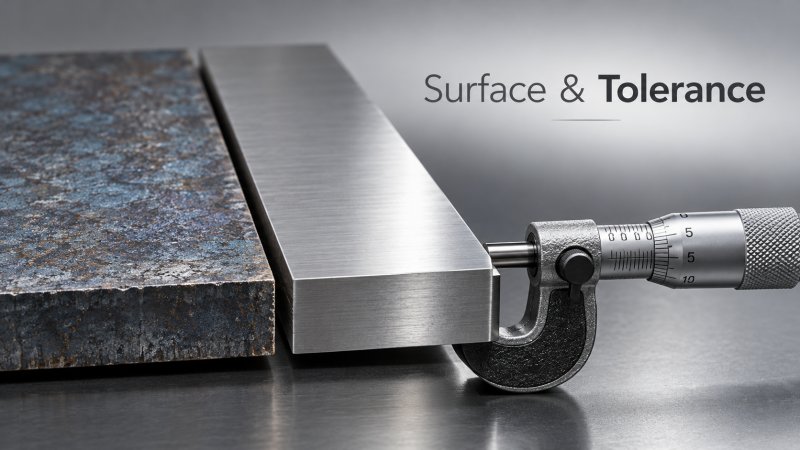
Dimensional Tolerances: Thickness, Width, and Edge Conditions
Dimensional tolerances represent the most critical differentiator in material selection, particularly for automated manufacturing and precision structural assemblies. The thermal contraction and uneven cooling inherent in hot rolling introduce wider variance in thickness and width. Standard hot rolled steel sheet tolerances, such as those defined in ASTM A568 or EN 10051, allow for broader deviations. For instance, a 2.0mm thick hot rolled sheet might permit a thickness tolerance of ±0.15mm to ±0.18mm, depending on the width and standard applied.
Cold rolling, being a room-temperature process, achieves much tighter dimensional control. The reduction in thickness is mechanically forced through precision rolls, resulting in tolerances that are often half or even a third of those permitted for hot rolled products. A cold rolled sheet of the same 2.0mm thickness typically maintains a tolerance of ±0.05mm to ±0.08mm. This precision is non-negotiable in applications where stacking, nesting, or high-speed feeding into progressive dies is required. When evaluating a Cold Rolled Steel Coil for such applications, verifying the specific tolerance class against the intended machinery's acceptance limits is a critical step to prevent feeding jams or misaligned cuts.
Edge condition is another parameter frequently overlooked in initial evaluations. Hot rolled sheets are typically supplied with mill edges, which are natural, rounded, and can exhibit minor irregularities or micro-cracks from the rolling process. Cold rolled sheets are usually supplied with slit edges, which are square, sharp, and highly consistent. If the material is to be welded edge-to-edge, the mill edge of a hot rolled sheet might require edge preparation or milling to ensure proper penetration and avoid slag inclusions. Slit edges on cold rolled material generally allow for direct welding, provided the fit-up is precise.
Flatness and Residual Stresses in Engineering Applications
Flatness is a parameter where the two processes diverge significantly, directly impacting fabrication efficiency. Hot rolled sheets are prone to edge waves, center buckles, and coil set due to residual stresses from uneven cooling across the width and thickness. While leveling processes can improve flatness, achieving the strict I-unit flatness standards required for laser cutting or robotic welding is difficult. When a hot rolled sheet with high residual stress is cut, the release of these stresses can cause the plate to twist or bow, ruining dimensional accuracy and complicating assembly.
Cold rolled sheets, subjected to temper rolling and precise leveling, exhibit superior flatness, minimizing the risk of misalignment during assembly and ensuring consistent gap tolerances in welded structures. The residual stresses in cold rolled steel are primarily tensile on the surface and compressive in the core, a result of the cold reduction. While this provides excellent flatness, these locked-in stresses can lead to distortion during welding if the heat input is not carefully controlled. Engineering assessments must balance the need for initial flatness against the potential for welding distortion, sometimes specifying stress-relief annealing for complex cold rolled fabrications.
Downstream Processing and Operational Realities
A common misjudgment in material selection is assuming that tighter tolerances and better surface finishes universally justify the specification of cold rolled steel. The decision must be anchored in the specific downstream processing and service environment. For welding applications, the mill scale on hot rolled steel can introduce porosity and inclusions if not completely removed. Specifications must mandate adequate surface preparation, such as abrasive blasting or chemical cleaning, which adds to the overall project cost.
In cold forming operations, the surface condition directly influences tool wear and forming limits. The rougher surface of hot rolled steel increases friction, accelerating die wear and potentially causing galling during severe bending. Cold rolled steel's smooth surface reduces friction, allowing for more complex geometries and longer tool life. However, the higher yield strength and work hardening induced by cold rolling mean that intermediate annealing might be necessary for multi-stage forming, a factor that impacts both lead time and cost. The choice between the two often depends on whether the fabrication facility is equipped to handle surface preparation for hot rolled material or manage distortion and work hardening for cold rolled material.
Standard Compliance and Acceptance Boundaries
Navigating international standards requires a precise understanding of how tolerances are measured and applied. ASTM and EN standards define tolerance classes based on thickness, width, and sometimes the cutting method. A frequent error occurs when the tolerance limits of a standard sheet are applied to the entire coil, including the uncropped ends. Standards typically specify that tolerance limits apply to the usable length of the material, excluding the non-conforming ends. Clarifying this boundary with the supplier prevents disputes during incoming quality inspections.
Furthermore, the measurement methodology must align with the standard. Using a micrometer at the edge of a hot rolled sheet might yield a different reading than measuring at the center due to edge drop—a phenomenon where the edges are slightly thinner than the center. Cold rolled sheets exhibit less edge drop, but it is still a factor in high-precision applications. Specifications should define whether measurements are to be taken at a specific distance from the edge, as outlined by the relevant material standard, ensuring that the inspection process accurately reflects the standard's intent.
The economic evaluation of hot rolled versus cold rolled steel sheet extends beyond the initial material cost. While cold rolled material commands a premium due to the additional processing steps, the total cost of ownership must account for downstream efficiencies. If a project requires extensive machining, cold rolled steel's tighter tolerances can reduce machining time and material waste. In contrast, if the application involves heavy structural framing where surface finish is irrelevant and tolerances are loose, specifying cold rolled steel introduces unnecessary material costs. Ultimately, the selection is a balance of surface requirements, dimensional precision, downstream processing capabilities, and total project economics, ensuring optimal performance without compromising structural integrity.
Please give us a message


Please enter what you want to find