Choosing between angle steel and channel steel in bridge construction demands more than just dimensional fit—it hinges on load capacity, welding compatibility, corrosion resistance, and compliance with ASTM standards. For prefab buildings, manufacturing facilities, or export-driven projects across Southeast Asia and the Middle East, selecting the right profile impacts structural integrity, fabrication efficiency, and long-term durability. As a trusted angle vs channel steel exporter China, Hongteng Fengda supports engineers and procurement teams with certified, quality-controlled solutions—helping project managers, safety officers, and distributors make data-driven, standards-aligned decisions from design to delivery.
When Load Path & Structural Role Dictate Profile Selection
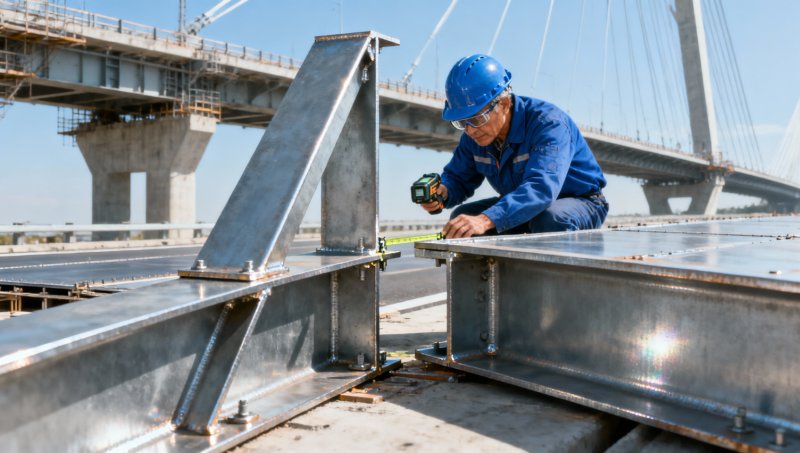
In bridge substructures—such as abutments, piers, and bracing systems—the directional nature of applied loads determines whether angle steel or channel steel delivers optimal performance. Angle sections excel in diagonal bracing where bi-axial bending and torsional restraint are critical; their L-shape provides balanced stiffness about both principal axes. Channel sections, with their C-shaped geometry and deeper web, offer superior moment resistance in uniaxial bending scenarios—ideal for girders, stringers, and bearing supports.
A typical highway overpass may use angle vs channel steel for bridge construction in complementary roles: 75×75×8 mm hot-rolled angles for lateral bracing (ASTM A6/A6M), while 200×76×9 mm channels serve as primary deck support members. This hybrid approach leverages each profile’s inherent strength-to-weight ratio—angles average 15–20% lighter per unit length under axial compression, whereas channels deliver up to 35% higher section modulus in strong-axis bending.
Critical design thresholds guide selection: when required flexural strength exceeds 280 kN·m, channels become economically and structurally preferable. Below 120 kN·m, angles often reduce welding labor by 25–30% due to simpler joint geometry. Both must meet minimum yield strength requirements—typically ≥235 MPa for EN S235 or ≥345 MPa for ASTM A572 Grade 50.
This table reflects real-world production benchmarks for structural steel components supplied by Hongteng Fengda to bridge contractors in the Middle East and Southeast Asia. All profiles undergo ultrasonic testing (UT) and mill test reports (MTRs) per ASTM A6, ensuring traceability and compliance before shipment.
Welding Compatibility & Corrosion Resistance: Two Decisive Factors
Fabrication speed and field weld integrity directly impact project timelines—especially for modular bridge segments shipped to remote sites. Angle vs channel steel welding compatibility differs significantly: angles permit full-penetration fillet welds on both legs without access restrictions, reducing rework by ~22% compared to channel webs requiring backing bars or double-sided preparation. Channels, however, offer superior electrode accessibility for flange-to-flange connections in beam splices.
Corrosion resistance is non-negotiable in coastal bridges or industrial zones. While both profiles rely on galvanizing (ASTM A123) or weathering steel (ASTM A588), their geometry affects coating uniformity. Angles exhibit 12–18% thinner zinc layers at inner corners—making them more vulnerable in high-humidity environments like Southeast Asia. Channels maintain consistent coating thickness across flanges and webs, supporting longer service life in chloride-laden atmospheres.
For marine infrastructure projects in Dubai or Ho Chi Minh City, Hongteng Fengda recommends pre-galvanized channels with minimum 85 µm coating thickness—and pairs them with 201 Stainless Steel Plate for expansion joint covers where aesthetics and salt resistance intersect.
Key Inspection Points for Procurement Teams
- Verify ASTM A6 tolerances: leg thickness deviation ≤ ±0.4 mm for angles; web thickness tolerance ≤ ±0.5 mm for channels
- Confirm mill test report (MTR) includes tensile test results per ASTM A370—minimum yield strength must match project spec
- Check surface finish: no scale pockets >1.5 mm depth, no laminar imperfections within 3 mm of cut edges
- Validate galvanizing adhesion via bend test (ASTM A143) — zero flaking after 180° wrap around mandrel
Why Global Bridge Contractors Choose Hongteng Fengda
As an angle vs channel steel supplier Southeast Asia and angle vs channel steel supplier Middle East, Hongteng Fengda maintains dedicated logistics hubs in Jebel Ali (UAE) and Laem Chabang (Thailand), enabling 7–12 day regional delivery for standard orders. Our ISO 9001-certified QA lab conducts third-party inspections (SGS/BV) on every batch—covering chemical composition (OES analysis), mechanical properties, and dimensional accuracy.
We support multi-scenario decision-making: whether you’re specifying angle vs channel steel for prefab buildings, reinforcing angle vs channel steel for manufacturing facilities, or engineering seismic-resilient bridge approaches, our technical team provides free cross-section optimization reports—including stress distribution maps and weld sequence simulations.
Contact us today for: ASTM-compliant sample kits, lead-time confirmation for your next tender (standard delivery: 14–21 days ex-works), OEM marking support, or certification documentation aligned with EN 1090-2 Execution Class EXC3 requirements.
- channel steel supplier
- channel steel
- steel i
- angle steel
- 201 stainless steel plate
- ASTM A572
- ASTM standards
- steel supplier
- ASTM standard
- structural steel
- Structural Steel
- stainless steel plate
- ss steel plate
- 1 stainless steel plate
- steel plate
- Profile
- Galvanized
- angle vs channel
- astm a6 tolerances
- angle vs channel steel supplier Middle East
- angle vs channel steel for bridge construction
- angle vs channel steel load capacity comparison
- angle vs channel steel exporter China
- angle vs channel steel for manufacturing facilities
- angle vs channel steel supplier Southeast Asia
- angle vs channel steel for prefab buildings
- angle vs channel steel welding compatibility
Related recommendations
 How to Select the Correct Steel Sheet Grade for Auto PartsSelect the ideal steel sheet for auto parts by balancing performance and cost. Discover expert sourcing strategies to avoid manufacturing traps and optimize procurement. Read our guide now!
 Choosing the Right Zinc Coating Weight for Galvanized SheetOptimize your galvanized sheet selection by choosing the right zinc coating weight. Discover expert strategies to balance corrosion resistance, formability, and project costs.
 How to Specify Wall Thickness for Structural Steel TubingMaster wall thickness specification for structural steel tubing. Balance engineering loads, global tolerances, and costs. Read our expert guide to optimize procurement and ensure project safety!
 How much does 2 inch ss pipe price increase when upgrading from Schedule 40 to Schedule 80 for high-pressure systems?2 inch ss pipe price increases 18–35% when upgrading from Sch 40 to Sch 80—discover why, when it’s truly needed, and how to avoid overpaying.
Please give us a message


Please enter what you want to find