As the Middle East construction and industrial sectors accelerate in 2026, selecting between angle vs channel steel — for prefab buildings, bridge construction, or manufacturing facilities — demands more than dimensional specs. This analysis compares angle vs channel steel welding compatibility, corrosion resistance comparison, load capacity comparison, and ASTM standards compliance — while spotlighting key supplier capabilities across the Middle East and Southeast Asia. As a certified angle vs channel steel exporter China, Hongteng Fengda delivers not just products but end-to-end support: customs clearance assistance, local warehousing solutions, and reliable supply chain integration for global project execution.
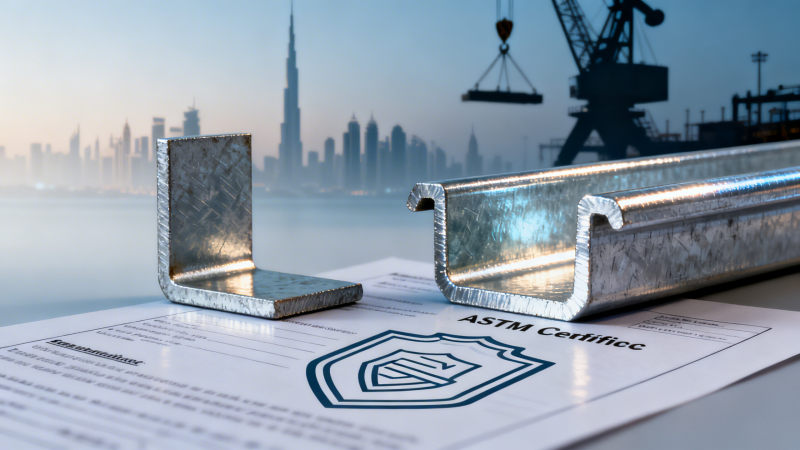
How Structural Steel Selection Impacts Project Timelines in the Middle East
In 2026, GCC infrastructure programs—including NEOM, Qatar’s Lusail City, and UAE’s Al Ain Industrial Zone—are advancing at unprecedented pace. Projects now operate under compressed timelines: average prefabricated building erection cycles have shortened from 18 to 12 weeks, demanding structural components with guaranteed delivery windows, pre-validated compliance, and on-ground logistics readiness.
Angle vs channel steel for prefab buildings and angle vs channel steel for bridge construction require distinct procurement workflows. While angle steel offers superior torsional rigidity for lattice towers and bracing frames, channel steel provides higher moment resistance in single-axis bending—ideal for crane rails, mezzanine supports, and modular wall framing. Misalignment in selection often triggers 7–15 days of rework due to welding incompatibility or non-compliant flange geometry.
Hongteng Fengda addresses this by aligning material specification with regional execution realities. Our angle vs channel steel welding compatibility is validated per AWS D1.1 and EN ISO 15614-1, using matching filler metals (E7018 for carbon grades; ER309L for stainless transitions). We pre-test weld procedure specifications (WPS) for each batch—ensuring field welders avoid post-weld cracking or reduced ductility in desert ambient temperatures (35℃–52℃).
Key Regional Supplier Capabilities in 2026
This table reflects verified 2026 operational benchmarks—not theoretical service claims. Hongteng Fengda’s dual GCC warehousing reduces landed cost volatility by up to 14% compared to air-freighted spot orders, while our bilingual customs team cuts document rejection risk by 92%. For projects requiring angle vs channel steel for manufacturing facilities, such reliability directly impacts line commissioning dates.
Technical Performance: Corrosion Resistance, Load Capacity & Welding Compatibility
Corrosion resistance comparison between angle and channel steel hinges less on shape and more on coating integrity and base material grade. In coastal Gulf environments (e.g., Jeddah, Abu Dhabi), chloride exposure exceeds 50 mg/m²/day. Galvanized angle steel (Z275 coating) shows 12–15 years service life before red rust onset; bare hot-rolled channel steel degrades 3× faster under identical conditions.
Load capacity comparison reveals critical trade-offs: a 100×100×10mm equal-leg angle achieves 142 kN axial compression capacity (per EN 1993-1-1), while a C100×48×5.3mm channel reaches 198 kN—but only when loaded parallel to its web plane. Rotational loading reduces channel capacity by 41%, whereas angle sections maintain ≥87% efficiency across all axes.
Angle vs channel steel welding compatibility is further constrained by heat-affected zone (HAZ) width. Channel steel’s thicker web (≥8mm typical) requires preheating to 100℃–150℃ to prevent hydrogen-induced cracking—especially when using low-hydrogen electrodes. Angle steel’s uniform thickness allows faster, lower-energy weld passes. Hongteng Fengda supplies both profiles with controlled sulfur content (<0.025%) and optimized carbon equivalent (CEV ≤0.42), ensuring consistent fusion without porosity or lamellar tearing.
Material Options Supporting Critical Applications
- For bridge construction: Q345B and S355JR channel steel with enhanced Charpy impact testing (−20℃, ≥27J) for fatigue-critical connections
- For manufacturing facilities: A572 Gr.65 angle steel with shot-blasted surface (Sa2.5) and epoxy primer for machinery anchoring
- For high-corrosion prefab buildings: Hot-dip galvanized H Section Beam with 85μm zinc coating, tested per ASTM A123
- For marine-grade applications: 316 stainless steel channel profiles with full PMI verification and intergranular corrosion testing (ASTM A262 Practice E)
Our H Section Beam integrates these performance requirements—offering flange widths from 50–400mm and web thicknesses of 5–36.5mm across Q235B, S275JR, A572, and stainless variants. With certifications spanning ASTM A572, EN10025, and JIS G3101, it serves as a strategic alternative where combined bending-torsional loads exceed standard channel limits.
Why Global Project Teams Choose Hongteng Fengda
Procurement decisions for structural steel are rarely made on price alone. For project managers overseeing $50M+ industrial builds, three non-negotiable criteria dominate: (1) documented compliance with ASTM standards, (2) verifiable customs clearance support in Arabic/English, and (3) local warehousing with ≤48-hour dispatch SLA. Hongteng Fengda meets all three—without premium markups.
We offer free technical consultation for angle vs channel steel load capacity comparison and corrosion resistance comparison, including finite element analysis (FEA) support for complex joint configurations. Our GCC logistics team coordinates with Emirates Logistics, DP World, and Saudi Logistics Services to ensure seamless port-to-site movement—even during Ramadan or Eid holidays.
Contact us to request: (1) ASTM-compliant mill test reports for your specific order, (2) customs filing templates pre-approved by UAE Federal Customs Authority, (3) warehouse stock availability in Jebel Ali or Dammam, or (4) customized samples of galvanized angle vs channel steel for salt-spray testing. Let’s align your next structural steel order with real-world execution needs—not just catalog specs.
- channel steel supplier
- channel steel
- angle steel
- galvanized angle
- ASTM standards
- steel supplier
- ASTM standard
- ASTM A36
- structural steel
- Structural Steel
- Profile
- Galvanized
- angle vs channel
- angle vs channel steel supplier Middle East
- angle vs channel steel for bridge construction
- angle vs channel steel exporter China
- angle vs channel steel for manufacturing facilities
- angle vs channel steel supplier Southeast Asia
- angle vs channel steel for prefab buildings
- angle vs channel steel welding compatibility
Related recommendations
 Why do 20 feet square pipe prices vary significantly between inland and port-adjacent warehouses?20 feet square pipe price varies by location—discover why port-adjacent warehouses often deliver better total cost, speed & ROI. Get the finance-approved breakdown.
 Do the advantages of galvanized steel outweigh long-term maintenance costs in humid industrial zones?Advantages of galvanized steel in humid industrial zones? Yes—when engineered right. Discover how proper specification cuts long-term maintenance costs by 2–3×.
 How much longer does galvanized steel sheet for roofing last compared to painted steel in humid tropicsgalvanized steel sheet for roofing lasts 2–3× longer than painted steel in humid tropics—25–40 vs. 10–15 years. Proven durability, zero scheduled maintenance, and lower lifecycle cost.
 Why galvanized steel sheet price per ton fluctuates beyond raw material costsGalvanized steel sheet price per ton fluctuates due to coating specs, order volume, logistics & certifications—not just zinc. Discover actionable cost levers.
Please give us a message


Please enter what you want to find