Selecting a steel Profile is rarely a single-variable decision. Load capacity, span length, connection details, and fabrication limits interact from the first drawing to the final installation. When the wrong section is chosen, the result is usually not dramatic failure, but avoidable weight, higher processing cost, awkward welding, or reduced structural efficiency.
That is why Profile selection matters across construction, industrial equipment, transport structures, and custom manufacturing. A practical review should balance engineering performance with supply stability, standards compliance, and downstream workability. For projects that source globally, this balance often determines whether the design remains economical after production, shipment, and site assembly are considered.
Why Profile selection deserves closer attention
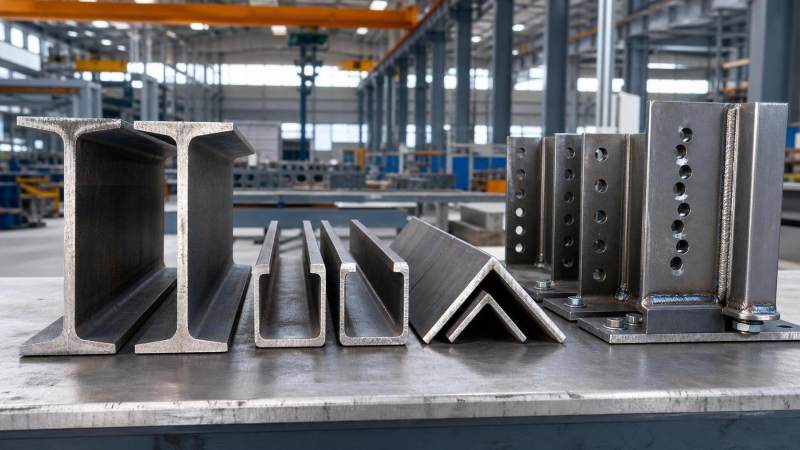
A steel Profile does more than carry force. It also affects stiffness, deflection control, joint complexity, coating access, transport efficiency, and fabrication hours. Two sections can meet the same basic strength requirement while performing very differently in production.
This has become more relevant as projects demand tighter budgets and shorter lead times. Buyers also compare suppliers across ASTM, EN, JIS, and GB systems, so the chosen Profile must work both structurally and commercially.
In export-oriented steel supply, consistency matters as much as nominal size. Hongteng Fengda, as a structural steel manufacturer and exporter from China, supports this need through stable production, customized structural components, and quality control aligned with major international standards.
Start with load path, not just section size
The first question is not which Profile looks strongest. It is how the load moves through the member, into the connection, and then into the larger structure. That path defines whether bending, axial force, shear, torsion, or combined stress governs the choice.
For example, I-beams and H-beams are often preferred where bending dominates over longer spans. Channel sections may work well in secondary framing or edge conditions, but can become less efficient under torsion. Angle steel is useful for bracing and support frames, yet its eccentric geometry may complicate some loading cases.
Cold formed sections are attractive when weight reduction, repetitive production, or light structural duty is important. Still, thin-walled behavior, local buckling, and fastening details need closer checking than with heavier hot rolled shapes.
Key load questions before comparing a Profile
- Is the member governed by bending, compression, tension, or a combination?
- Will the section face impact, vibration, cyclic loading, or thermal movement?
- Are serviceability limits, especially deflection, stricter than strength limits?
- Do connection zones create local stress concentrations?
Span changes the economics of every Profile
Longer spans magnify stiffness demands. A Profile that passes strength checks may still feel inefficient if deflection, vibration, or lateral stability require extra material or added bracing. In practice, span often shifts the decision from a light section to a more stable shape.
Short spans allow more flexibility. Fabrication simplicity can then outweigh pure section efficiency. A slightly heavier Profile may still be the better choice if it reduces welding passes, eliminates stiffeners, or simplifies bolted connections.
The table below shows how span usually changes the evaluation focus.
Fabrication needs often decide the final section
A theoretically efficient Profile can become expensive once shop operations begin. Hole layout, end preparation, welding access, camber control, and tolerance management all affect real cost. This is especially true for customized structural steel components and export projects with strict documentation.
Open sections are usually easier to inspect, coat, and connect. Closed or more complex shapes may improve torsional behavior, but can slow processing. When fabrication capacity or site assembly speed is important, simpler geometry often wins.
Material choice also enters the discussion when corrosion, temperature, or hygiene requirements sit alongside structural demands. In mixed-material assemblies, plate products may be selected for covers, guards, equipment supports, or chemically exposed zones rather than for the primary frame.
A useful example is 316 Stainless Steel Plate. Where acidic exposure, heat resistance, or pitting resistance are required, it can support fabricated parts for chemical equipment, food processing, transport components, and medical installations.
Its typical tensile strength is at least 520, yield strength at least 275, and elongation about 55 to 60. With 2 to 3 percent molybdenum, it performs well in corrosive environments and is available in broad thickness and width ranges, which helps when structural detailing meets process equipment requirements.
Fabrication checkpoints that should influence Profile choice
- Can the Profile be cut, drilled, or punched using existing shop equipment?
- Will weld access be restricted by flange depth or section geometry?
- Are standard lengths available, or will waste become excessive?
- Does the surface need galvanizing, painting, or stainless finishing?
- Can the section travel within packing and container limits?
Common Profile types and where they fit best
Most selection work becomes clearer once the main section families are viewed by function rather than by catalog name alone. The point is not to memorize shapes. The point is to understand where each Profile tends to create value.
Standards, traceability, and sourcing discipline
A suitable Profile on paper is still a risk if the delivered product lacks traceability or dimensional consistency. Global projects frequently require compliance with ASTM, EN, JIS, or GB. Equivalent grades are not always directly interchangeable without checking chemistry, yield behavior, tolerance class, and test documentation.
This is where supply capability becomes part of technical evaluation. Stable production capacity, controlled tolerances, and dependable lead times reduce the chance that a section must be redesigned late in the process. For export projects, that reliability is often as valuable as a small saving in unit price.
A manufacturer with experience in angle steel, channel steel, steel beams, cold formed sections, and OEM processing can usually support more practical alternatives when the first Profile choice creates cost or schedule pressure.
A workable approach for final evaluation
Good selection usually comes from comparison, not intuition. Build a short list of sections, then rank each Profile against the real project constraints rather than against ideal laboratory conditions.
- Confirm governing loads and allowable deflection limits.
- Match the span to the stiffness and stability demands.
- Review connection details before locking the section.
- Check fabrication routes, coating needs, and transport lengths.
- Verify standards, certificates, and dimensional tolerances.
- Compare supply continuity for both standard and customized items.
The strongest choice is not automatically the heaviest or the most familiar. It is the Profile that carries the design load, controls span-related behavior, fits the fabrication route, and arrives with the documentation and consistency the project requires.
The next step is to organize the project by load case, span band, and fabrication method, then compare two or three realistic section options against those conditions. That process usually reveals whether a standard structural Profile is enough or whether a customized solution will produce a better overall result.
Please give us a message


Please enter what you want to find