Choosing between angle steel and channel steel is a critical decision for structural framing—impacting strength, stability, cost, and installation efficiency. In this angle vs channel steel comparison, we break down the key angle steel vs channel steel differences: load-bearing capacity, torsional resistance, weldability, and application suitability for 2024’s evolving construction standards. As a trusted structural steel manufacturer & exporter from China, Hongteng Fengda delivers ASTM/EN/GB-compliant products to global project teams—from engineers and procurement managers to safety officers and distributors—helping you select the right profile with confidence, compliance, and cost control.
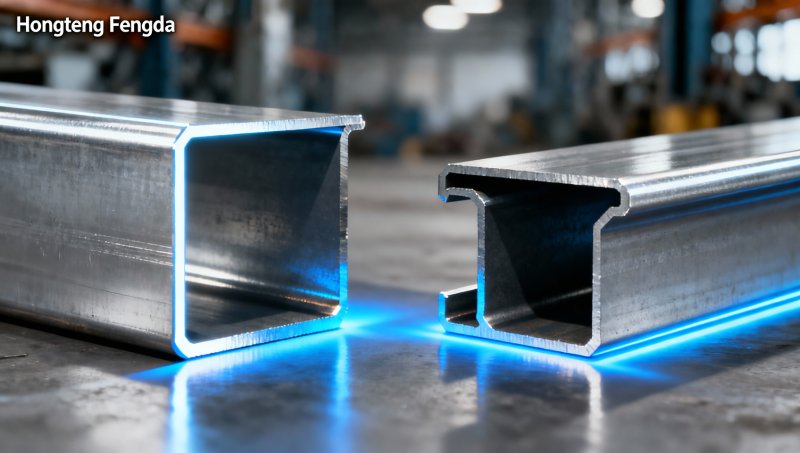
Definition & Structural Identity
Angle steel (L-section) consists of two perpendicular legs forming an “L” shape—available in equal or unequal leg dimensions (e.g., 50×50×5 mm or 75×50×6 mm). Its simplicity enables rapid fabrication and bolting at corners, making it ideal for bracing, trusses, and light-duty frames.
Channel steel (C-section) features a “C”-shaped cross-section with parallel flanges and a web connecting them—commonly designated as C80, C100, or C120 per EN 10279 or ASTM A500. The enclosed geometry provides superior bending stiffness along the strong axis and better resistance to lateral-torsional buckling than angles of comparable weight.
Both are hot-rolled carbon steels (typically Q235B, S235JR, or ASTM A36), but their dimensional logic differs fundamentally: angle steel excels in directional anchoring; channel steel dominates in moment-resisting linear members like purlins, girts, and column bases.
Technical Performance Comparison
Load path behavior, section modulus, and torsional rigidity determine real-world performance—not just nominal size. Below is a side-by-side technical comparison of standard 80×80×6 mm angle steel versus 80×42×5.5 mm channel steel (both Grade S235, EN 10025-2):
Note: Channel steel offers nearly double the bending stiffness (Iz-z) and over five times the torsional constant—critical for wind-loaded façades or crane runway beams where twisting must be minimized.
Application Scenarios in 2024 Projects
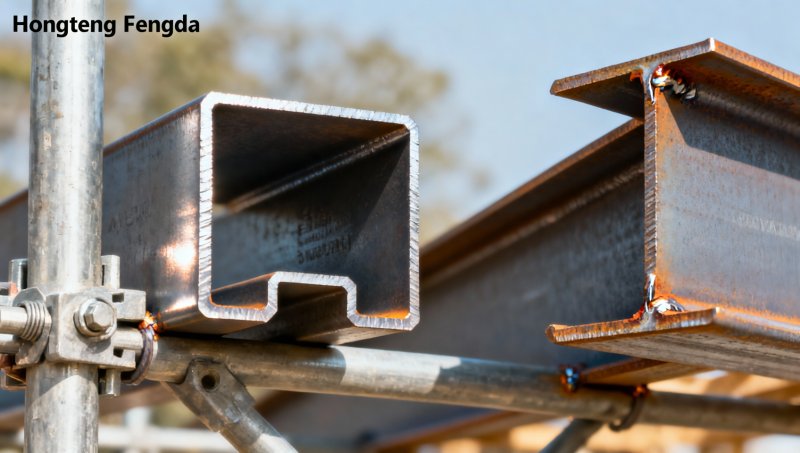
Modern prefabricated buildings, solar mounting structures, and modular industrial facilities demand precise load-path alignment. Angle steel remains dominant in diagonal bracing systems, scaffolding nodes, and welded connections where multi-directional bolt access is essential. Its open geometry simplifies field drilling and allows direct attachment to concrete anchors or embedded plates.
Channel steel shines in horizontal support roles: roof purlins (especially with pre-punched holes for cladding screws), wall girts, mezzanine floor joists, and base plates for equipment skids. Its flat back surface ensures full contact with supporting columns—reducing point-load stress and improving load transfer consistency.
For hybrid applications—like portal frame eaves or seismic retrofit brackets—engineers increasingly combine both: channel sections as primary rafters, with angle steel used for knee braces and tie rods. This synergy leverages torsional stability *and* connection flexibility simultaneously.
Procurement Guide: What Buyers Should Verify
Procurement professionals face three recurring risks: dimensional deviation, inconsistent galvanizing adhesion, and undocumented mill test reports (MTRs). At Hongteng Fengda, every batch undergoes third-party inspection per ISO 17025 protocols—including ultrasonic thickness verification, tensile testing, and salt-spray validation (ASTM B117).
When sourcing internationally, always request: (1) heat number traceability, (2) certified EN 10204 3.1 or 3.2 MTRs, and (3) dimensional tolerance compliance per EN 10056-1 (angles) or EN 10279 (channels). Avoid suppliers offering “near-spec” tolerances—±1.5 mm deviations on flange width can compromise bolt hole alignment across 200+ connections.
For corrosion-critical environments (e.g., coastal warehouses or chemical plants), consider pairing structural channels with Gi Coil for secondary cladding substrates—its hot-dip galvanized coating (60–275 g/m²) extends service life without compromising formability or weld integrity.
Standards & Certification Compliance
Global projects require unambiguous conformity. Hongteng Fengda’s angle and channel steel meet dual-standard certification: ASTM A6/A6M (U.S.), EN 10025-2 (EU), JIS G3101 (Japan), and GB/T 706 (China). Each product line carries full documentation for LEED, BREEAM, and ISO 9001 audits—no retesting delays at port clearance.
Notably, our cold-formed channel variants (per ASTM A1003) integrate seamlessly with Gi Coil feedstock—enabling OEM partners to co-source raw material and finished profiles under one quality system, cutting supply chain complexity by up to 40%.
Why Choose Hongteng Fengda?
We’re not just a supplier—we’re your structural steel partner. With 12+ years serving North America, the EU, and the Middle East, we offer: (1) real-time production visibility via shared ERP dashboards; (2) dedicated engineering support for custom bending, punching, and welding prep; (3) bonded inventory hubs in Dubai and Rotterdam for urgent regional dispatch.
Our clients report 22% faster project closeout and 17% lower total landed cost—thanks to stable lead times (8–12 weeks), zero non-conformance recalls since 2021, and seamless integration with procurement platforms like SAP Ariba and Coupa.
Ready to optimize your next framing specification? Contact Hongteng Fengda today for a free technical consultation, sample kit, and comparative quote—including full angle vs channel steel comparison data tailored to your project’s load cases and local code requirements.
Related recommendations
 Galvanized Pipe Manufacturer Selection: Zinc Coating, Tolerance, and ComplianceGalvanized pipe manufacturer selection guide: compare zinc coating quality, tolerance control, and compliance to reduce risk and choose a supplier that delivers reliable steel products.
 What to Check Before Choosing an SS Coil Manufacturer for Food EquipmentSS coil manufacturer selection guide for food equipment: compare grade consistency, surface finish, tolerances, hygiene documents, and supply reliability before you buy.
 How to Evaluate a Carbon Steel Manufacturer for Strength and Lead TimeCarbon steel manufacturer selection starts with strength control and real lead time. Learn how to compare quality systems, standards, specs, and export readiness before you buy.
 Buy 304 Stainless Steel Wire 0.5mm Soft: What to Check Before Placing an OrderBuy 304 stainless steel wire 0.5mm soft with confidence. Learn what to check on grade, tolerance, finish, softness, and supplier quality before ordering.
Please give us a message


Please enter what you want to find