Understanding the key angle steel vs channel steel differences is essential for achieving durable and reliable structural performance. This comprehensive guide explains how geometry, load-bearing characteristics, and mechanical properties distinguish these two critical profiles in structural engineering. As a leading structural steel manufacturer and exporter from China, Hongteng Fengda offers professional insights for engineers, procurement teams, and project leaders who need to balance strength, cost, and international compliance. With modern production technology and experience across multiple sectors, the company supports global projects requiring optimized structural profiles designed for longevity and safety.
Definition and Basic Differences between Angle Steel and Channel Steel
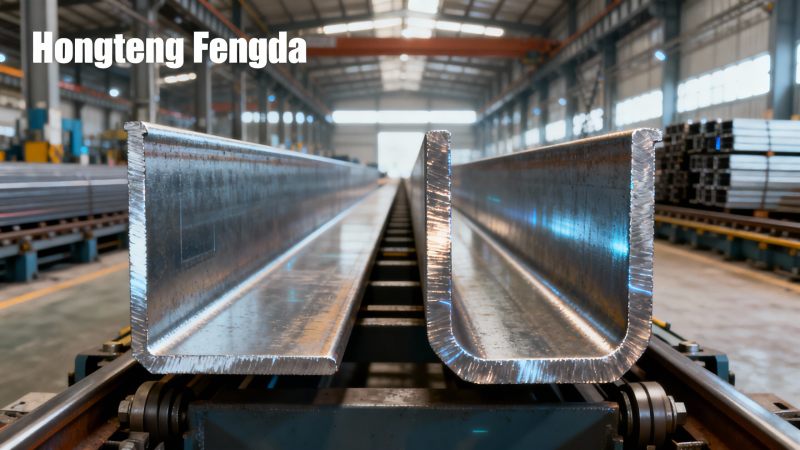
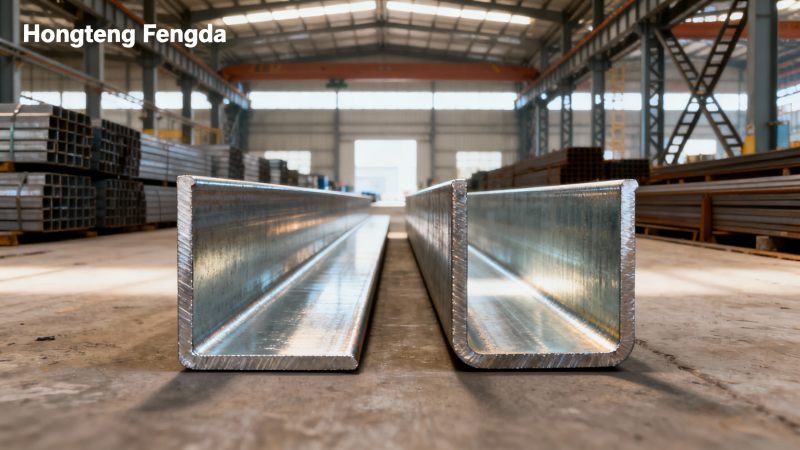
Angle steel, often called angle iron, features an “L”-shaped cross-section that provides versatile support in frameworks and bracings. It is commonly used where a combination of tensile and compressive strength is needed. In contrast, channel steel, recognized by its “U” or “C” profile, serves well for applications that require linear strength and stiffness, such as beams, frames, and columns. The difference in geometry leads to variation in how each type handles bending moments and distributed loads. Structural engineers often analyze cross-sectional moments of inertia to determine suitability. Typically, angle steel performs best where multi-directional support or reinforcement is required, whereas channel steel excels in longitudinal applications and load-bearing systems.
Market Overview and Industry Background
The global demand for structural steel continues to rise, supported by urbanization, infrastructure renewal, and industrial expansion. In Asia and Europe, manufacturers seek standardized profiles that meet ASTM, EN, JIS, and GB classifications to ensure product compatibility across borders. For many constructors, understanding angle steel vs channel steel differences is not only a technical necessity but also a cost-efficiency factor in procurement planning. In large-scale infrastructure, the right choice of steel profile can reduce material waste, simplify fabrication, and mitigate stress concentrations. Hongteng Fengda’s international distribution network, spanning North America, Europe, the Middle East, and Southeast Asia, ensures that buyers receive consistent quality and reliable delivery schedules. Moreover, demand in the renewable energy and lightweight construction sectors is pushing the industry toward precision cold-formed sections and high-strength alloys that support modern design philosophies.
Technical Performance and Load-Bearing Properties
Mechanical performance distinguishes angle steel and channel steel in notable ways. The symmetrical design of angle steel allows uniform stress distribution when used as corner support or reinforcement brace. In comparison, the asymmetric U-shaped channel steel provides better resistance to vertical loads but requires careful orientation to avoid lateral-torsional buckling. Under ASTM A36 or GB/T 706 standards, yield strength typically ranges from 235 MPa to 355 MPa for mild structural steels. For construction of bridges, industrial buildings, and towers, engineers evaluate deflection limits, section modulus, and fatigue properties. Angle steel’s versatility makes it suitable for producing connecting frames, machinery mounts, and transmission towers, while channel steel offers excellent performance in longitudinal beam systems, such as floor joists and support girders.
Comparison Analysis: Strength, Stability, and Application Efficiency
The choice between angle and channel steel is often determined by project requirements and load direction. When precision, lateral stability, and high torsional resistance are essential, channel steel’s depth and flange height confer notable advantages. For lattice-type frameworks and reinforcement grids, angle steel ensures efficient connections and geometric flexibility. The following table gives a brief overview:
Application Scenarios and Industry Use
In real-world construction, angle steel is prevalent in tower lines, engineering trusses, and bracing systems. The material’s geometry enables easy welding and bolting in complex assemblies. Channel steel finds wide use in vehicle chassis, crane rails, mezzanine floors, and bridge components. Both types may appear in composite structures alongside other materials for enhanced performance. In mechanical manufacturing, the lightweight yet strong characteristics of channel sections offer efficient solutions in conveyor frameworks and machinery bases. Hongteng Fengda’s advanced forming lines further customize dimensions, hole patterns, and surface treatments to ensure compatibility with modern fabrication. The company’s offerings extend even to special components such as Wire Rod, which complements angle and channel steel in reinforcement, welding wire production, and automotive component processing, benefiting from excellent carbon steel formability and compliance with ASTM and GB standards.
Procurement Guide and Quality Considerations
When selecting structural profiles, buyers must consider both engineering performance and supply reliability. Reliable suppliers ensure material traceability, dimensional precision, consistent surface finish, and certification compliance. Hongteng Fengda employs strict inspection procedures covering tensile tests, ultrasonic checks, and yield point verification. For international projects, understanding angle steel vs channel steel differences aids in specifying correct material grade and section size to meet design codes. Project managers and quality inspectors value suppliers capable of offering ASTM, EN, and JIS-approved products with flexible MOQ and logistics coordination. Integrating materials like the carbon-based Wire Rod enhances assembly efficiency for auto manufacturing, shipbuilding, and industrial frameworks, reinforcing productivity while reducing processing time.
Standards, Certification, and Compliance
Global structural engineering requires adherence to international standards that guarantee uniform quality and safety. Angle and channel steels from Hongteng Fengda undergo rigorous conformity assessments aligned with ASTM A36, A572, EN 10025, and GB/T 706. Quality control extends from raw material selection—typically low-carbon or medium-carbon steel—through to mechanical testing and third-party verification. Compliance with ISO 9001 and CE certification ensures customers receive materials with documented mechanical properties and heat treatment traceability. Standardized tolerance levels and test certificates support easy acceptance across jurisdictions, reducing the risk of rework or rejection during inspection. In addition, every batch is certified for chemical composition, yield strength, and elongation percentage, providing engineers and safety managers with data-driven assurance of performance reliability.
Trends and Future Insights in Structural Steel Development
Modern steel design trends emphasize lightweight structures, corrosion resistance, and optimized fabrication. Research into high-strength low-alloy (HSLA) steels and cold-formed thin-wall profiles enhances the energy efficiency and sustainability of buildings. Smart manufacturing and digital modeling further facilitate precision cutting, reducing waste during production. Digital engineering integration allows designers to compare finite element results automatically for angle vs channel configurations, ensuring optimal cost-performance balance. Moreover, as green building certifications gain prominence, recycled content and reduced carbon footprints are increasingly key decision factors during procurement. Forward-looking enterprises like Hongteng Fengda adopt environment-friendly production systems and collaborate with testing institutes to maintain cutting‑edge quality and compliance with the evolving demands of global construction markets.
Case Studies and Successful Engineering Practices
Hongteng Fengda has participated in numerous infrastructure projects, delivering both angle and channel steel solutions customized to client requirements. In a Southeast Asian logistics hub, the team provided high-yield channel beams for modular warehouse frames that simplified assembly and reduced welding time. In another project, telecom tower fabrication used hot-rolled angle steel treated with anti-corrosion coating, helping achieve over 25 years of service life under tropical climate conditions. Each successful supply reinforces why understanding angle steel vs channel steel differences directly contributes to operational safety and lifecycle value. Through responsive engineering support, material traceability documentation, and on-time shipment performance, Hongteng Fengda remains a preferred partner for contractors managing complex international builds.
Why Choose Hongteng Fengda
Choosing Hongteng Fengda means selecting a structural steel expert who delivers beyond specifications. The company combines manufacturing strength, rigorous testing, and customer-oriented service to provide dependable building solutions. Their expertise in angle steel, channel steel, and related components ensures every product meets local regulation and project-specific design parameters. Backed by ISO-certified systems, stable production capacity, and professional export logistics, Hongteng Fengda helps clients reduce procurement risks and achieve cost-effective construction success. Whether you are an engineer seeking technical advice, a sourcing manager ensuring timely supply, or a distributor looking for reliable OEM solutions, contact Hongteng Fengda today to experience a trusted partnership built on quality, reliability, and global support.
Related recommendations
 Why do 20 feet square pipe prices vary significantly between inland and port-adjacent warehouses?20 feet square pipe price varies by location—discover why port-adjacent warehouses often deliver better total cost, speed & ROI. Get the finance-approved breakdown.
 Do the advantages of galvanized steel outweigh long-term maintenance costs in humid industrial zones?Advantages of galvanized steel in humid industrial zones? Yes—when engineered right. Discover how proper specification cuts long-term maintenance costs by 2–3×.
 How much longer does galvanized steel sheet for roofing last compared to painted steel in humid tropicsgalvanized steel sheet for roofing lasts 2–3× longer than painted steel in humid tropics—25–40 vs. 10–15 years. Proven durability, zero scheduled maintenance, and lower lifecycle cost.
 Why galvanized steel sheet price per ton fluctuates beyond raw material costsGalvanized steel sheet price per ton fluctuates due to coating specs, order volume, logistics & certifications—not just zinc. Discover actionable cost levers.
Please give us a message


Please enter what you want to find