Do the advantages of galvanized steel outweigh long-term maintenance costs in humid industrial zones?
For facility managers, EPC contractors, and procurement leads overseeing infrastructure or manufacturing plants in high-humidity environments—coastal refineries, tropical processing hubs, inland chemical facilities with steam-rich atmospheres—the question isn’t theoretical. It’s operational: Will specifying galvanized structural steel reduce total cost of ownership over 15–25 years, or will the upfront premium erode under real-world exposure, inspection cycles, and unplanned repairs?
The short answer is: Yes—but only when corrosion resistance is engineered into the system, not just applied to the surface. Galvanizing alone doesn’t guarantee lifecycle savings in aggressive industrial zones. What matters is how the coating performs under sustained humidity, chloride deposition, thermal cycling, and mechanical abrasion—and whether it integrates reliably with other components (fasteners, welds, connections) without creating galvanic traps. In our experience supporting projects across Southeast Asia, the Middle East, and Latin America, the advantage emerges not from zinc thickness alone, but from coating integrity, substrate preparation, and design-aware specification.
Where galvanizing delivers measurable ROI—and where it falls short
In humid industrial zones, corrosion doesn’t progress uniformly. It accelerates at micro-defects: cut edges, welded joints, bolt holes, and areas where moisture pools and contaminants concentrate. Hot-dip galvanized steel resists this well—but only if the coating meets minimum ASTM A123/A153 or EN ISO 1461 requirements (minimum 85 μm on structural sections >6 mm thick). Under-specifying zinc mass—or accepting inconsistent coverage—turns a protective layer into a false economy.
Real-world risk appears most often in three scenarios:
- Thermal cycling zones: Where equipment surfaces regularly exceed 60°C (e.g., near exhaust ducts, boiler enclosures, or process piping supports), standard galvanizing can oxidize faster and lose adhesion. Zinc-aluminum alloys—like those in PPGL Steel Sheet—offer superior stability above 300°C and resist white rust formation in damp-heat conditions.
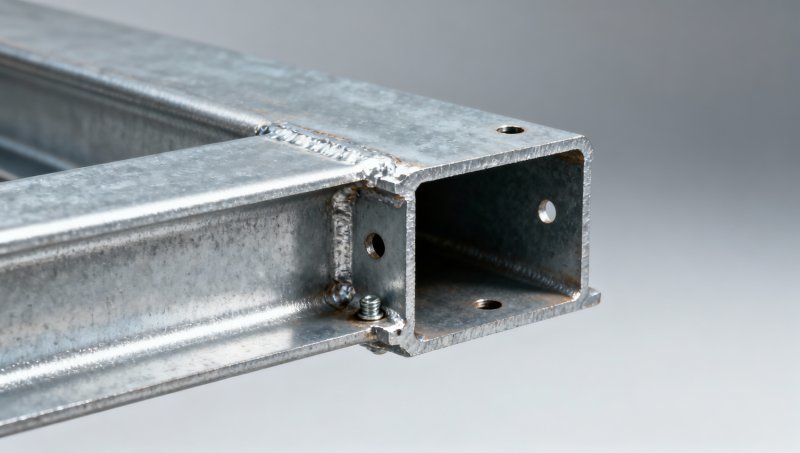
- Mechanically stressed assemblies: Bolting, drilling, or field-welding galvanized members without proper touch-up creates localized weak points. Uncoated steel exposed at weld seams corrodes rapidly—and often invisibly beneath adjacent zinc layers. This is rarely caught during routine visual inspections but shows up in ultrasonic thickness testing after 8–10 years.
- Chloride-laden coastal sites: Salt spray doesn’t just attack bare steel—it degrades zinc through electrochemical dissolution. In such settings, galvanizing must be combined with design mitigation: drainage channels, standoff brackets, and non-conductive gaskets to prevent crevice corrosion. Relying solely on coating thickness invites premature failure.
That said, when properly specified and installed, galvanized steel consistently extends service life by 2–3× compared to painted carbon steel in humid industrial use. Field data from petrochemical plants in Vietnam and fertilizer terminals in Oman show average structural re-coating intervals extending from every 5–7 years (for epoxy-painted steel) to 18–22 years for hot-dip galvanized beams and columns—provided weld zones were post-galvanized or thermally sprayed.
It’s not about “galvanized vs. not galvanized”—it’s about system-level durability
The most overlooked factor isn’t material choice—it’s how the steel integrates into the larger asset system. A galvanized purlin may last decades, but if it’s fastened to an uncoated steel frame with carbon-steel bolts, corrosion migrates to the interface. Similarly, galvanized cladding panels bolted directly to untreated structural supports create galvanic couples that accelerate degradation at the connection point—not the panel itself.
This is where pre-engineered solutions gain traction. For roofing and wall cladding in humid factories or cold-storage facilities, materials like PPGL Steel Sheet combine aluminum-zinc alloy coating (55% Al, 43.4% Zn, 1.6% Si) with factory-applied organic topcoats. The result is not just enhanced corrosion resistance, but also thermal reflectivity that reduces roof surface temperature by up to 20°C—lowering condensation risk and HVAC load in humid interiors. Its service life exceeds 25 years even in high-salinity, high-humidity applications like poultry processing plants in Thailand or refrigerated warehouses in Brazil.
Crucially, PPGL avoids two pitfalls common in humid zones: chalking (which compromises UV resistance and aesthetic consistency) and coating delamination at cut edges. Its aluminum-rich intermetallic layer forms a self-healing oxide barrier—even when scratched—slowing undercutting corrosion far more effectively than pure zinc coatings.
What decision-makers should verify before committing
Before approving galvanized specifications for humid industrial use, ask these four questions—not of your supplier, but of the project’s actual operating environment:
- What’s the dominant corrosion mechanism? Humidity alone rarely drives failure. Is it chlorides? Sulfur compounds? Organic acids from fermentation or food processing? Or condensate pH swings? Each demands different coating chemistry—not just thickness.
- Where will moisture accumulate—and how will it drain? A 120-μm zinc coating means little if water pools behind a bracket or under a flashing detail for weeks. Design trumps specification.
- How will field modifications be handled? If welding or drilling is unavoidable onsite, does your team have certified procedures for post-weld touch-up (e.g., zinc-rich paint per ASTM D6386) and verification (e.g., coating thickness gauge + copper sulfate test)?
- Is the full assembly compliant—not just the base steel? Fasteners, washers, gusset plates, and anchor bolts must match or exceed the cathodic protection potential of the main member. Mixing stainless and galvanized components without isolation risks accelerated galvanic corrosion.
Also note: Not all “galvanized” is equal. Batch hot-dip galvanizing offers the best protection for structural shapes—but continuous galvanizing (used for thin sheets and coils) produces thinner, less durable coatings unless alloy-modified. For cladding, roofing, or lightweight support systems in humid zones, aluminum-zinc coated products provide a more balanced profile of longevity, thermal performance, and weight efficiency.
A pragmatic path forward
Don’t treat galvanizing as a checkbox. Treat it as a system boundary condition—one that must align with environmental stress, maintenance access, inspection protocols, and end-of-life considerations.
Start with corrosion mapping: identify zones by exposure severity (ISO 12944 C4–C5-M), then tier your specification accordingly. Use hot-dip galvanizing for primary structural elements exposed to splash and condensation. For secondary framing, cladding, and enclosure systems, consider aluminum-zinc coated options like PPGL Steel Sheet, especially where thermal management, color retention, or lightweight installation adds value beyond corrosion resistance.
Finally, prioritize traceability over price. Require mill test reports showing coating mass per ASTM A123, batch records for galvanizing temperature and immersion time, and third-party verification for critical weld zones. In humid industrial zones, the cheapest quote is rarely the lowest-cost solution—especially when downtime, safety incidents, or unplanned retrofits enter the equation.
Please give us a message


Please enter what you want to find