Evaluating Z150 Steel Sheet Before Defense Specification
Before specifying Z150 steel sheet for military applications, engineers must carefully assess material strength, corrosion resistance, and compliance with defense-grade standards. As a trusted structural steel manufacturer and exporter, Hongteng Fengda supports such critical evaluations with expert knowledge of materials like Hot Rolled I Beam for structural support, C section steel for trailer manufacturing, and ASTM steel profile for transmission towers. Understanding these factors ensures structural integrity, safety, and reliability across demanding defense projects.
Z150 steel sheet, with its zinc coating of approximately 150 g/m², provides a measurable level of corrosion protection for structural and protective applications. However, when this steel is applied in defense projects such as troop carrier cabins, radar shelters, or perimeter armoring, engineers must examine not only coating mass but also tensile behavior, weldability, and compatibility with field maintenance conditions. The following sections explore the main evaluation parameters and how Hongteng Fengda assists design and procurement teams worldwide in this process.
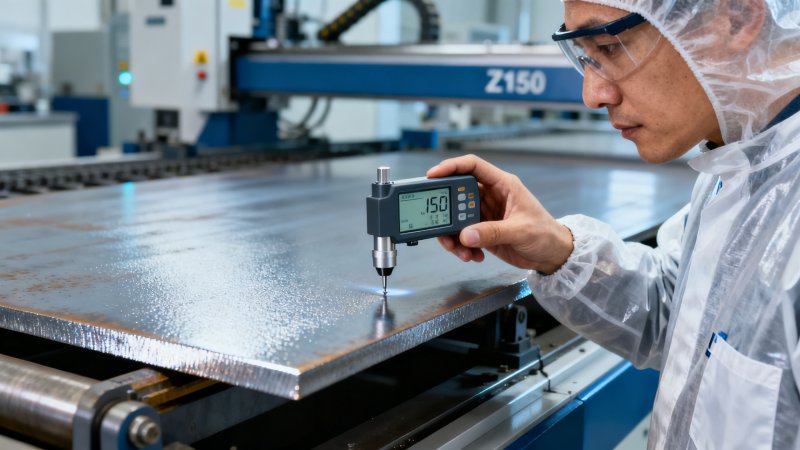
1. Mechanical Performance and Structural Integrity
Defense structures require predictable strength levels even under impact or vibration. Z150 steel sheet usually delivers yield strength between 250–350 MPa, but actual thresholds vary depending on alloy composition and rolling method. Engineers should compare tensile values to the minimum of 1.2× expected working stress to maintain a 20% safety margin, particularly when integrated with heavy welded reinforcements.
It is essential to balance formability and rigidity. Excessive hardness may increase microcrack sensitivity under ballistic vibration. Therefore, for armored personnel housing or vehicle panels exposed to cyclic loads beyond 10⁵ cycles, homogeneity across sheet thickness must be verified via tensile test sampling at intervals of 500–800 mm. Hongteng Fengda applies EN 10025 process standards to monitor these variations and provides mill certificates with elongation and flatness indices.
When mechanical demand extends to reinforcement structures, products like HPB300 Rebar can be used alongside Z150 sheets within concrete-embedded sections. Its standard yield strength of no less than 300 MPa ensures anchoring reliability and simplifies rebar bending on-site. The moderate cost and availability in 6–50 mm diameters support flexible reinforcement solutions in modular defense infrastructure.
These mechanical checks provide a unified basis for deciding whether Z150 sheet can substitute thicker hot-rolled plate, especially where weight reduction of 10–15% is targeted without compromising operational durability.
2. Corrosion Resistance in Harsh Defense Environments
In defense projects deployed across coastal and desert zones, corrosion is one of the leading degradation risks. Z150, with a 150 g/m² zinc layer, offers around 8–12 years of atmospheric protection under moderate humidity (RH 60%–75%). However, in saline or polluted environments, the protective life may decrease by 40% unless supplemented with paint or polymer coatings.
To maximize lifecycle performance, anti-corrosion design should consider the three-layer system: galvanized base, primer sealant, and polyurethane finish. The combined system can increase corrosion resistance by up to 2.5 times compared with single-layer galvanization. Engineers should test coating adhesion through 240 h salt-spray exposure following ASTM B117, ensuring blister ratio below level 2 as defined by ISO 4628-2.
Maintenance planning is also significant. Regular inspection intervals of 6–9 months are recommended for field installations such as radar towers and weapon storage enclosures. Structural joints or edges should receive extra sealing since these areas exhibit 25–35% higher corrosion rate than flat areas.
Through these preventive measures, engineers can reduce total maintenance costs by an estimated 25–30% over a 10‑year deployment period, extending service availability of metal structures under defense operations.
3. Compliance with Defense Standards and Quality Assurance
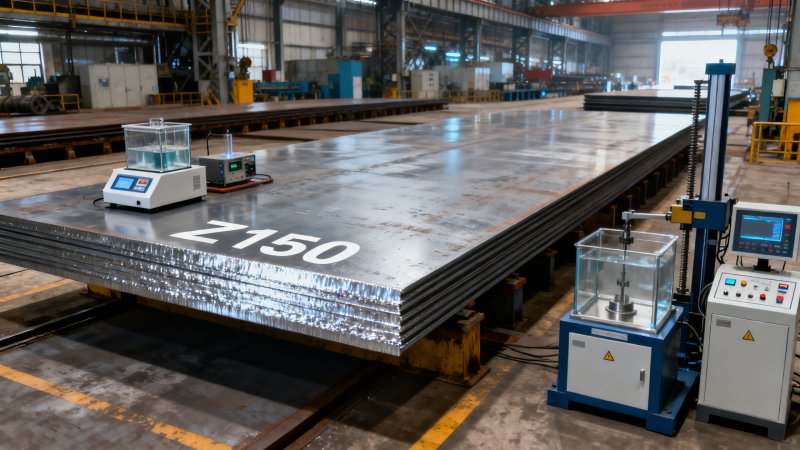
Before final specification, Z150 steel sheet must demonstrate compliance with both civilian industrial and defense-specific standards. Common references include ASTM A653/A653M for coating mass and EN 10142 for surface finish quality. However, ministries of defense may establish additional testing for ballistic tolerance or radiation shielding depending on intended use.
Manufacturers should provide traceable mill data, including chemical composition within ±0.02% deviation for main alloying elements like Mn and Si. Consistent batch-to-batch analysis ensures stable welding conditions during field assembly. Hongteng Fengda maintains ISO9001-2008 certification and partners with SGS and BV for third-party inspection, ensuring documentation integrity and reproducibility for export batches above 500 tons.
In addition, inspection protocols may include flatness checks (tolerance ≤3 mm/m) and coating weight verification through gravimetric measurement every 200 m² production segment. Non-conforming samples exceeding ±5% deviation should be immediately replaced to conform with military acceptance Level II standards.
Beyond Z150, structures may combine supporting members such as H‑Beams or reinforcement bars to fulfill load distribution requirements. Using compatible materials—like Q235 or Q345 steel grades—helps maintain homogenous thermal expansion and simplifies repair logistics during multi-year service periods.
4. Practical Procurement and Cost Optimization Strategies
Procurement teams targeting defense-grade Z150 sheets should focus on six parameters: material standard, coating mass, thickness tolerance, coil width, test certification, and delivery assurance. Each parameter should be verified against project timelines that typically span 8–12 weeks of manufacturing and inspection before shipment.
Material thickness between 1.5–3.0 mm is common for vehicle or shelter applications. For larger batches, pre‑cut dimensions reduce waste by 5–8% and simplify assembly logistics. Buyers should request continuous galvanizing output reports to confirm production rate consistency (usually 40–60 m/min) and target weight variation below ±2%.
Hongteng Fengda’s supply capacity reaches over 30,000 tons/month, allowing stable commitments even under urgent procurement programs. Paired with OEM customization for defense-specific profiles, the company supports global buyers from North America to Southeast Asia, ensuring compliance and just‑in‑time logistics. Engineers combining Z150 with reinforcement solutions like HPB300 Rebar gain additional structural consistency within hybrid assemblies.
- Material verification within 5 business days after order confirmation.
- Production lead time: 15–25 days depending on batch tonnage.
- Third‑party inspection window: typically 3–5 working days.
- Packing and sealing in line with MIL‑STD‑2073 for corrosion control.
By adopting standardized procurement and inspection routines, organizations can reduce rework incidents by 12–18% and maintain predictable lifecycle performance under variable field conditions.
5. Implementation Challenges and Risk Management
Implementing Z150 steel sheet specifications in defense projects often encounters three categories of risks: material misidentification, welding incompatibility, and coating damage during transport. Addressing these proactively improves initial project reliability and minimizes warranty claims.
Material identification errors may occur when multiple galvanization grades (Z100, Z275) are stored together. A coded labeling system and handheld XRF verification can reduce such errors to below 1%. Meanwhile, welding incompatibility stemming from high coating thickness can be managed by localized coating removal along the weld line (20–30 mm width) before joining.
To avoid coating damage, every bundle should be padded with anti-friction material and stacked at a maximum height of 1.2 m. Field studies show that maintaining transport humidity below 60% minimizes white rust formation by up to 70%, preserving coating integrity for subsequent manufacturing stages.
Defense project managers should define inspection steps according to a five‑phase quality control process: incoming material validation, pre‑fabrication check, on‑site welding qualification, corrosion test monitoring, and final acceptance. Each phase should generate traceable documentation reviewed by quality assurance officers.
- Incoming material check – verify chemical certification and batch number allocation.
- Pre‑fabrication inspection – assess dimension tolerances within ±0.5 mm.
- Welding qualification – perform cross‑section integrity test under 200 A current.
- Surface protection verification – salt spray test ≥240 h.
- Final acceptance – summary report with acceptance ratio ≥98%.
Systematic monitoring through these steps minimizes part rejection rate to below 2%, securing consistent performance throughout armored unit deployments or static defense facilities.
Conclusion and Partnership Outlook
Selecting Z150 steel sheet for defense projects demands a balanced view of mechanical performance, corrosion resistance, and global standard compliance. When properly evaluated and combined with reliable reinforcement products and supply management, the material supports safe, durable, and cost‑effective defense infrastructure.
Hongteng Fengda, as a professional structural steel manufacturer and exporter from China, brings over a decade of OEM supply, modern coating lines, and quality certifications such as ASTM, EN, JIS, and GB. Serving clients across North America, Europe, the Middle East, and Southeast Asia, the company provides stable production, consistent quality, and responsive delivery—making it a trusted partner for defense‑grade steel sourcing.
For engineering teams, procurement officers, or project managers seeking to specify Z150 or related structural steel materials, engaging early with Hongteng Fengda’s technical consultants ensures optimized design and risk control.
Contact us today to discuss customized structural steel solutions and secure dependable supply for your next defense project.
- steel i
- Z150 steel sheet
- Hot Rolled I Beam
- structural steel
- C section steel
- ASTM steel profile
- Structural Steel
- Profile
- Rebar
- Galvanized
- steel sheet
- steel profile
- ASTM steel profile for transmission towers
- C section steel for trailer manufacturing
- Hot Rolled I Beam for structural support
- Z150 steel sheet for military applications
Related recommendations
 How to Select the Correct Steel Sheet Grade for Auto PartsSelect the ideal steel sheet for auto parts by balancing performance and cost. Discover expert sourcing strategies to avoid manufacturing traps and optimize procurement. Read our guide now!
 Choosing the Right Zinc Coating Weight for Galvanized SheetOptimize your galvanized sheet selection by choosing the right zinc coating weight. Discover expert strategies to balance corrosion resistance, formability, and project costs.
 How to Specify Wall Thickness for Structural Steel TubingMaster wall thickness specification for structural steel tubing. Balance engineering loads, global tolerances, and costs. Read our expert guide to optimize procurement and ensure project safety!
 Galvanized Pipe vs. Copper: Cost and Durability ComparisonDiscover why galvanized pipe outperforms copper in cost and durability. Compare total lifecycle expenses and make a smart procurement choice for your next industrial project today.
Please give us a message


Please enter what you want to find