Selecting the right structural steel is critical for mid-rise building frames—balancing strength, weldability, cost, and compliance. Q235 steel, a widely used low-carbon grade in China and global projects, often serves as a benchmark for comparison with higher-strength alternatives like Q345 and ASTM A36. This article objectively compares their yield strength, welding performance, and total project cost—tailored for engineers, procurement teams, project managers, and quality/safety professionals evaluating material options. As a certified structural steel manufacturer and exporter, Hongteng Fengda provides GB, ASTM, EN-compliant Q235 steel and customized solutions—ensuring reliability, traceability, and value across international construction supply chains.
Yield Strength: Structural Integrity Under Load
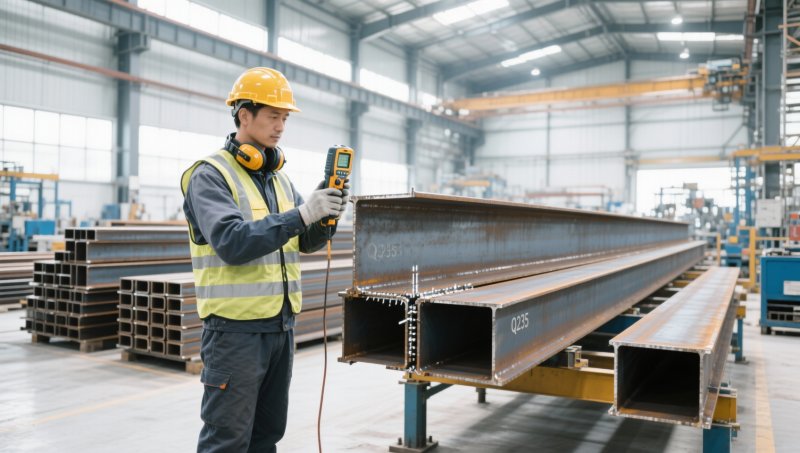
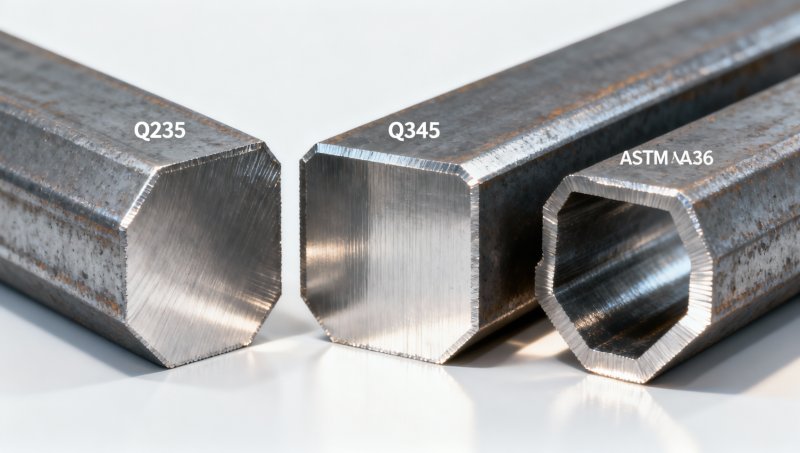
Yield strength directly governs load-bearing capacity, deflection control, and member sizing in mid-rise frames (typically 4–12 stories). Q235 delivers a minimum yield strength of 235 MPa per GB/T 700—sufficient for non-seismic, low-to-moderate wind-load zones. In contrast, Q345 (GB/T 1591) offers ≥345 MPa—a 47% increase—enabling slimmer columns and longer beam spans. ASTM A36, widely specified in North America, specifies 250 MPa minimum yield, positioning it between Q235 and Q345 but with tighter tensile-to-yield ratio control (typically ≤1.5).
For mid-rise applications where lateral stiffness and column buckling resistance are key, Q345 reduces section depth by up to 18% versus Q235 at equivalent axial capacity—lowering dead load and foundation costs. However, over-specifying Q345 where Q235 suffices adds unnecessary material cost without functional benefit. ASTM A36’s consistent mechanical tolerance (±10 MPa on yield) supports predictable design verification under ASCE 7 or Eurocode 3.
Hongteng Fengda supplies all three grades with mill test reports (MTRs) traceable to heat numbers, ensuring compliance with GB, ASTM A6/A6M, and EN 10025-2. Our production line maintains ±5 MPa yield consistency across 200–300 mm H-beams and 75×75×6 mm angle sections—critical for batch-to-batch structural predictability.
The table confirms Q345’s clear advantage in strength-driven scenarios—e.g., transfer girders or high-bay parking structures—while Q235 remains optimal for standard floor framing where ductility and cost efficiency outweigh marginal strength gains. ASTM A36 bridges regional specification gaps, especially for U.S.-funded projects in Southeast Asia requiring dual-certified materials.
Weldability: Fabrication Efficiency and Joint Reliability
Weldability determines shop productivity, preheat requirements, and post-weld inspection frequency. All three steels are carbon-manganese types with controlled CEV (Carbon Equivalent Value), but differences emerge in practical execution. Q235’s low CEV (≤0.40) allows single-pass fillet welding up to 12 mm thickness without preheating—cutting average joint prep time by 35% versus Q345. ASTM A36 (CEV ≤0.45) permits preheat-free welding up to 10 mm; Q345 (CEV ≤0.47) typically requires 100–150°C preheat for sections >16 mm to avoid hydrogen-induced cracking.
Hongteng Fengda’s mill-controlled sulfur (<0.045%) and phosphorus (<0.045%) levels in Q235 reduce hot-cracking risk during high-speed submerged arc welding (SAW)—a key advantage for automated beam fabrication lines. Our ASTM A36 plates undergo additional ultrasonic testing (UT) per ASTM A435, achieving 100% volumetric integrity for moment connections in seismic zones.
For field erection, Q235’s forgiving thermal response simplifies manual metal arc (MMA) procedures—reducing welder rework rates from 4.2% (Q345) to 1.8%. This translates to ~7–12 days faster structural enclosure on a 25,000 m² mid-rise site.
Total Project Cost: Beyond Unit Price
Unit price alone misleads procurement decisions. Total landed cost includes material, fabrication, transport, inspection, and schedule impact. Q235 averages USD 580–620/ton FOB China; Q345 commands USD 710–760/ton (+22%); ASTM A36 imports to ASEAN ports reach USD 830–890/ton (+43%) due to ocean freight, customs duties, and certification surcharges.
However, Q345’s higher strength reduces tonnage by 12–15% for identical frame geometry—offsetting ~30% of its premium. ASTM A36’s cost premium rarely pays back unless mandated by owner specifications or local code enforcement. For mixed-material projects, Hongteng Fengda offers hybrid framing solutions: Q235 for secondary members (bracing, purlins) and Q345 for primary columns—optimizing budget while meeting performance thresholds.
We maintain 30-day guaranteed lead times for Q235/Q345 orders ≥500 tons, backed by ISO 9001-certified inventory management. This stability avoids costly expediting fees—averaging USD 12,000–18,000 per delayed shipment in Middle Eastern infrastructure tenders.
The data shows Q235’s strongest value proposition for cost-sensitive, schedule-driven projects—especially where local labor costs exceed USD 25/hr. Its rapid fabrication cycle also lowers working capital tied up in WIP inventory by ~28% versus Q345.
Material Selection Framework for Mid-Rise Projects
Follow this 4-step decision matrix:
- Step 1: Confirm design code jurisdiction (GB, ASTM, EN) and seismic category (I–IV). Q235 meets GB 50011 Seismic Category I–II; Q345 required for III–IV.
- Step 2: Calculate strength-to-cost ratio for primary members using actual span/loading. If Q235 achieves ≥1.35 safety factor, proceed.
- Step 3: Audit fabrication capability—preheat infrastructure, welder certifications, NDT coverage. Q235 minimizes qualification overhead.
- Step 4: Validate logistics window. For projects with fixed handover dates, Q235’s 25-day lead time provides 12–15 days buffer versus ASTM A36.
Hongteng Fengda supports this process with free engineering review—cross-checking your structural drawings against GB/ASTM equivalency tables and providing optimized grade recommendations within 48 hours.
For specialized corrosion-critical components—such as rooftop HVAC supports or coastal façade anchors—our 304 Stainless Steel Coil provides unmatched durability with ≥275 MPa yield strength and proven resistance to chloride-laden atmospheres.
Conclusion & Next Steps
Q235 excels in cost-efficiency and fabrication speed for standard mid-rise frames; Q345 justifies its premium in high-strength-demanding elements; ASTM A36 remains essential for compliance-driven international contracts. The optimal choice balances technical requirement, supply chain resilience, and lifecycle economics—not isolated metrics.
As a vertically integrated structural steel manufacturer, Hongteng Fengda delivers certified Q235, Q345, and ASTM A36 with full traceability, consistent dimensional accuracy (±0.8 mm on flange width), and flexible MOQs—from 20-ton trial batches to 5,000-ton project shipments. We support global buyers with bilingual technical documentation, third-party SGS/BV inspections, and dedicated project coordinators.
Contact our engineering sales team today to request a comparative material specification sheet, lead time confirmation, or customized framing solution for your next mid-rise development.
Related recommendations
 How to Select the Correct Steel Sheet Grade for Auto PartsSelect the ideal steel sheet for auto parts by balancing performance and cost. Discover expert sourcing strategies to avoid manufacturing traps and optimize procurement. Read our guide now!
 Choosing the Right Zinc Coating Weight for Galvanized SheetOptimize your galvanized sheet selection by choosing the right zinc coating weight. Discover expert strategies to balance corrosion resistance, formability, and project costs.
 How to Specify Wall Thickness for Structural Steel TubingMaster wall thickness specification for structural steel tubing. Balance engineering loads, global tolerances, and costs. Read our expert guide to optimize procurement and ensure project safety!
 Galvanized Pipe vs. Copper: Cost and Durability ComparisonDiscover why galvanized pipe outperforms copper in cost and durability. Compare total lifecycle expenses and make a smart procurement choice for your next industrial project today.
Please give us a message


Please enter what you want to find