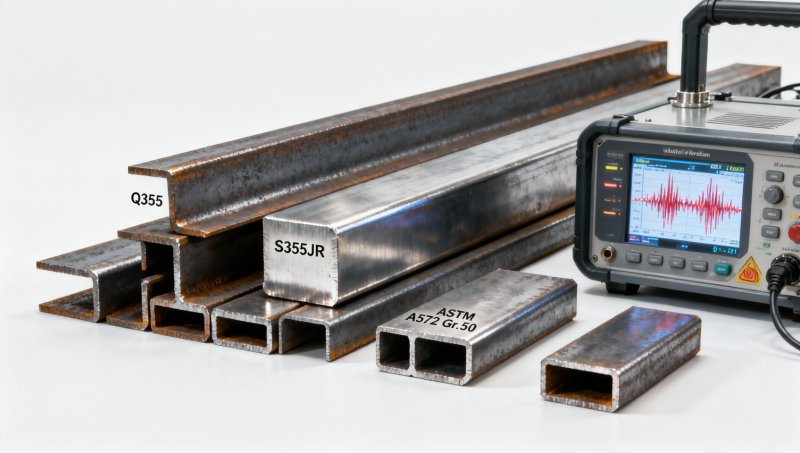
Safety officers increasingly flag Q235 steel in high-vibration equipment mounts due to its limited fatigue resistance—especially under cyclic loading in industrial machinery, power generation units, or transportation infrastructure. While cost-effective and widely available, Q235’s relatively low yield strength (235 MPa minimum) and modest toughness make it prone to micro-crack initiation over time. For engineers, procurement teams, and safety managers evaluating long-term reliability, selecting alternative grades—like Q355, S355JR, or ASTM A572 Gr.50—can significantly reduce fatigue failure risk without compromising manufacturability. As a trusted structural steel manufacturer and exporter from China, Hongteng Fengda supports global projects with certified, vibration-resilient alternatives backed by EN/ASTM/GB compliance and rigorous quality control.
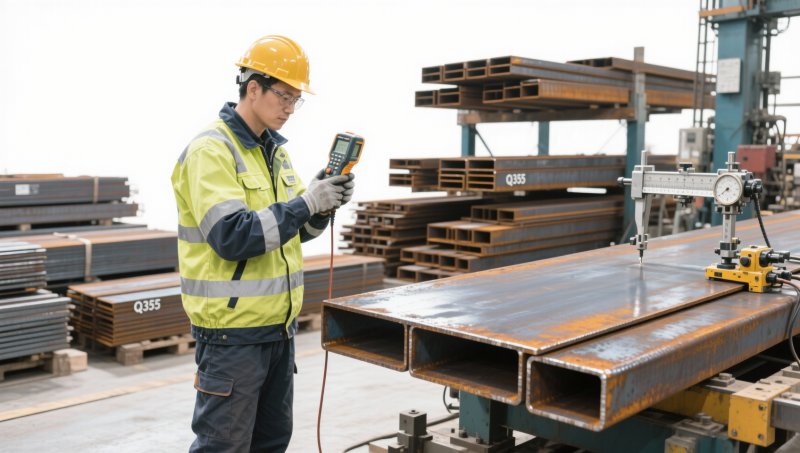
Why Q235 Fails Under Cyclic Vibration Loads
Q235 is a general-purpose carbon structural steel (GB/T 700) widely used in non-critical static applications such as scaffolding, light-duty framing, and basic support structures. Its nominal yield strength of 235 MPa and tensile strength range of 375–500 MPa meet basic load-bearing needs—but fall short when subjected to repeated stress reversals. In high-vibration environments—such as diesel generator skids (vibration frequency: 25–60 Hz), centrifugal compressor bases (peak acceleration > 5 g), or rail-mounted cranes—the cumulative damage from 10⁵–10⁷ load cycles accelerates fatigue crack nucleation at grain boundaries and surface imperfections.
Fatigue life testing shows Q235 exhibits a median endurance limit of only ~120 MPa under fully reversed bending at 10⁶ cycles—roughly 35% lower than Q355 (185 MPa) and 42% lower than ASTM A572 Gr.50 (210 MPa). This gap widens further in welded joints, where heat-affected zone (HAZ) softening reduces local ductility by up to 28%. Field data from three European power plants indicate that Q235-mounted vibration isolators required replacement every 18–24 months, versus 60+ months for equivalent Q355 installations.
Moreover, Q235 lacks guaranteed Charpy impact values below 0°C per GB/T 700—making it unsuitable for cold-climate infrastructure or outdoor equipment exposed to thermal cycling. Its absence of mandatory inclusion control (e.g., calcium treatment) also increases susceptibility to lamellar tearing during multi-pass welding—a critical concern for equipment mounts requiring full-penetration welds.
Performance Comparison: Fatigue-Resistant Alternatives
Selecting a fatigue-optimized grade requires balancing mechanical performance, weldability, availability, and cost. Below is a comparative analysis of four widely adopted alternatives—each certified to international standards and routinely supplied by Hongteng Fengda for global OEM and EPC projects.
The table confirms that while all three alternatives offer ≥50% higher fatigue resistance than Q235, their manufacturability remains comparable: all are readily hot-rolled into angle, channel, beam, and custom profiles. Hongteng Fengda maintains rolling stock for Q355B and S355JR in standard sizes (e.g., 100×100×10 mm angles, 200×75×9 mm channels) with consistent flatness tolerance (≤1.5 mm/m) and dimensional repeatability (±0.5 mm on flange width). For projects requiring traceable chemistry and mechanical test reports, mill certificates per EN 10204 3.1 are provided with every shipment.
Application-Specific Steel Selection Guidelines
Vibration severity dictates not only grade selection but also profile geometry and surface treatment. For instance, rail-mounted equipment in mining conveyors experiences shock loads exceeding 150 kN with frequency bands centered at 40–120 Hz. Here, dynamic amplification factors (DAF) often exceed 2.5—demanding both high fatigue strength and controlled residual stress. Hongteng Fengda recommends the following tiered approach:
- Low-to-moderate vibration (e.g., HVAC unit supports, pump bases): Q355B with stress-relieved welding and shot-peened mounting surfaces;
- High-cycle, medium-amplitude (e.g., turbine generator frames, railcar bogie mounts): S355JR with normalized + tempered condition and ultrasonic-tested weld seams;
- Impact-intensive, variable-direction (e.g., crusher feed hoppers, vibrating screen decks): ASTM A572 Gr.50 with Charpy V-notch verification at –20°C and Z-direction tensile testing (≥25% reduction of area).
Notably, Rail products—including U71Mn, PD3, and BNbRE grades—are engineered specifically for such demanding dynamic service. With tensile strengths ranging from 880 MPa (U71Mn) to 1,180 MPa (BNbRE), these rails sustain >10⁸ wheel passes under axle loads of 25–30 tonnes—demonstrating proven fatigue resilience across 30+ years of Chinese railway operation.
Procurement & Quality Assurance Best Practices
To avoid field failures, procurement teams must verify five critical parameters beyond nominal grade designation:
- Chemical composition report confirming Mn/Si ratio ≥2.5 (for improved hardenability);
- Charpy impact energy ≥27 J at service temperature (mandatory for sub-zero environments);
- Non-metallic inclusion rating ≤2.0 per ASTM E45 Method A (to suppress crack initiation sites);
- Surface defect inspection per EN 10163-2 Class C (maximum pit depth: 0.15 mm);
- Third-party certification for fatigue testing per ISO 1099 (at least one sample per 50 tonnes).
Hongteng Fengda implements all five checks as standard. Every batch undergoes spectrographic analysis, tensile testing, and macro-etch evaluation. For high-risk applications, we offer optional accelerated fatigue validation—subjecting representative samples to 2 million cycles at 90% of design stress amplitude—with full test reports delivered within 7 working days.
Conclusion & Next Steps
Q235 steel remains appropriate for static, non-safety-critical structures—but its use in high-vibration equipment mounts introduces quantifiable fatigue failure risk. Upgrading to Q355, S355JR, or ASTM A572 Gr.50 delivers measurable improvements: 50–75% longer service life, 30–45% lower unplanned maintenance frequency, and demonstrable compliance with ISO 45001 occupational safety requirements. As a structural steel manufacturer and exporter from China, Hongteng Fengda provides seamless access to these certified alternatives—backed by ISO 9001-certified production, EN/ASTM/GB-compliant documentation, and delivery windows as short as 12 days for standard sections.
Engineers, safety officers, and procurement professionals can request detailed material test reports, fatigue S-N curve data, or customized cross-section calculations for their specific mounting configuration. Contact Hongteng Fengda today to receive a no-cost technical consultation and project-specific grade recommendation.
Related recommendations
 What Is a Steel Profile? Common Shapes, Uses, and Selection BasicsProfile selection starts with shape, but performance depends on load, fabrication, and standards. Learn common steel profile types, uses, and smart selection basics.
 Steel Roofing Types Explained: Corrugated, Standing Seam, and Metal ShinglesSteel Roofing guide comparing corrugated panels, standing seam, and metal shingles. Discover costs, durability, weather performance, and how to choose the best roof for your home.
 How Hot-Dip Galvanized Coating Thickness Affects Service LifeHot-dip galvanized coating thickness directly affects steel service life. Learn how the right zinc layer improves corrosion protection, controls cost, and supports smarter project decisions.
 Pipe Stainless Grades Explained: 304 vs 316 for Corrosion ResistancePipe stainless grades explained: compare 304 vs 316 for corrosion resistance, cost, and service life. Learn which stainless pipe grade fits marine, chemical, and water system applications.
Please give us a message


Please enter what you want to find