Hot galvanizing transforms steel’s durability—by immersing structural components in molten zinc, a metallurgical bond forms that dramatically extends service life. But not all zinc coatings are equal: thickness directly governs corrosion resistance, affecting project longevity, maintenance costs, and compliance with ASTM A123 or EN ISO 1461. For engineers, procurement teams, and project managers sourcing angle steel, beams, or custom profiles from China, understanding this process is critical—not just for specification accuracy, but for risk mitigation and lifecycle value. As a certified structural steel manufacturer serving global markets, Hongteng Fengda ensures precise, standards-compliant hot galvanizing for every export order.
What Actually Happens to Steel During Hot Galvanizing?
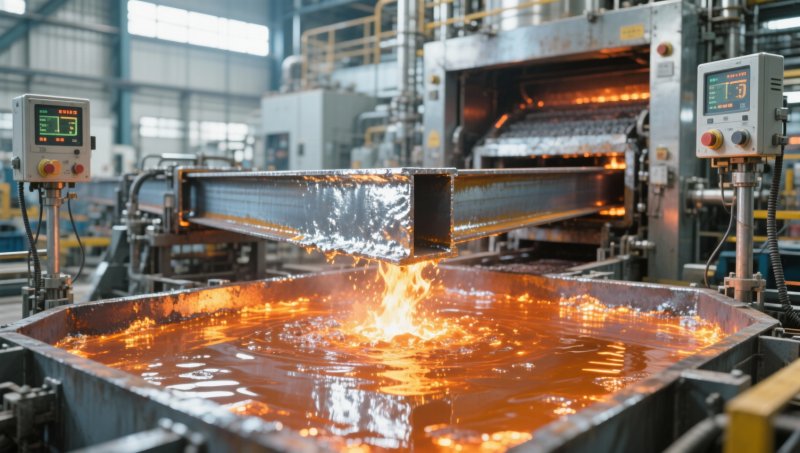
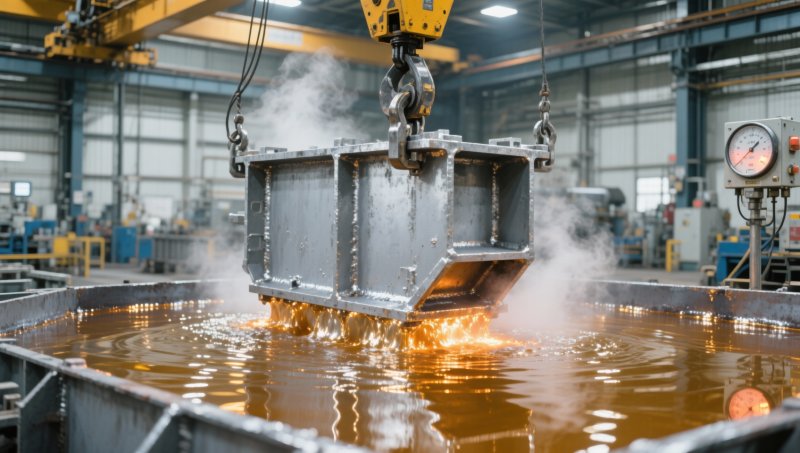
Hot dip galvanizing is not merely a surface coating—it’s a controlled metallurgical reaction. When cleaned structural steel (e.g., ASTM A36 angle or EN S275JR channel) is immersed in molten zinc at 449–460°C, iron atoms from the steel substrate diffuse into the zinc bath while zinc atoms simultaneously migrate into the steel. This interdiffusion forms four distinct, tightly bonded intermetallic layers: Gamma (Fe3Zn10), Delta (FeZn7), Zeta (FeZn13), and finally the outer pure zinc (Eta) layer.
The Gamma layer—typically 7–10% of total coating thickness—is hardest and most abrasion-resistant. The Delta and Zeta layers provide ductility and bonding integrity, while the Eta layer delivers sacrificial cathodic protection and smooth finish. Crucially, this layered structure only forms under strict pre-treatment: degreasing, pickling (HCl or H2SO4), and fluxing must remove all oxides and contaminants—otherwise, bare spots or blistering occur.
At Hongteng Fengda, every batch undergoes automated surface profiling (Ra ≤ 3.2 µm) and real-time bath temperature monitoring (±1.5°C tolerance). This ensures consistent diffusion kinetics—critical for structural components exposed to coastal salt spray or industrial SO2 environments where premature coating failure can trigger pitting corrosion within 18–24 months.
Key Metallurgical Parameters Governing Coating Quality
This metallurgical precision explains why Hongteng Fengda’s galvanized beams consistently pass ASTM A123 Section 7.3 bend tests (no flaking after 180° wrap around mandrel diameter = 2× coating thickness) and EN ISO 1461 adhesion verification via tape test per ISO 2409.
Why Zinc Coating Thickness Is the Single Most Critical Corrosion Metric
Coating thickness isn’t just “more is better”—it’s the primary determinant of service life in atmospheric exposure. According to ISO 9223, average corrosion loss of zinc is 0.8–1.5 µm/year in rural environments, but jumps to 5–8 µm/year in industrial or marine zones. A 55 µm coating provides ~35 years of protection inland—but only ~7 years near seawater without maintenance.
ASTM A123 mandates minimum average thicknesses by steel category: 45 µm for structural shapes >5 mm thick, 55 µm for items 1.6–5 mm thick, and 70 µm for sheet steel<1.6 mm. EN ISO 1461 specifies even tighter tolerances: ±15% deviation allowed on average, but no single reading may fall below 85% of nominal thickness. Under-specification risks early red rust appearance—often within 3–5 years in humid Southeast Asian climates.
Hongteng Fengda measures thickness at ≥5 points per meter using magnetic induction gauges (accuracy ±0.5 µm) and maintains full traceability per batch. For projects in the Middle East—where sand abrasion and high UV accelerate degradation—we recommend +20% over minimum specs (e.g., 66 µm avg for beams) to ensure 20+ year maintenance-free operation.
Corrosion Resistance vs. Coating Thickness: Real-World Data
For North American bridge projects requiring ASTM A767 compliance, our clients specify 85–100 µm coatings—achievable through dual-dip processes validated by independent lab reports (e.g., SGS Report No. CN2023-GALV-8874).
How Hongteng Fengda Ensures Compliance & Reduces Procurement Risk
As a structural steel exporter to 32 countries, Hongteng Fengda embeds quality control at three non-negotiable checkpoints: pre-galvanizing dimensional verification (±0.5 mm tolerance on beam flange width), in-line coating thickness mapping, and post-process salt-spray testing (ASTM B117, 96 hours neutral pH 5% NaCl). Every export order includes a Certificate of Conformance listing actual measured thickness values per ASTM E376.
We also offer hybrid solutions for cost-sensitive applications: DX53D Galvalume Steel Coil —a low-carbon steel substrate with 55% Al–43.5% Zn–1.5% Si alloy coating—delivers superior heat reflectivity (up to 80% solar reflectance) and 3–5× longer life than standard galvanized steel in roofing applications, especially where thermal cycling exceeds 200 cycles/year.
Our OEM support includes joint specification development: if your project requires EN 10346 DX53D coil for HVAC ducting in Dubai (where ambient temps reach 50°C), we coordinate material certification, coil slitting to 1250mm width, and laser-cutting per your CAD files—all within 25–30 days from PO confirmation.
Procurement Decision Checklist for Global Buyers
- Verify galvanizer’s ASTM A123/EN ISO 1461 third-party audit report (valid within last 12 months)
- Require batch-specific thickness test reports—not just “meets spec” statements
- Confirm whether coating thickness includes or excludes surface roughness peaks (per ISO 2178)
- Validate cold-formed profile compatibility: some high-strength steels (yield >345 MPa) require modified flux chemistry to prevent hydrogen embrittlement
Assess logistics readiness: Hongteng Fengda’s bonded warehouse in Tianjin Port enables LCL/FCL consolidation and 72-hour documentation turnaround
Conclusion: Precision Galvanizing Is a Lifecycle Investment, Not a Line Item
Choosing the right zinc coating thickness—and partnering with a manufacturer who controls the entire metallurgical chain—is how forward-looking project managers de-risk infrastructure investments. At Hongteng Fengda, we treat every ton of angle steel, channel, or custom beam as mission-critical: because a 5 µm shortfall in coating thickness can translate to $120,000+ in premature repainting costs for a 10,000 m² warehouse roof over 20 years.
Whether you’re specifying ASTM A992 beams for a Texas data center, EN 10025 S355JR columns for a Berlin transit hub, or cold-formed profiles for modular housing in Vietnam—we deliver verified, traceable, and globally compliant hot galvanizing. Our engineering team supports technical reviews, sample submissions, and DFM optimization—free of charge.
Contact Hongteng Fengda today to request your customized galvanizing specification guide, including thickness recommendations by climate zone, substrate grade, and application type—or schedule a virtual factory audit to observe our ASTM-certified coating line in action.
Related recommendations
 How long does acero prepintado retain gloss and color stability in direct desert sunlight?Acero prepintado gloss & color stability in desert sun? Discover real-world performance data, PVDF vs. polyester longevity, and spec-critical insights for GCC projects.
 Does acero pregalvanizado maintain coating integrity after cold bending to 90 degrees?Acero pregalvanizado maintains coating integrity after 90° cold bending — when engineered right. Discover how Hongteng Fengda guarantees real-world performance, adhesion & corrosion resistance.
 Do the advantages of galvanized steel include reduced fire risk compared to untreated carbon steel?Advantages of galvanized steel include measurable fire-risk reduction vs. untreated carbon steel—learn how zinc delays ignition, buys critical escape time, and enhances safety without false 'fireproof' claims.
 What is the minimum bend radius for 12mm steel wire rope without permanent deformation?12mm steel wire rope capacity depends on bend radius — discover the safe 72–96mm minimum to prevent permanent deformation, fatigue & failure. Expert rigging insights inside.
Please give us a message


Please enter what you want to find