How Hot-Dip Galvanized Coating Thickness Affects Service Life
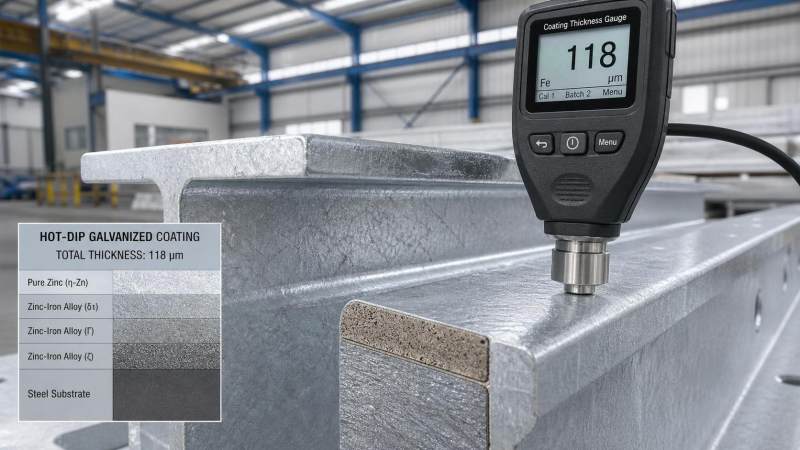
For corrosion control, coating thickness is never a minor detail.
It directly shapes how long hot-dip galvanized steel can resist rust in real service conditions.
That matters in bridges, plants, warehouses, utility structures, and exposed industrial equipment.
A thicker zinc layer usually means longer protection, but only when the specification matches the environment.
If the coating is too thin, corrosion starts earlier and maintenance intervals become shorter.
If the coating is unnecessarily heavy, costs can rise without creating proportional value.
This is why hot-dip galvanized coating thickness should be treated as a service life decision, not only a compliance item.
In practical sourcing and inspection work, the goal is to connect thickness, exposure level, and expected life.
Why Coating Thickness Matters So Much
Hot-dip galvanized steel protects itself through a zinc coating formed during immersion in molten zinc.
That coating acts in two ways.
First, it creates a physical barrier between steel and moisture.
Second, zinc provides sacrificial protection when the surface is scratched or locally damaged.
Service life often tracks coating thickness because corrosion consumes zinc gradually over time.
The more zinc available, the longer the steel usually remains protected before red rust appears.
This relationship is simple in principle, yet highly dependent on the operating environment.
Dry indoor conditions consume zinc slowly.
Marine air, chemical fumes, standing water, and deicing salts consume it much faster.
So, hot-dip galvanized performance should always be judged against real exposure, not only nominal thickness.
How Thickness Relates to Service Life
A useful rule is straightforward: thicker coating, longer life, assuming the coating is sound and continuous.
However, the increase is not abstract.
It can be estimated using local corrosion rates and the required time to first maintenance.
For example, a moderate atmosphere may allow a medium coating to last decades.
The same coating in a coastal plant may lose protective zinc much earlier.
This is why service life charts from ISO 14713 are often used during design and procurement.
They help estimate how long hot-dip galvanized steel may perform in different atmospheric categories.
Still, estimates work best when supported by field data and realistic exposure assumptions.
Typical Factors That Change the Result
- Atmospheric category, including urban, rural, industrial, and marine exposure.
- Surface orientation, drainage quality, and water retention points.
- Steel chemistry and section thickness, which influence galvanized coating growth.
- Mechanical damage during transport, erection, or later operation.
- Contact with incompatible materials or trapped debris.
In other words, coating thickness is critical, but it works within a larger durability system.
Relevant Standards and What They Actually Control
When teams specify hot-dip galvanized products, they usually refer to standards such as ASTM A123, ASTM A153, ISO 1461, or EN equivalents.
These standards define minimum coating thickness or coating mass for different steel sections and product types.
That minimum matters because it sets the baseline for durability and acceptance.
But a minimum standard value is not automatically the best value for every project.
A compliant coating may still be insufficient for splash zones, aggressive industrial sites, or hard-to-maintain structures.
This is where engineering judgment becomes important.
The specification should reflect both the standard and the service life target.
What Quality Control Should Check in Practice
Inspection should start before galvanizing, not after it.
Poor venting, hidden cavities, rough welds, and contamination can all reduce coating consistency.
After galvanizing, thickness measurements should be taken at representative points using calibrated magnetic gauges.
Single readings matter, but average thickness often gives the better picture.
The inspection record should also note bare spots, runs, ash inclusion, dross pimples, and repair areas.
More importantly, teams should ask whether the measured hot-dip galvanized coating suits the intended environment.
Passing a factory check is only one step.
Long service life depends on specification accuracy, field handling, and installation details.
A Practical Inspection Checklist
- Confirm the governing standard and required thickness before production.
- Review steel grade, section size, and fabrication details.
- Check coating thickness at multiple locations per lot.
- Verify repaired areas meet the repair method requirement.
- Document storage, loading, and site protection conditions.
In broader structural packages, coating selection also needs to align with component function.
For example, reinforcement choices affect material efficiency even when corrosion strategy is the main concern.
A product such as HRB600 Rebar is designed for construction use with a standard yield strength of 600 MPa.
It offers 39% higher strength than HRB400 grade steel bars, helping reduce reinforcement ratio and steel consumption.
Available diameters range from φ6 to φ50, with lengths including 1M, 4M, 6M, 8M, and 12M.
It also supports major standards such as ASTM, DIN, GB, JIS, bs, and AiSi.
How Environment Changes the Thickness Decision
Not every project needs the same hot-dip galvanized coating thickness.
A sheltered interior frame and a coastal conveyor support face very different corrosion loads.
That difference should appear directly in the specification.
Where inspection access is limited, a thicker coating often provides better risk control over time.
Where replacement is easy and the atmosphere is mild, standard minimums may be economically reasonable.
The key is to estimate the cost of failure, not only the initial coating cost.
Unplanned shutdowns, access equipment, labor, and safety exposure often outweigh small coating savings.
Common High-Risk Conditions
- Coastal air with chloride exposure.
- Industrial zones with sulfur compounds or acidic pollutants.
- Areas with frequent wetting and poor drainage.
- Contact points, bolted joints, and crevices that trap moisture.
- Structures exposed to abrasion or repeated mechanical contact.
In these cases, hot-dip galvanized service life predictions should be conservative.
Balancing Durability, Compliance, and Cost
The best coating thickness is not always the heaviest one available.
It is the thickness that meets service life targets with acceptable cost and manageable inspection risk.
That means procurement teams should define expected exposure, maintenance strategy, and design life early.
Once those inputs are clear, hot-dip galvanized specifications become much easier to justify.
This also improves supplier communication and reduces disputes over acceptance criteria.
For global projects, reliable manufacturers with stable process control make a measurable difference.
Hongteng Fengda, a structural steel manufacturer and exporter from China, supplies structural steel products and customized solutions for international construction and industrial projects.
Its product range includes angle steel, channel steel, steel beams, cold formed steel profiles, and customized structural components.
With modern facilities and strict quality control, products are produced to standards including ASTM, EN, JIS, and GB.
That kind of consistency helps reduce sourcing risk and supports dependable long-term performance planning.
Final Takeaway
Hot-dip galvanized coating thickness has a direct and practical effect on service life.
More zinc usually means more time before maintenance, but only when exposure conditions are understood correctly.
The right decision comes from combining standard requirements, environmental severity, inspection discipline, and lifecycle cost thinking.
In real projects, that approach leads to safer assets, fewer corrosion surprises, and better use of budget.
When specifying hot-dip galvanized steel, define the service environment first, then set the coating thickness around the real risk.
That is usually where long-term durability starts.
Please give us a message


Please enter what you want to find