Pipe Stainless Grades Explained: 304 vs 316 for Corrosion Resistance
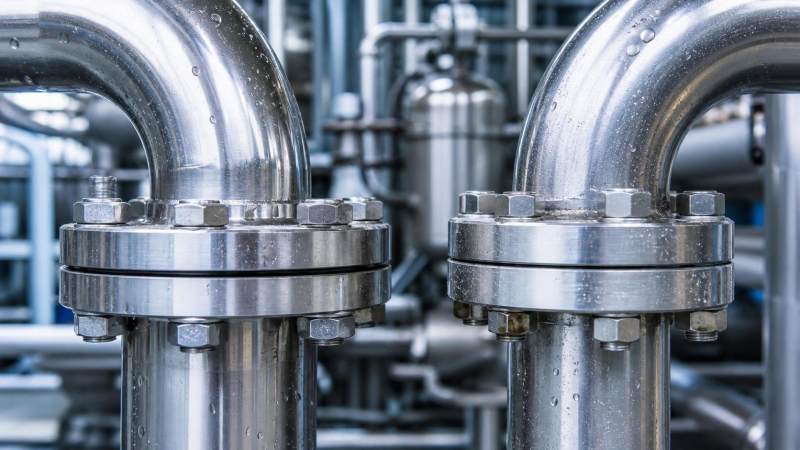
Choosing the right pipe stainless grade affects corrosion resistance, service life, and total project cost.
When teams compare pipe stainless options, 304 and 316 are usually the first two candidates.
At first glance, they look similar.
Both are austenitic stainless steels.
Both offer strong formability, weldability, and a clean surface finish.
But their corrosion behavior can separate quickly in demanding service conditions.
That difference matters in chemical handling, coastal construction, food processing, and water systems.
This guide explains how pipe stainless grade selection should be evaluated in practical terms.
The goal is simple.
Match the alloy to the exposure, the standard, and the expected maintenance risk.
What Makes 304 and 316 Different
The main difference is chemistry.
304 pipe stainless typically contains chromium and nickel as its primary alloying elements.
316 pipe stainless adds molybdenum, usually around 2% to 3%.
That addition improves resistance to chlorides and localized corrosion.
In normal indoor or mildly corrosive environments, 304 often performs well.
In harsher conditions, 316 usually provides a wider safety margin.
This is why many engineers treat 316 as the better choice for aggressive media.
Still, better does not always mean necessary.
A correct pipe stainless decision depends on actual exposure data, not assumptions.
Typical Composition Overview
How Corrosion Resistance Changes in Real Service
General corrosion is only part of the evaluation.
For pipe stainless systems, localized attack often creates the bigger long-term problem.
This includes pitting, crevice corrosion, and stress corrosion cracking.
304 can resist many cleaning agents, fresh water conditions, and dry indoor exposure.
However, chloride-rich environments can weaken its passive layer more quickly.
That can lead to small pits.
Once pits start, wall loss may accelerate in hidden areas.
316 handles chlorides better because molybdenum improves passive film stability.
That advantage becomes more obvious in marine air, brackish water, and process fluids.
In actual business settings, this often means fewer failures at flanges, welded zones, and trapped moisture points.
Where 304 Is Usually Enough
- Indoor utility piping
- Dry structural or mechanical areas
- Food equipment with controlled washdown chemistry
- Fresh water systems with low chloride content
Where 316 Often Makes Sense
- Coastal or offshore projects
- Chemical and pharmaceutical process lines
- Water treatment systems with higher chloride exposure
- Installations where corrosion shutdown risk is costly
Standards, Surface Condition, and Fabrication Matter Too
Pipe stainless grade selection should never rely on grade name alone.
Specification alignment matters just as much.
For global procurement, common references include ASTM, EN, JIS, and GB standards.
Those standards define chemistry, mechanical properties, dimensions, and testing expectations.
Surface finish also changes corrosion performance.
Rougher surfaces retain contaminants more easily.
Heat tint near welds can reduce local resistance if it is not properly treated.
Fabrication details therefore deserve close review.
Welding procedure, post-weld cleaning, passivation, and storage conditions all affect service results.
From a sourcing perspective, this is often where hidden risk enters the project.
A lower-cost quote on pipe stainless can become expensive if processing quality is unstable.
Hongteng Fengda supports international buyers with controlled production, documented quality inspection, and compliance with major global standards.
Alongside structural steel supply, projects often require corrosion-protected sheet materials for secondary fabrication.
A practical example is Galvanized Steel Coil Sheet.
It is available in grades such as DX51D+Z, SGCC, and S350GD+Z.
Typical thickness ranges from 0.12mm to 3.5mm.
Widths from 600mm to 1500mm support different fabrication plans.
Zinc coating options like Z80 to Z275 help improve atmospheric protection in complementary steel applications.
Cost Difference Versus Lifecycle Value
Price is usually the reason 304 remains widely specified.
Its initial cost is lower than 316 in most markets.
For non-aggressive service, that choice can be fully justified.
The problem appears when the environment is underestimated.
A lower-priced pipe stainless grade may save budget at purchase, then lose money through inspection, repairs, downtime, or replacement.
This is why lifecycle thinking matters.
A useful comparison should include more than material price.
- Expected chloride level and humidity
- Accessibility for maintenance and cleaning
- Failure consequence for safety and operations
- Required design life
- Replacement logistics and shutdown cost
In short, 316 often looks expensive only when viewed as a line-item purchase.
In harsher exposure, it may be the lower-risk commercial option.
A Practical Selection Checklist for Pipe Stainless
A consistent review method helps prevent over-specifying or under-specifying pipe stainless.
Use the checklist below before final approval.
- Define the medium, temperature, pressure, and cleaning regime.
- Check chloride content, splash risk, and condensation frequency.
- Review whether crevices, dead legs, or moisture traps exist.
- Confirm the applicable ASTM, EN, JIS, or GB specification.
- Request mill test documents and surface condition details.
- Review welding and post-fabrication treatment requirements.
- Compare replacement cost against the grade upgrade premium.
When the exposure is uncertain, conservative selection usually pays back.
That does not always mean moving straight to 316.
It means using actual service evidence before locking the pipe stainless grade.
Final Decision: 304 or 316
For many indoor, low-chloride, and general-purpose applications, 304 pipe stainless remains a sound choice.
It offers a balanced mix of corrosion resistance, fabrication flexibility, and cost control.
For coastal, chemical, saline, or high-risk installations, 316 pipe stainless usually provides stronger long-term protection.
The right answer depends on environment, fabrication quality, and compliance requirements working together.
In practical sourcing work, the best material decision is rarely the cheapest or the most upgraded by default.
It is the one that matches exposure risk with verified performance.
Before placing the order, align grade, standard, finish, and inspection scope so the pipe stainless system performs as expected from day one.
Please give us a message


Please enter what you want to find