Understanding SS 316 Coil Specifications for Marine Durability
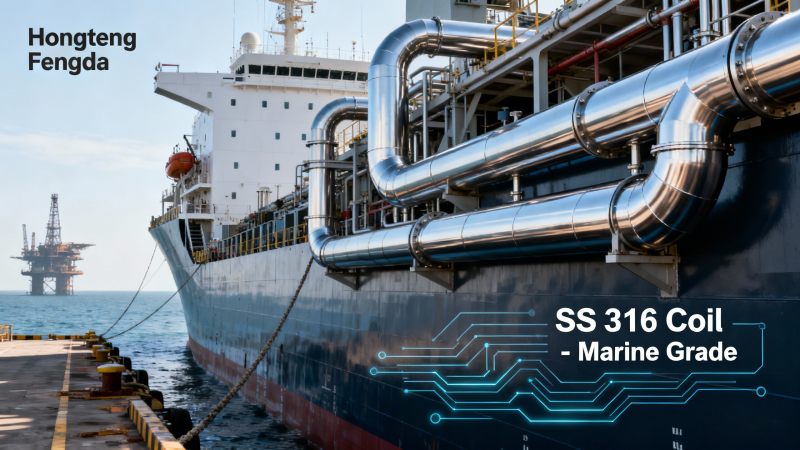
When selecting stainless steel materials for marine or high-corrosion environments, understanding the SS 316 coil technical specifications is essential. As a high temperature steel manufacturer in China, Hongteng Fengda provides SGS certified steel for construction and precision coil stainless steel for automotive industry applications. Stainless steel 316, known for its enhanced molybdenum content, exhibits superior corrosion resistance in chloride environments, which makes it a preferred alloy in shipbuilding, offshore platforms, and desalination plants. This guide explains how to choose the right SS 316 coil grade for durability, performance, and cost efficiency, helping buyers, project managers, and distributors make informed sourcing decisions in global markets. Marine project engineers face constant challenges regarding material longevity, exposure to seawater, and structural integrity under high pressure. Therefore, knowing the metallurgical behavior and mechanical data of SS 316 coil allows better project feasibility evaluation and ensures compliance with international safety standards such as ASTM A240, EN 10088, and JIS G4304.
Definition and Material Overview
The SS 316 coil, often referred to as 316 stainless steel coil, belongs to the austenitic stainless family derived from the 18-8 series but with added molybdenum. This addition enhances pitting and crevice corrosion resistance when compared with 304. The alloy typically contains around 16% chromium, 10% nickel, and 2% molybdenum. It is favored in industries that demand resistance to saline or acidic environments. Similar to the 201 Stainless Steel Coil, the SS 316 coil showcases excellent formability and stable weldability, enabling flexible fabrication in marine, chemical, and food industries. However, 316 provides higher cost efficiency in high corrosion resistance contexts, while 201 may be chosen for indoor or architectural applications due to its cost advantage. Buyers also need to understand the metallurgical differences between SS 316L and SS 316Ti versions—L indicates lower carbon for better weldability without carbide precipitation, while Ti addition improves high-temperature oxidation resistance, making it crucial for exhaust systems and heat exchangers installed on ships or offshore rigs.
Technical Performance and Core Parameters
The technical specifications of SS 316 coil emphasize mechanical stability and surface finish diversity. Tensile strength typically ranges from 515 to 620 MPa, with yield strength at approximately 205 MPa. The elongation rate of around 40% ensures excellent forming performance, important for welded stainless tubing price list evaluations during high-deformation production. Hardness levels vary between 90 HRB and 95 HRB depending on annealing conditions. Its density remains near 8.0 g/cm³, and the thermal conductivity is about 16 W/m·K—an attribute supporting consistent heat distribution in ship engine components and thermal control units. The oxidation resistance extends up to 870°C in intermittent use or 925°C in continuous service, qualifying SS 316 coil for high temperature steel manufacturing segments. The chemical stability against chlorides makes it superior for stainless steel roll for food processing plants exposed to cleaning chemicals or saltwater spray. Compared to carbon steels, its lower maintenance cost justifies the material’s higher initial price. Each coil can be precision-rolled or slit according to design drawings, meeting dimensional parameters from 0.3 mm up to 10 mm in thickness and 610 mm to 2000 mm in width. Meanwhile, finishes like 2B, BA, NO.4, and HL are customizable for both structural and decorative purposes in marine architecture.
Market Overview and Industry Trends
Global demand for stainless steel coils has been expanding due to infrastructure and energy projects that require long service life with minimal maintenance. SS 316 coils remain central to sectors prioritizing hygiene or saline resistance, including desalination facilities, coastal infrastructure, offshore platforms, and seafood processing plants. According to industry data, the Asia-Pacific region has become the fastest-growing consumption hub, followed by the Middle East and Europe, where 304 coil supplier in Middle East networks often complement their portfolios with SS 316 alternatives to satisfy premium clients. Stainless steel consumption in the marine industry is projected to grow by over 5% annually, spurred by investments in sustainable vessel designs and advanced wastewater systems. Hongteng Fengda, as a structural steel manufacturer and exporter from China, integrates intelligent production control to ensure stable supply and SGS certified steel for construction, supplying both bulk and customized grades. The market has shifted towards traceable sources emphasizing ISO, SGS, and BV compliance, reflecting stronger quality assurance expectations among international buyers concerned with sustainability, emission control, and material recycling potential.
Comparison Analysis: SS 316 vs 201 Stainless Steel Coil
For procurement personnel and project managers, distinguishing between SS 316 and 201 stainless steel coil is crucial for cost–benefit optimization. The 201 Stainless Steel Coil contains higher manganese and lower nickel content, which reduces its production cost but also limits corrosion resistance compared to 316. The 201 coil’s tensile strength is ≥520 MPa with yield ≥275 MPa, and elongation ≥55%, making it suitable for various tabletops, kitchenware, and decorative panels where acid exposure is minimal. In contrast, the SS 316 coil, though slightly softer, excels in seawater, chemical, and pharmaceutical environments, where its molybdenum-enriched structure prevents rust formation and stress cracking. Engineers choosing materials for marine pipelines or heat exchangers typically perform lifecycle analyses—201 coils excel in architectural interior designs, while 316 grades dominate in safety-critical assemblies. For buyers evaluating welded stainless tubing price lists or bulk steel strapping orders, decision metrics include regional humidity, service temperature, and mechanical fatigue cycles. Both grades adhere to SGS and ISO quality assurance protocols but differ in alloy composition, determining their place in global procurement strategy.
Procurement Guide and Cost Considerations
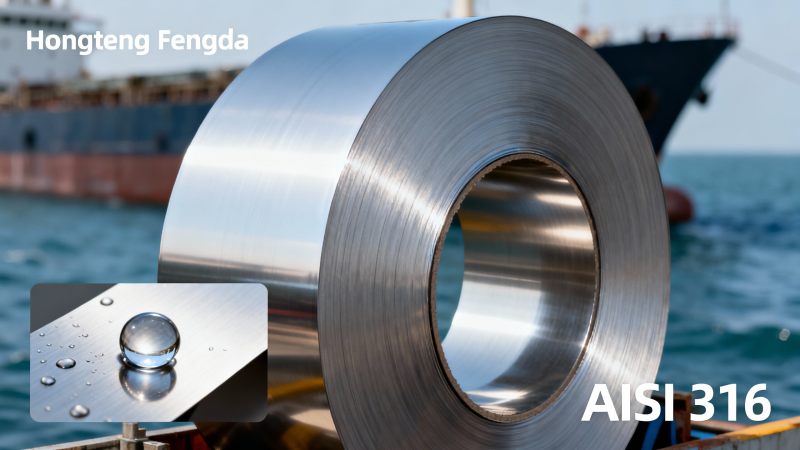
Procurement professionals must balance mechanical requirements, long-term performance, and project cost frameworks when selecting SS 316 coils for marine applications. Start by reviewing specifications such as grade type (316 or 316L), required surface finish, thickness, and dimensional tolerances. The supplier’s steel strapping bulk order capacity and delivery schedule affect logistics planning, while SGS certified documentation verifies compliance. It is advisable to request mill test certificates (EN 10204-3.1) that ensure chemical composition conformity, especially when exporting to Europe or North America. Cost trends for SS 316 coils often fluctuate with nickel and molybdenum market prices, encouraging buyers to negotiate framework agreements to secure price stability. When evaluating a high temperature steel manufacturer in China, reputation for quality control and after-sales support significantly impacts sourcing confidence. Hongteng Fengda provides consistent batch uniformity through automated rolling lines and non-destructive testing. Considering substitutes, 201 stainless steel coil or duplex 2205 may offer partial cost advantages; however, their corrosion resistance levels and welding characteristics should be validated before application in marine structures. Ultimately, total lifecycle value—rather than price per ton—defines procurement success.
Standards, Certifications, and Compliance
Compliance is essential for structural integrity and maritime safety. SS 316 coils supplied for international projects commonly adhere to ASTM A240/A240M standards for plate, sheet, and strip and EN 10088 counterparts in the European Union. The ISO 9001 quality management framework ensures process repeatability, while SGS and BV certification validate external audit performance. For food processing or pharmaceutical systems, material traceability according to ASME BPE standards may also be required. Hongteng Fengda’s stainless steel products, including coils, channels, and beams, meet multiple certification routes and can be custom-labeled for OEM partners. Buyers targeting the Middle Eastern or Indian markets can reference local building codes aligned with ASTM standards to streamline import clearance. Incorporating SGS certified steel for construction materials also enhances project qualification during government tendering, a vital factor for enterprise decision-makers and safety managers. Documentation transparency and standardized packaging—through labels encoding heat number, batch number, and coil weight—further ensure reliability throughout transit and installation.
Case Studies: Successful Marine Project Applications
Numerous marine construction projects illustrate the durability advantage of SS 316 coils supplied by Hongteng Fengda. In 2023, a coastal desalination plant in the Middle East adopted 316L coils to fabricate pipeline liners and seawater pumps. The project experienced a 35% reduction in maintenance frequency compared to units previously using 304-grade material. Another case involved a ferry terminal upgrade in Southeast Asia, where SS 316 coils were used for canopy structures exposed to high chloride-saturated air. Despite continuous UV and moisture exposure, the structure retained its surface integrity for over two years without discoloration. These outcomes result from careful alignment between ss 316 coil technical specifications and environmental stress variables. Meanwhile, in the automotive sector, stainless steel roll for food processing and vehicle exhaust units employ similar alloys to ensure hygiene and high heat resistance. Such evidence supports why choosing a reputable Chinese structural steel manufacturer guarantees performance consistency and compliance confidence, particularly when serving multinational engineering clients.
FAQ and Common Misconceptions
Several misconceptions surround stainless steel selection. One frequent misunderstanding is that all stainless steels resist corrosion equally; however, SS 316 coil significantly outperforms 201 and 304 grades under marine spray or acidic drainage. Another question often raised is whether welding affects corrosion properties—proper shielding gas control and post-weld pickling maintain passive film integrity. Procurement professionals sometimes believe that higher hardness equals better quality, yet extremely hardened coils may sacrifice formability and cracking tolerance. Furthermore, food industry specifiers occasionally confuse surface appearance with sanitary suitability, when in reality, micro-smooth finishes like BA or 2B ensure easier sterilization. Regarding costs, buyers should remember that initial pricing differences narrow over time, as corrosion repairs for cheaper alloys can exceed installation budgets. To avoid overestimation or mismatch, one should consult suppliers who provide detailed ss 316 coil technical specifications and real mechanical test results for verification. Selecting SGS certified steel for construction not only ensures strength but also simplifies project approval by regulatory agencies.
Trend and Insights: Sustainability in Stainless Steel Manufacturing
Sustainability drives the stainless steel industry’s next growth phase. Manufacturers are investing in energy-efficient furnaces, digital traceability, and recycling systems to cut carbon footprints. SS 316 coils, due to their extended service life, align with eco-friendly infrastructure objectives by minimizing replacement frequency. Hongteng Fengda integrates environmentally responsible sourcing and production, utilizing renewable electricity where feasible. Another trend involves hybrid alloy development—enhancing corrosion performance while reducing nickel content to control volatility in raw material costs. In the realm of architectural design, flat stainless steel for architectural design with 316 aesthetic finishes offers both elegance and durability in waterfront urban projects. With increasing global regulations on material traceability, the capacity to provide detailed batch documentation and automated chemical verification positions responsible manufacturers ahead of less standardized competitors. For project managers and safety officers, opting for partners that adopt digital inspection systems ensures smoother compliance audits and consistent delivery timelines, both critical to meeting construction milestones in complex marine environments.
Why Choose Hongteng Fengda
Hongteng Fengda stands as a trusted structural steel manufacturer and exporter from China, combining modern production infrastructure with stringent quality control. The company’s stainless and structural steel portfolio covers angle steel, channel beams, cold formed profiles, and a wide range of coil products including SS 316 and 201 stainless steel coils. With compliance to ASTM, EN, JIS, and GB standards and ISO/SGS/BV certifications, Hongteng Fengda delivers materials that ensure project reliability globally. Customers in North America, Europe, the Middle East, and Southeast Asia benefit from stable capacity, professional technical consultation, and responsive after-sales service. For purchasing managers and safety directors, partnering with Hongteng Fengda means reducing sourcing risks, optimizing total cost, and accessing flexible OEM solutions. Whether your requirement involves coil stainless steel for automotive industry assemblies, stainless steel roll for food processing applications, or structural solutions for marine engineering, our experienced team ensures on-time, certified, and fully traceable deliveries. Contact Hongteng Fengda today to explore customized stainless steel solutions that combine performance, sustainability, and long-term value for every project.
- channel beam
- steel i
- angle steel
- ASTM standards
- ASTM standard
- steel coil
- structural steel
- Structural Steel
- Construction Materials
- high temperature steel
- SGS certified steel
- 201 stainless steel coil
- 316 stainless steel coil
- welded stainless tubing
- stainless steel coil
- coil stainless
- 304 coil
- ss 316 coil
- stainless steel roll
- steel strapping
- flat stainless steel
- Profile
- carbon steel
- flat stainless steel for architectural design
- steel strapping bulk order
- stainless steel roll for food processing
- ss 316 coil technical specifications
- 304 coil supplier in Middle East
- coil stainless steel for automotive industry
- welded stainless tubing price list
- SGS certified steel for construction
- high temperature steel manufacturer in China
Related recommendations
 What is an H-Beam and How Does it Differ from an I-Beam?Discover what an H-beam is and how it differs from an I-beam. Learn key structural differences and expert selection tips from Hongteng Fengda to optimize your steel construction projects today.
 Hot Rolled vs. Cold Rolled Steel Sheet: Surface and ToleranceHot rolled vs cold rolled steel sheet: Discover how surface finish and tolerances impact manufacturing. Optimize material selection, reduce costs, and ensure quality. Read our expert guide today!
 Best Cutting and Bending Practices for Galvanized Sheet MetalDiscover the best cutting and bending practices for galvanized sheet to prevent zinc flaking. Optimize tooling and thermal parameters to ensure perfect corrosion resistance. Read the full guide!
 What is Galvanized Sheet and How Does the Zinc Coating Work?Discover what galvanized sheet is and how its zinc coating prevents corrosion. Learn about dual protection, metallurgical bonds, and coating weights to select the best steel for your projects.
Please give us a message


Please enter what you want to find