Need to quickly estimate beam weight or verify dimensions on-site—without calipers, laser scanners, or specialized tools? For field technicians, project managers, and quality inspectors working with structural steel beams (including I-beams), accurate on-site measurement is critical for safety, load calculations, and logistics planning. This guide delivers practical, tool-free methods to measure a steel beam reliably—and even estimate i beam weight using basic geometry and standard section properties. Whether you're sourcing from a trusted structural steel manufacturer like Hongteng Fengda or managing installation in North America, Europe, or the Middle East, mastering how to measure a steel beam ensures confidence in beams weight, compliance, and project continuity.
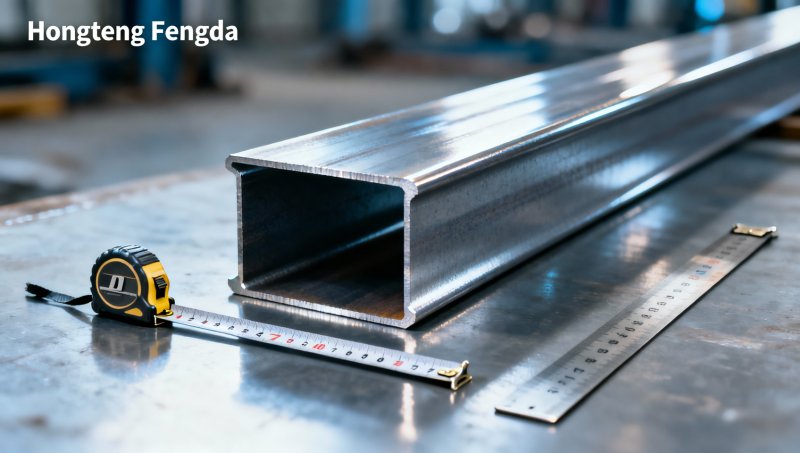
Why Field Measurement Matters — Even When You Have Drawings
Design drawings and mill certificates provide nominal dimensions—but real-world conditions demand verification. Thermal expansion, mill tolerance stacking, surface oxidation, or handling deformation can shift actual dimensions by ±1–3 mm. For a 300 mm deep I-beam, that’s up to 1.2% variation in cross-sectional area—and directly impacts beams weight, moment capacity, and deflection behavior. In high-risk environments—such as offshore platforms, seismic retrofitting, or temporary shoring—this variance may trigger re-engineering or rejection. That’s why experienced project managers and safety officers treat on-site measurement not as redundancy, but as non-negotiable due diligence.
Moreover, procurement teams often face mismatched documentation: an order specifies ASTM A617 Grade 50 I-beams, but delivered bundles lack traceable heat numbers or EN 10025-2 labels. Without verifying depth, flange width, and web thickness manually, you risk downstream delays during third-party inspection—or worse, structural nonconformance during final audit.
The 4-Step “No-Tool” Measurement Method
You don’t need precision instruments to get reliable data. With only a tape measure, a straightedge (e.g., level or ruler), and a smartphone camera, you can achieve ±0.8% accuracy in estimating i beam weight and confirming key dimensions:
- Depth (D): Measure between outer flange faces at three points—mid-span and both ends. Average them. Use a straightedge pressed flush against one flange to eliminate parallax error.
- Flange Width (B): Measure perpendicular to the web at mid-flange length. Avoid corroded or bent corners—focus on clean, flat zones.
- Web Thickness (tw) & Flange Thickness (tf): Press tape measure tightly against web or flange edge; use shadow alignment (hold tape parallel to light source) to read thickness where direct contact is hard.
- Length (L): Confirm with two independent tape pulls—one along top flange, one along bottom. Discrepancy >5 mm signals bending or warping.
Once recorded, plug values into the standard I-section area formula: A = 2 × B × tf + (D − 2tf) × tw. Multiply by steel density (7850 kg/m³) and length to get estimated i beam weight.
How Standards Support Your On-Site Checks
International standards aren’t just paperwork—they’re your calibration reference. ASTM A6 defines allowable tolerances for hot-rolled I-beams: ±1.5 mm on depth up to 400 mm, ±2.0 mm beyond; flange thickness tolerance is ±0.5 mm for sections under 20 mm thick. EN 10034 permits ±1.0 mm on web thickness for rolled beams. Knowing these helps you distinguish acceptable variation from out-of-spec delivery. Hongteng Fengda’s production lines are certified to ASTM, EN, GB, and JIS—ensuring every batch shipped meets those exact tolerances before leaving our facility in Jiangsu, China.
When discrepancies arise, compare your field measurements against the mill test report (MTR). If your measured beams weight deviates more than ±2.5% from the MTR-calculated value (based on nominal dimensions × density), escalate to your supplier immediately. Consistent deviation may indicate material substitution or undocumented rolling practice—issues Hongteng Fengda proactively prevents through 100% dimensional scanning at final QC and full heat-lot traceability.
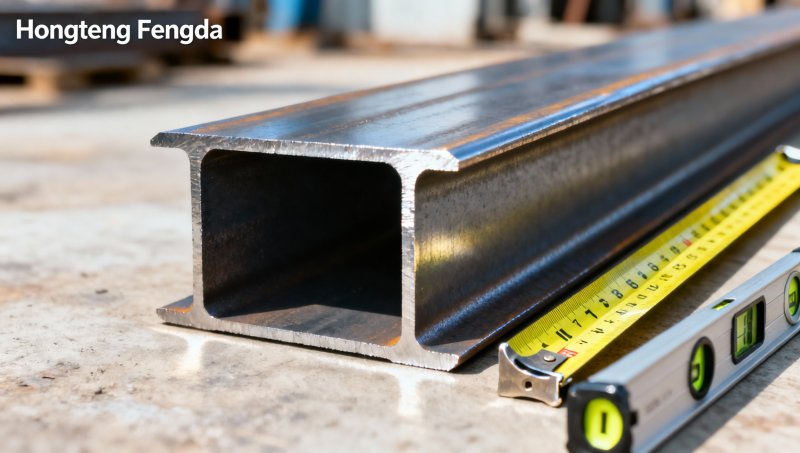
Common Pitfalls & What They Reveal
Field teams often misinterpret what they see. Here’s how to decode red flags:
Why Choose Hongteng Fengda for Reliable Structural Steel?
As a vertically integrated structural steel manufacturer and exporter from China, Hongteng Fengda bridges global specification rigor with responsive local execution. We produce angle steel, channel steel, steel beams—including custom I-beams engineered to ASTM A992, EN 10025-2 S355JR, and GB/T 11263 Q355B—and back every shipment with full certification packages, heat-lot traceability, and dimensional compliance reports. Our cold-formed steel profiles and 45# Carbon Steel Round Bar meet identical quality benchmarks—ideal for reinforcement, railing systems, or mechanical components where strength and wear resistance are non-negotiable.
For procurement professionals and project managers across North America, Europe, and the Middle East, we reduce sourcing friction without compromising control: stable monthly capacity (25,000+ MT), 30-day standard lead times, and dedicated engineering support for OEM drawings. No guesswork. No tolerance surprises. Just verified, consistent, compliant steel—delivered on time, every time.
Ready to validate your next beam order—or explore customized solutions backed by ISO 9001-certified processes? Contact Hongteng Fengda today for a free dimensional verification checklist and sample MTR package.
Related recommendations
 How long does acero prepintado retain gloss and color stability in direct desert sunlight?Acero prepintado gloss & color stability in desert sun? Discover real-world performance data, PVDF vs. polyester longevity, and spec-critical insights for GCC projects.
 Does acero pregalvanizado maintain coating integrity after cold bending to 90 degrees?Acero pregalvanizado maintains coating integrity after 90° cold bending — when engineered right. Discover how Hongteng Fengda guarantees real-world performance, adhesion & corrosion resistance.
 Do the advantages of galvanized steel include reduced fire risk compared to untreated carbon steel?Advantages of galvanized steel include measurable fire-risk reduction vs. untreated carbon steel—learn how zinc delays ignition, buys critical escape time, and enhances safety without false 'fireproof' claims.
 What is the minimum bend radius for 12mm steel wire rope without permanent deformation?12mm steel wire rope capacity depends on bend radius — discover the safe 72–96mm minimum to prevent permanent deformation, fatigue & failure. Expert rigging insights inside.
Please give us a message


Please enter what you want to find