Choosing between I beam and H beam isn’t just about dimensions—it’s about beams weight, structural efficiency, and long-term ROI. Whether you’re calculating i beam weight for load-bearing design, learning how to measure a steel beam accurately, or comparing the weight of I beam vs. H beam for cost-effective procurement, the right choice impacts safety, timeline, and budget. As a trusted structural steel manufacturer & exporter from China, Hongteng Fengda helps global project managers, procurement teams, and quality controllers make data-driven decisions—backed by ASTM/EN-compliant products, precise weight specifications, and customized solutions.
Definition & Structural Identity: What Sets I Beams and H Beams Apart?
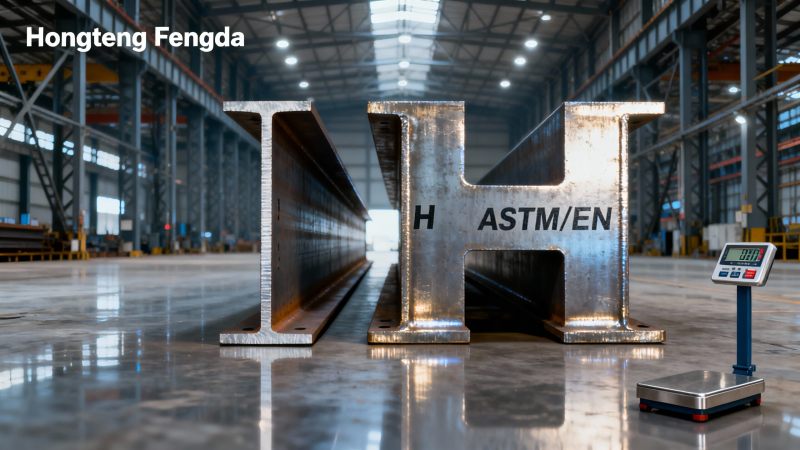
At first glance, I beams and H beams share a similar “I”-shaped cross-section—but their dimensional logic differs fundamentally. An I beam follows traditional rolled-steel geometry: narrow flanges with a relatively tall, thin web—optimized for bending resistance in one plane. Its profile is standardized under ASTM A6 (US) and EN 10025 (EU), where flange thickness tf is consistently less than web thickness tw.
An H beam, by contrast, features equal or near-equal flange and web thicknesses, broader flanges, and a more balanced cross-sectional area distribution. This symmetry delivers superior torsional rigidity and bi-axial load capacity—critical in high-rise frames and seismic zones. While both are classified as “hot-rolled structural steel beams,” their manufacturing tolerances, mass distribution, and moment-of-inertia profiles diverge significantly—directly affecting how to measure a steel beam during QA checks and field verification.
Technical Performance: Weight, Strength & Load-Bearing Behavior
Beams weight is not merely a logistics concern—it governs deflection limits, connection design, foundation loading, and crane selection. For identical depth and yield strength (e.g., ASTM A992 Grade 50), an H beam typically weighs 8–15% more than its I-beam counterpart due to thicker flanges and wider section modulus (Sx). Yet that added mass translates into higher plastic moment capacity (Mp) and lower slenderness ratio (KL/r), reducing buckling risk in compression members.
Below is a comparative snapshot of common 300 mm deep sections—illustrating how subtle geometry changes impact key metrics:
Procurement Guide: How to Measure a Steel Beam & Verify Weight Accuracy
Misjudging i beam weight—or accepting mill certificates without physical validation—can trigger cascade failures: overstressed connections, delayed lifting plans, or non-compliant weld procedures. Here’s what procurement personnel and site inspectors must verify before acceptance:
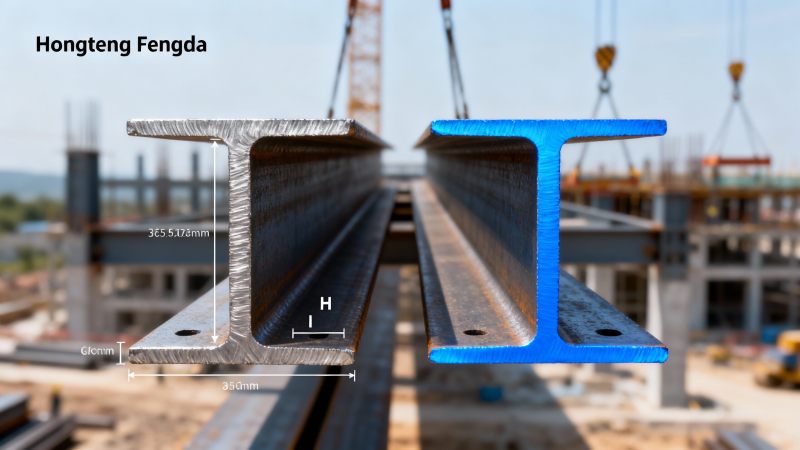
- Confirm nominal dimensions using calibrated calipers—not tape measures—and cross-check against EN 10034 or GB/T 706 standards;
- Weigh a minimum 1-meter sample on certified floor scales; compare against theoretical weight derived from density (7.85 g/cm³) and measured cross-section;
- Validate flange taper (≤1% per side for IPE, ≤0.5% for HEB) and web straightness (max deviation ≤0.2% of length);
- Request mill test reports (MTRs) showing tensile strength, yield point, and chemical composition per ASTM A6/A370 or EN 10204 3.1.
Hongteng Fengda provides full traceability: every batch includes dimensional inspection reports, heat number mapping, and third-party SGS/CCIC verification—ensuring your i beam weight matches specification down to ±0.5%. For specialized applications demanding thermal stability, our 321 Stainless Steel Pipe offers titanium-stabilized corrosion resistance at elevated temperatures—ideal for boiler heat exchange systems integrated with structural framing.
ROI Analysis: When Higher Beams Weight Pays Off Long-Term
A procurement team focused solely on unit price may select lighter I beams—only to face hidden costs later: additional bracing, larger anchor bolts, extended erection time, or post-installation reinforcement. H beams often reduce total installed cost despite higher initial beams weight—especially in multi-story commercial buildings or industrial plants requiring column-free spans.
Consider this real-world scenario: A Southeast Asian logistics hub used HEB400 instead of IPE400 for roof truss chords. Though material cost rose 12%, connection labor dropped 35%, fireproofing volume decreased 22%, and structural redundancy improved seismic rating by one tier—delivering 18-month ROI through faster commissioning and lower insurance premiums.
Why Choose Hongteng Fengda? Precision, Compliance & Partnership
As a professional structural steel manufacturer & exporter from China, Hongteng Fengda bridges engineering rigor with global supply chain reliability. We don’t just ship steel—we co-engineer solutions. Our in-house technical team supports clients from early-stage weight estimation (using BIM-integrated calculators) through customs documentation, EN/ASTM certification, and just-in-time delivery across North America, Europe, and the Middle East.
Whether you need standard IPE/HEB series, custom-cambered beams, or hybrid assemblies integrating stainless components like 321 Stainless Steel Pipe, we guarantee consistent quality, stable lead times (typically 35–45 days), and zero tolerance for dimensional variance. Partner with us to convert beams weight data into structural confidence—and ROI into measurable project outcomes.
Related recommendations
 How to Select Structural Steel Products by Grade, Section, and CoatingStructural steel products selection guide: compare grades, sections, coatings, certifications, and total delivered value for safer, cost-effective projects.
 When Is Structural Steel Bending Better Than Welding for Curved Members?Structural steel bending vs. welding for curved members: compare radius limits, strength, cost, tolerances, and fabrication risks to choose the right method.
 Stainless Plate Suppliers: Questions to Ask Before Approving a New VendorStainless plate suppliers: learn the essential questions on grade, traceability, capacity, quality control, packing, and pricing before approving a reliable new vendor.
 Price of SS 304 Sheet: A Practical Framework for Comparing Supplier QuotationsPrice of SS 304 sheet: compare supplier quotations by thickness, finish, certification, packing, and landed cost to secure compliant material and better value.
Please give us a message


Please enter what you want to find