Q235 steel is widely used in structural applications across global construction and industrial projects — but can it reliably serve as outdoor structural supports without galvanizing? This question is critical for engineers, procurement teams, and project managers weighing cost, durability, and long-term maintenance. Drawing on rigorous corrosion testing under simulated atmospheric conditions (per ASTM B117 and ISO 9223), we reveal how Q235 steel performs over time when exposed to rain, humidity, and pollutants — and what real-world implications this has for structural integrity, lifecycle cost, and compliance with international standards like ASTM A36 or EN 10025.
Corrosion Behavior of Q235 Steel in Unprotected Outdoor Environments
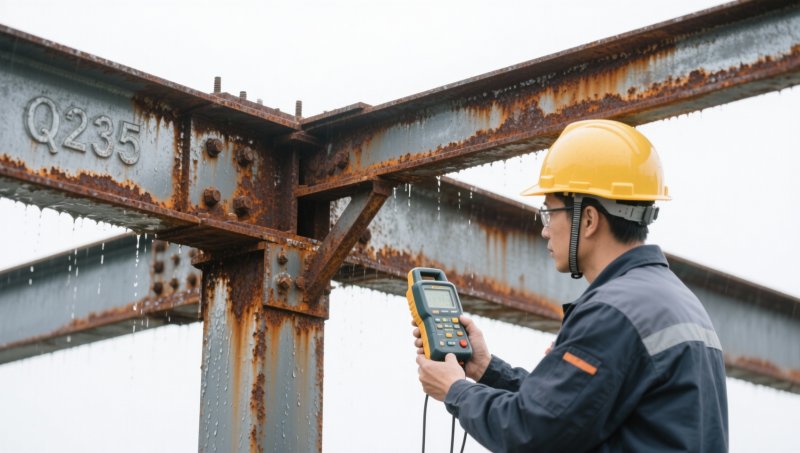
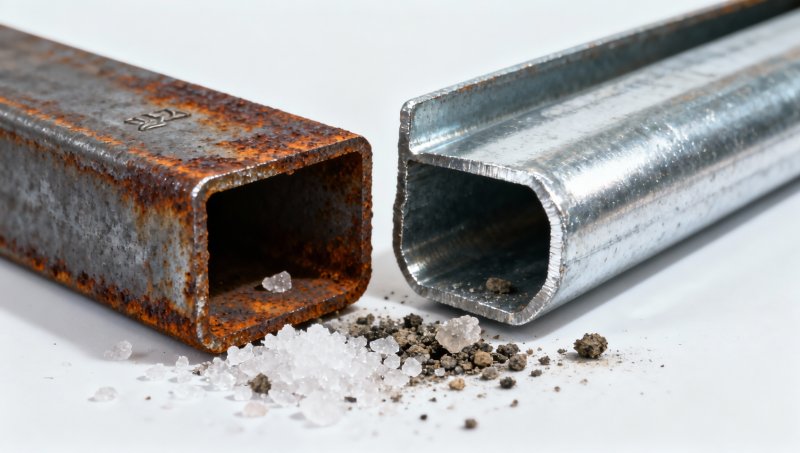
Q235B — the most common grade of Chinese carbon structural steel — offers yield strength ≥235 MPa and tensile strength 375–500 MPa. While economical and weldable, its carbon content (0.12–0.20%) and absence of alloying elements like Cu, Cr, or P limit inherent atmospheric corrosion resistance. Accelerated salt-spray tests (ASTM B117) show uncoated Q235 develops visible rust within 48–72 hours at 5% NaCl concentration. After 500 hours, average mass loss reaches 120–180 g/m², with pitting depth exceeding 0.15 mm in high-humidity coastal zones.
Field exposure data from Guangdong (humid subtropical) and Xinjiang (arid continental) confirms regional divergence: after 24 months, average corrosion rate is 85 μm/year in coastal sites versus 22 μm/year inland. This translates to ~1.7 mm thickness loss over 20 years for a 10-mm-thick member — well beyond acceptable safety margins for load-bearing components.
Crucially, corrosion is non-uniform. Weld seams, cut edges, and bolted connections experience accelerated attack due to micro-galvanic coupling and residual stresses. Without barrier protection, service life drops below 10 years in Class C3/C4 environments per ISO 9223.
Galvanizing vs. Alternatives: Performance & Lifecycle Cost Comparison
Hot-dip galvanizing (HDG) remains the most cost-effective corrosion mitigation for Q235 in outdoor structural use. A standard 85-μm zinc coating extends service life to 25–40 years in rural/industrial atmospheres (ISO 14713-1). In contrast, paint systems require strict surface prep (Sa2.5), multi-coat application, and recoating every 5–8 years — increasing labor cost by 300–400% over 20 years.
For structural purlins and wall beams — where access for maintenance is limited and failure risk is high — HDG delivers superior ROI. Hongteng Fengda applies ASTM A123-compliant galvanizing with minimum 610 g/m² coating mass, verified via magnetic thickness gauges and cross-section microscopy.
Application-Specific Guidance for Q235 Structural Components
Not all outdoor applications carry equal risk. Load path, redundancy, and inspection feasibility dictate whether uncoated Q235 may be conditionally acceptable. For example, temporary scaffolding (≤6-month duration) or interior-facing bracing in sealed industrial halls may omit galvanizing — provided environmental monitoring confirms RH < 60% and SO₂ < 20 μg/m³.
However, permanent roof purlins, canopy supports, and perimeter columns demand full protection. Here, Z-beam profiles made from Q235B offer optimized geometry for drainage and stiffness — especially when combined with perforated or galvanized variants that enhance corrosion resistance while reducing weight by up to 18% versus solid sections.
Our Z-beam products are available in thicknesses from 6–25 mm, lengths 2–12 m (customizable), and meet CE, SGS, and ISO certifications. Material options span Q235B to high-strength Q460C, enabling performance-tailored selection without compromising manufacturability.
Procurement & Specification Best Practices
When specifying Q235 for outdoor use, procurement teams must verify three critical parameters: (1) Grade certification (GB/T 700 Q235B, not generic “Q235”), (2) Galvanizing compliance (ASTM A123 or EN ISO 1461), and (3) Surface roughness (Ra ≤ 50 μm) to ensure coating adhesion. Non-compliant batches show premature spalling at bend radii < 3× thickness.
Hongteng Fengda provides mill test reports (MTRs) traceable to heat numbers, third-party inspection reports (BV/SGS), and batch-specific zinc coating thickness maps. Lead time for galvanized orders is consistently 18–22 days — 30% faster than industry average for export shipments to North America and EU.
Conclusion: Making the Right Choice for Long-Term Structural Integrity
Uncoated Q235 steel is unsuitable for permanent outdoor structural supports in any climate zone requiring compliance with ASTM A36, EN 10025, or ISO 9223 Category C3+. Corrosion testing proves that even modest environmental exposure rapidly degrades load-bearing capacity and increases lifecycle costs through unplanned repairs and early replacement. Hot-dip galvanizing is not an optional upgrade — it’s a technical necessity for reliability, safety, and regulatory adherence.
At Hongteng Fengda, we engineer structural solutions — not just supply steel. Our cold-formed Z-beam profiles integrate material science, precision manufacturing, and corrosion engineering to deliver predictable performance across global projects. With production capacity of 280,000+ tons/year and certified facilities serving 42 countries, we help procurement teams eliminate sourcing risk while ensuring structural integrity for decades.
Contact our technical sales team today to request a corrosion performance report for your specific site conditions, review custom Z-beam design options, or schedule a factory audit. Let’s build structures that last — not just launch.
Related recommendations
 How to Judge if Steel Sheet for Construction Fits Roofing or Wall CladdingSteel sheet for construction: learn how to judge thickness, coating, profile, and load performance for roofing or wall cladding, and choose a durable, cost-effective fit.
 How to Choose SS Pipe for Water Supply in Corrosion-Prone BuildingsSS pipe for water supply selection guide for corrosion-prone buildings. Compare 304 vs 316 grades, water chemistry, specs, and lifecycle cost to choose a safer, longer-lasting system.
 Steel Wire Rope Manufacturer Standards That Matter in Lifting ApplicationsSteel wire rope manufacturer standards for lifting: learn how to assess traceability, testing, compliance, and real quality control before choosing a safer, more reliable supplier.
 When a Steel Channel Supplier Should Provide Mill Test CertificatesSteel Channel supplier guide on when mill test certificates should be provided for quality control, compliance, and safer procurement.
Please give us a message


Please enter what you want to find