When a Steel Channel Supplier Should Provide Mill Test Certificates
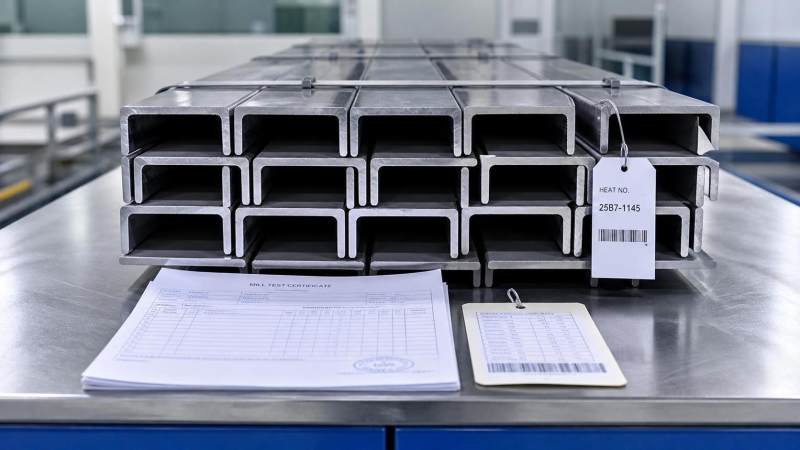
For quality control and safety teams, mill test certificates are not paperwork for paperwork’s sake. They are one of the few documents that connect the physical steel channel on site with the steelmaking batch it came from, the grade it was ordered to, and the standard it is supposed to meet. When that link is missing, problems tend to show up late—during receiving inspection, fabrication, third-party audit, or worse, after installation.
A capable Steel Channel supplier should understand that the question is not simply whether certificates exist, but when they should be issued, what they should cover, and how they should match the delivered material. In structural steel procurement, timing matters almost as much as content. A certificate sent after goods have already reached site may still be useful for records, but it does little to prevent loading the wrong grade into a critical structure.
The practical answer: before release, and certainly before installation
In most real projects, mill test certificates should be available before shipment release or at least before the material is accepted into stock for production use. That is the safest point for QC review. If the purchase order requires a specific channel grade under ASTM, EN, JIS, or GB standards, the buyer needs enough time to compare the certificate with the order, the markings, and the packing list.
There are a few stages where requesting the document makes sense:
- At quotation stage, if the project is regulated or safety-sensitive. This confirms the supplier can provide traceable material rather than generic stock.
- Before production or cutting, especially for OEM structural components. Once channels are cut, punched, welded, or painted, traceability becomes harder to defend if batch control is weak.
- Before shipment, so discrepancies can be corrected before export documentation and loading are finalized.
- At receiving inspection, as part of material release to warehouse or fabrication.
If the supplier says the certificates will be available “later,” the next question should be simple: later than what? Later than booking? Later than loading? Later than customs clearance? A vague answer is usually a warning sign that the document flow is not tightly connected to production control.
When certificates become non-negotiable
Not every steel channel order carries the same level of risk. For some secondary uses, a buyer may accept less documentation if local practice allows it. But for many structural and industrial situations, mill test certificates should be treated as mandatory.
The requirement is strongest when the channel steel is used in load-bearing frames, safety-related supports, infrastructure, offshore or marine environments, government-inspected works, or projects where third-party verification is written into the contract. It also matters when the specified grade has performance implications—yield strength, tensile strength, chemistry limits, weldability, impact properties, or corrosion-related requirements.
Imported material deserves extra attention. For cross-border procurement, the buyer often relies on documents before seeing the steel in person. Companies exporting from China to North America, Europe, the Middle East, or Southeast Asia usually deal with this expectation regularly. Suppliers with mature export routines tend to align manufacturing records, heat numbers, inspection reports, and standard references more consistently, which reduces disputes at destination.
What the certificate should actually verify
A useful mill test certificate should allow your team to answer a few basic questions without guessing:
- Is this the ordered steel grade?
- Does the chemistry fall within the relevant standard limits?
- Do the mechanical properties match the claimed grade?
- Can the heat number or batch number be traced to the delivered channels?
- Is the cited manufacturing standard the one required by the contract or design?
The exact format differs by mill and by standard, but the core idea stays the same. The certificate should not merely repeat the product description from the invoice. It should tie the steel to measured or declared compliance values from the producing mill. For quality managers, that distinction matters. A commercial packing list says what was sold. A mill certificate is supposed to say what was made.
Where buyers often get caught out
One common mistake is assuming any “test report” is the same as a mill test certificate. It is not. A warehouse-issued compliance sheet, a trader’s summary, or an internal inspection note may help, but those documents do not automatically replace mill-origin traceability. Another issue appears when one certificate is used to cover mixed stock from different heats without a clear allocation method. That can be acceptable only if the supplier has a controlled traceability system and the project specification allows it.
Mismatch between markings and paperwork is another familiar problem. The certificate may look fine, but if bundle tags, heat numbers, or item descriptions do not match the delivered channels, your receiving team still has a gap. In practice, disputes often come from these small breaks in traceability rather than from dramatic chemistry failures.
This is even more relevant on projects that involve several structural steel categories at once. A manufacturer handling channel steel, angle steel, beams, cold formed profiles, and custom fabricated parts needs document discipline across all lines. The stronger suppliers are usually the ones that can keep ASTM, EN, JIS, and GB references organized without mixing commercial descriptions with technical compliance records.
The timing changes with the application
Not all jobs move at the same speed. For routine stock replenishment, the certificate may be checked at goods receipt. For project-based procurement, that is often too late. If channels are going straight into fabrication or site erection, the document review should happen before the material is released downstream.
A useful comparison comes from heavier civil and marine work. In applications such as cofferdams or construction in deep water, documentation discipline tends to be stricter because material substitution can have major consequences. Products like Steel Sheet Piles are commonly specified by grade and production standard—EN10248, EN10249, JIS5528, JIS5523, or ASTM—with defined interlock types, long single lengths, and in some cases demanding environmental exposure. When material is expected to deliver high strength, waterproof performance, or reliable penetration into hard soil layers, the certification discussion usually happens early, not after delivery. The same mindset should apply to structural channels used in critical assemblies.
What a QC team should ask the supplier before ordering
A short pre-order check can save a lot of friction later. Ask whether the Steel Channel supplier will provide mill test certificates by heat, by shipment, or by item. Confirm whether the steel will come from mill-origin production or mixed trader stock. If third-party inspection is required, state that early. Also verify how the supplier identifies bundles and preserves traceability after cutting, blasting, galvanizing, or other processing.
It is also worth asking which standard will appear on the certificate. Some disputes are not about quality at all; they come from a buyer expecting one standard family while the supplier certifies to another. Equivalent grades are sometimes discussed commercially, but equivalence should not be assumed unless the project documentation accepts it.
How reliable suppliers usually handle it
Experienced exporters typically build certification into the order flow rather than treating it as an afterthought. That means the certificate request is tied to the production batch, the quality review is completed before dispatch, and the final document package travels with the shipping set or is sent in advance for approval. Buyers sourcing from established structural steel manufacturers in China often look for this level of control because it reduces the chances of customs delay, receiving rejection, or engineering queries after arrival.
Hongteng Fengda, for example, operates as a structural steel manufacturer and exporter with channel steel among its core products, alongside angle steel, steel beams, cold formed profiles, and customized structural components. For buyers working across ASTM, EN, JIS, and GB requirements, that kind of standards familiarity matters less as a sales point and more as a document-control capability. QC teams do not need promises; they need paperwork that matches the steel and arrives when decisions are still reversible.
A sensible rule for acceptance
If the steel channel is going into a structural, regulated, or safety-relevant application, do not wait until installation to ask for the mill test certificate. Require it early enough to verify grade, chemistry, mechanical properties, and standard conformity before the material is consumed. If the supplier cannot define when the certificate will be available, how it links to the delivered bundles, or which standard it certifies against, the real issue is not paperwork—it is traceability.
That is usually the point where a quality team should slow the order down and ask harder questions.
Please give us a message


Please enter what you want to find