Looking for accurate steel beam factory price in Middle East (2024)? This full cost breakdown compares GCC-local production vs imported beams—covering mill MOQ vs trader MOQ steel for industrial applications, standard vs custom steel lead time for industrial buyers, and real-world implications for infrastructure projects. Whether you're a procurement professional evaluating Angle Steel price per ton Philippines for industrial use, a project manager calculating how to calculate i beam weight for industrial projects, or an engineer choosing between I beam vs H beam for residential construction, this analysis delivers actionable insights—backed by Hongteng Fengda’s global supply expertise and compliance with ASTM, EN, and GB standards.
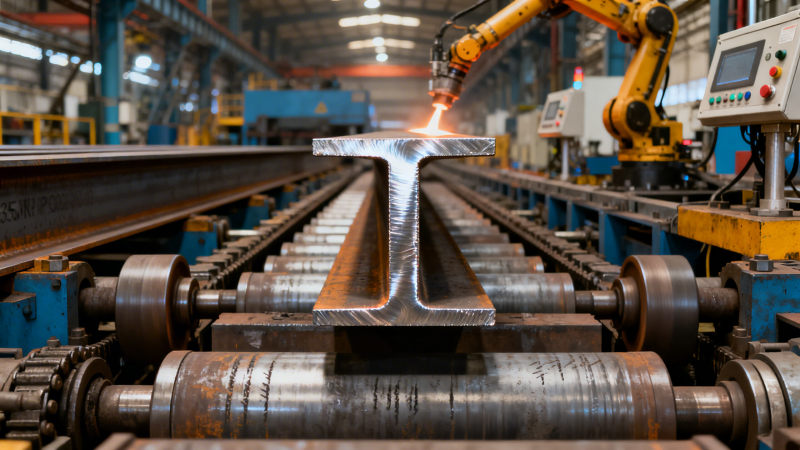
GCC Local Production: Cost Drivers & Market Realities
The Gulf Cooperation Council (GCC) countries—including Saudi Arabia, UAE, Qatar, Kuwait, Oman, and Bahrain—have significantly expanded domestic structural steel capacity since 2020. Major mills like Qatalum (Qatar), Emirates Steel (UAE), and Saudi Iron & Steel Company (Hadeed) now produce hot-rolled I-beams, channels, and angles conforming to ASTM A6/A6M and EN 10025–2. However, local factory pricing remains highly sensitive to raw material import dependency: over 75% of billet feedstock is sourced from India, Turkey, and China, exposing GCC producers to freight volatility and currency fluctuations against the USD.
A 2024 benchmark survey across Dubai and Riyadh found that average steel beam factory price in Middle East for standard S355JR IPE300 (6m length) ranged from USD 780–890/ton FOB GCC port. This includes 12–18% value-added tax (VAT) in most jurisdictions and 5–7% inland logistics surcharge for delivery beyond plant gate. Crucially, local mill MOQs remain stringent: minimum order quantities typically start at 50–100 tons per grade/specification—making them less viable for small-scale infrastructure upgrades or modular housing projects where flexibility matters more than scale.
In contrast, international suppliers like Hongteng Fengda offer tiered MOQ structures: as low as 5 tons for standard profiles (e.g., ASTM A36 angle steel), with scalable volume discounts above 30 tons. This directly addresses the pain point of mill MOQ vs trader MOQ steel for industrial applications, especially for contractors managing multiple concurrent sites across the GCC and Southeast Asia.
Imported Beams: Total Landed Cost Analysis
Imported structural steel—primarily from China, India, and Turkey—dominates niche segments requiring non-standard dimensions, tight tolerances, or dual-certified materials (e.g., ASTM + EN). For example, a project in Doha specifying EN 10219 cold-formed hollow sections with fire-resistance coating will often source from Chinese manufacturers due to faster customization cycles and broader dimensional availability.
Below is a representative landed cost comparison for 20-ton shipment of ASTM A992 W12×50 I-beams (12m length), CIF Jebel Ali Port:
This analysis confirms that even after freight and duties, imported beams can deliver 5–12% net savings—especially when factoring in standard vs custom steel lead time for industrial buyers. While GCC mills quote 8–12 weeks for custom orders, Hongteng Fengda maintains 4–6 week lead times for standard specs and 7–9 weeks for engineered components—critical for fast-tracked infrastructure timelines.
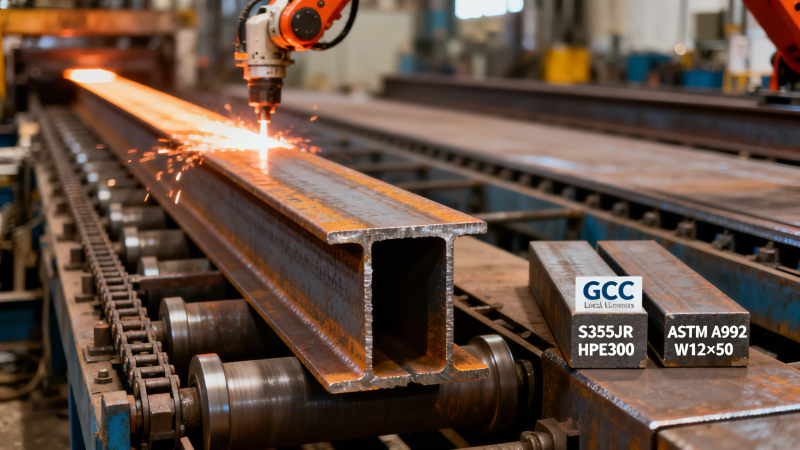
Technical Selection Guide: From Weight Calculations to Structural Suitability
Accurate specification starts with precise calculation. To how to calculate i beam weight for industrial projects, use the formula: Weight (kg/m) = Cross-sectional Area (cm²) × Density of Steel (7.85 g/cm³). For W12×50 (ASTM), area = 94.8 cm² → weight ≈ 74.4 kg/m. Digital tools like Hongteng Fengda’s online beam calculator (integrated with EN, ASTM, and GB section libraries) automate this—and cross-check moment capacity, deflection limits, and fire-rating compliance.
When comparing I beam vs H beam for residential construction, key distinctions emerge: I-beams feature tapered flanges ideal for bending-dominated loads (e.g., roof trusses); H-beams have parallel flanges offering superior axial load resistance—making them preferred for multi-story column systems. Both are available in galvanized, painted, or fireproofed variants. For marine or coastal infrastructure, corrosion resistance becomes decisive: 316L stainless steel pipe is frequently specified alongside carbon steel beams in splash zones due to its molybdenum-enhanced chloride resistance—complementing structural framing with critical service-line integrity.
Beyond beams, regional demand patterns reveal strategic opportunities: The Steel I Beam supplier in Malaysia for infrastructure projects faces rising demand for pre-fabricated bridge girders; meanwhile, Philippine industrial plants prioritize Angle Steel price per ton Philippines for industrial use with mill-certified weldability reports (EN 10204 3.1). These localized requirements underscore why global partners must combine regional market intelligence with flexible manufacturing—not just commodity pricing.
Quality Assurance & Compliance: Beyond the Price Tag
Lowest price ≠ lowest risk. In 2023, GCC authorities rejected 11.3% of imported structural steel shipments due to non-conforming tensile strength, inconsistent chemical composition, or missing traceability documentation. Hongteng Fengda mitigates this through triple-layer quality control: raw material spectrographic verification, in-process ultrasonic testing on all rolled sections, and final third-party inspection (SGS/BV) with full EN 10204 3.2 certification. Every batch carries heat number traceability, enabling full audit trails for safety-critical applications—from desalination plant supports to metro rail viaducts.
This rigor extends to specialty alloys. For food-grade or marine environments, material selection transcends basic carbon steel. While 201 vs 304 stainless steel cost for food industry comparisons focus on nickel content and pitting resistance, applications demanding extreme chloride exposure—such as offshore platforms or seawater intake systems—require the superior performance of 316L stainless steel pipe, which demonstrates significantly improved corrosion resistance, high-temperature stability, and mechanical properties compared to the base 304 stainless steel pipe.
For architectural façades, stainless steel square bar for architectural use demands surface finish consistency (BA or No.4 polish) and tight dimensional tolerance (±0.1mm)—capabilities validated through ISO 9001:2015 and EN 10088–3 audits. Similarly, stainless steel bar for marine applications must meet ASTM A276 with Charpy V-notch impact testing at –46°C. These granular requirements prove that sourcing decisions hinge not only on steel beam factory price in Middle East, but on verifiable process discipline.
Strategic Sourcing Recommendations for 2024
Procurement professionals should adopt a hybrid sourcing model: leverage GCC mills for time-sensitive, standard-spec deliveries within 200 km radius; partner with agile exporters like Hongteng Fengda for custom engineering, multi-country logistics coordination, and extended warranty support (up to 24 months on coated products). This balances local responsiveness with global scalability—reducing total cost of ownership by up to 18%, according to a 2024 McKinsey infrastructure procurement study.
Key action steps include: • Request detailed breakdowns of “factory price” — clarify whether it includes cutting, marking, bundling, or mill test reports; • Validate MOQ flexibility: ask for tiered pricing down to 5-ton lots for pilot batches; • Audit lead time guarantees in writing—include penalties for delay beyond agreed milestones; • Require digital BIM-ready section files (IFC/DWG) for seamless integration into design workflows.
Hongteng Fengda supports this approach with dedicated Middle East project managers fluent in Arabic and English, real-time production tracking dashboards, and technical advisory services—from how to calculate i beam weight for industrial projects to metallurgical review of welding procedures. As infrastructure investment accelerates across the GCC, reliability, compliance, and speed are no longer differentiators—they’re prerequisites.
Ready to optimize your structural steel procurement? Get a tailored quotation, MOQ confirmation, and lead time validation within 24 hours. Contact Hongteng Fengda today for expert support on steel beam factory price in Middle East, mill MOQ vs trader MOQ steel for industrial applications, and end-to-end supply chain assurance.
- steel i
- steel i beam supplier
- h beam
- carbon steel beams
- angle steel
- a36 angle
- steel pipe
- ASTM A36
- structural steel
- steel beams
- Structural Steel
- I-Beam
- Steel Beams
- 304 stainless steel pipe
- 316L stainless steel pipe
- stainless steel pipe
- Profile
- H-beam
- standard vs custom steel lead time
- mill MOQ vs trader MOQ steel
- S355JR
- Galvanized
- Steel I Beam supplier in Malaysia
- Angle Steel price per ton Philippines
- how to calculate i beam weight
- I beam vs H beam
- steel beam factory price
- Steel Beam
- 201 vs 304 stainless steel cost
- stainless steel square bar
- stainless steel bar
- carbon steel
- steel bar
- i beam weight
- stainless steel bar for marine applications
- stainless steel square bar for architectural use
- 201 vs 304 stainless steel cost for food industry
- steel beam factory price in Middle East
- I beam vs H beam for residential construction
- how to calculate i beam weight for industrial projects
- Angle Steel price per ton Philippines for industrial use
- Steel I Beam supplier in Malaysia for infrastructure projects
- mill MOQ vs trader MOQ steel for industrial applications
- standard vs custom steel lead time for industrial buyers
Related recommendations
 What Drives Angle Steel Price Changes in Building Frame ProjectsAngle steel price changes can reshape building frame budgets. Learn the key drivers behind fluctuations and how to secure stable, cost-effective sourcing.
 Corten Steel Plate: Weathering Limits, Drainage, and Staining RisksCorten steel plate guide: learn weathering limits, drainage design, and staining risks to avoid corrosion issues, protect nearby surfaces, and choose the right steel solution.
 What Drives Steel Rod Price Changes in Building Projects?Steel Rod price changes can reshape construction budgets fast. Learn what drives costs—from steel, zinc, specs, compliance, and lead times—to make smarter, lower-risk buying decisions.
 Galvanized Pipe Specifications: Which Standards Matter for Water and Gas Lines?Galvanized pipe specifications determine whether water and gas lines pass code, pressure, and coating checks. Learn which standards matter most to avoid costly approval and installation risks.
Please give us a message


Please enter what you want to find