Why do galvanized pipe specifications matter so much for utility lines?
For a technical evaluator, the real issue is not whether a pipe is simply “galvanized.” The issue is whether its specification matches the service condition, the target market, and the project documents. Water and gas lines may look similar on a drawing, but they are usually judged by different acceptance criteria: pressure class, coating method, dimensional tolerance, thread quality, leak tightness, and chemical compatibility all come into play.
That is why reviewing galvanized pipe specifications is a compliance task as much as a material selection task. A pipe that is acceptable for one utility may create approval problems, installation delays, or corrosion concerns in another. The safest approach is to read the standard designation, grade, coating description, and test records together rather than treating galvanizing as a standalone feature.
Which standards are usually checked first for galvanized steel pipe?
Start with the governing product standard, then move to coating and test requirements. In international procurement, common reference systems include ASTM, EN, JIS, and GB. The exact code depends on the project location and the engineering specification, but the review logic is consistent: first confirm the pipe manufacturing standard, then confirm whether the zinc coating and inspection requirements are stated separately or built into that standard.
A practical screening table looks like this:
A standard name on its own is not enough. You need the full callout, including size series, schedule or wall designation where applicable, end type, and coating description.
Are the same galvanized pipe specifications suitable for both water and gas lines?
Not automatically. That assumption causes a lot of procurement mistakes. Water service often focuses on corrosion behavior, internal cleanliness, pressure handling, and compatibility with potable or non-potable service requirements set by the project. Gas service puts more attention on pressure containment, joint integrity, threading quality, and any code restrictions tied to fuel gas installations.
In some markets, galvanized steel may still appear in certain water distribution or non-critical service lines, while gas applications may be more restricted by local installation codes or owner specifications. So the evaluator should not ask only, “Does this pipe meet a steel standard?” The better question is, “Does this exact pipe specification match the utility code, joining method, and approval path for this service?”
When the answer depends on jurisdiction, review three documents together: the design basis, the local code adopted for the project, and the supplier’s mill or inspection documentation. That combination usually tells you more than the catalog page.
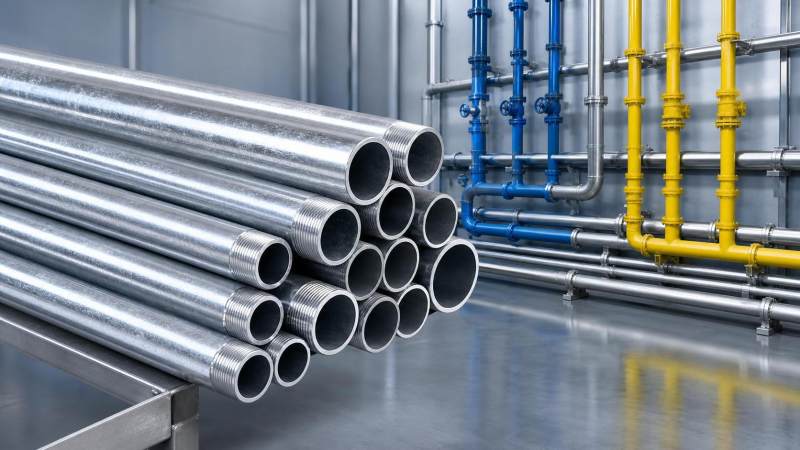
What should be checked in the coating specification, beyond “galvanized”?
You want the coating process and acceptance criteria, not just the word. Hot-dip galvanized and electro-galvanized finishes do not behave the same way. For utility piping, evaluators usually need to know whether the coating is intended for external corrosion protection only or whether the internal surface condition also matters for the service.
Key fields worth checking include:
- Coating method stated in the product documentation
- Coverage on internal and external surfaces
- Surface continuity after threading, cutting, or welding preparation
- Inspection method for coating thickness or finish quality
- Any repair procedure allowed for damaged zinc areas
A common oversight is approving galvanized pipe based on external appearance only. Bright finish does not confirm coating mass, adhesion, or consistency at ends and threads. If the system includes field fabrication, the zinc condition after processing becomes part of the performance review.
Which pressure and dimensional details usually decide acceptance?
For utility service, nominal size alone tells you very little. Acceptance often turns on wall thickness, outside diameter tolerance, end preparation, and the required hydrostatic or other pressure-related testing defined by the applicable standard. If the project uses threaded joints, dimensional accuracy becomes even more sensitive because poor thread engagement can turn a compliant pipe into a leaking installation.
Technical evaluators should compare the supplier’s submitted dimensions against the exact specification on the approved material list. “Equivalent” is risky if the standard system differs. One schedule or wall series cannot be assumed interchangeable with another without confirming design intent, joint type, and code acceptance.
What documents actually prove compliance?
In practice, you need a document set, not a single certificate. A workable review package usually includes:
- Product datasheet with full specification callout
- Mill test certificate showing material identity and relevant test results
- Inspection or quality record covering coating and dimensional checks
- Marking details tying the delivered pipe back to the paperwork
- Any project-required third-party documents if specified by contract
If the paperwork cannot connect the delivered bundle to the stated standard, that is a traceability problem, not just a filing problem. For export supply, manufacturers serving multiple markets often work across ASTM, EN, JIS, and GB frameworks, so it is worth checking whether the submitted documents clearly show which standard governs the shipment rather than listing several standards in a general way.
Where do technical evaluations usually go wrong?
Most failures happen in the gaps between documents. The pipe may match one standard, the coating may match another, and the project may require a third layer of approval that no one checked. Another frequent error is focusing on base steel grade while ignoring end use restrictions for potable water systems or gas service codes.
The highest-risk mistakes are usually these:
- Ordering by trade name instead of full standard and end condition
- Assuming all galvanized pipe is hot-dip galvanized
- Missing the effect of threading or cutting on zinc protection
- Accepting multi-standard claims without checking the primary governing specification
- Using water-line logic to approve gas-line material, or the reverse
Those are not theoretical issues. They are the kind that delay site acceptance and trigger replacement costs after delivery.
Does the supplier’s broader steel capability matter during evaluation?
Yes, especially if your project includes both piping and structural packages. A supplier that already works with multiple steel standards and custom fabrication routes is usually better positioned to align documentation, tolerances, and export packaging across the order. That does not replace product-specific review, but it reduces coordination risk.
For example, in projects where galvanized utility elements are procured alongside cold-formed structural members, evaluators often need consistent treatment of standards, coating descriptions, and processing tolerances across the package. A related item such as C-beam may be supplied in Q195, Q235, Q345, A36, SS400, or S235JR, with galvanized coated surfaces, thickness from 1 mm to 12 mm, and processing services such as bending, welding, punching, decoiling, and cutting. That kind of range is useful when structural and utility steel procurement need to stay aligned under one quality system.
How should a technical evaluator compare quotations for galvanized pipe?
Do not compare price sheets until the specification basis is normalized. One quotation may include testing, threaded ends, couplings, coating inspection, and traceable marking, while another may quote bare product with less documentation. The lower number can disappear quickly once missing compliance items are added back.
A practical review sequence is:
- Confirm the exact governing standard and utility service.
- Match dimensions, wall designation, and end condition.
- Check coating method and inspection scope.
- Review certification and traceability package.
- Only then compare lead time, unit price, and shipping terms.
That sequence keeps commercial decisions from outrunning technical acceptance.
What is the best final rule for approving galvanized pipe specifications?
Approve the pipe only when four points line up: the project standard, the utility service, the physical pipe details, and the supporting documents. If one of those is vague, the review is still incomplete. In water and gas line procurement, most expensive mistakes come from partial matches that looked acceptable at first glance.
A solid technical decision usually comes from reading the standard callout, coating description, pressure-related requirements, and traceability records as one package. That is the level of review galvanized pipe specifications deserve when the line will carry an essential utility.
Please give us a message


Please enter what you want to find