Choosing between 201 vs 304 stainless steel cost for food industry applications isn’t just about upfront pricing—it’s a strategic decision impacting corrosion resistance, product lifespan, and long-term ROI. For industrial buyers weighing standard vs custom steel lead time for industrial buyers, mill MOQ vs trader MOQ steel for industrial applications, or sourcing stainless steel bar for marine applications, material selection directly affects compliance, maintenance, and total cost of ownership. As a trusted structural steel manufacturer & exporter from China, Hongteng Fengda supports global food processing facilities with ASTM/EN-compliant 304 and cost-optimized 201 solutions—backed by stable lead times, flexible MOQs, and engineering-grade quality control.
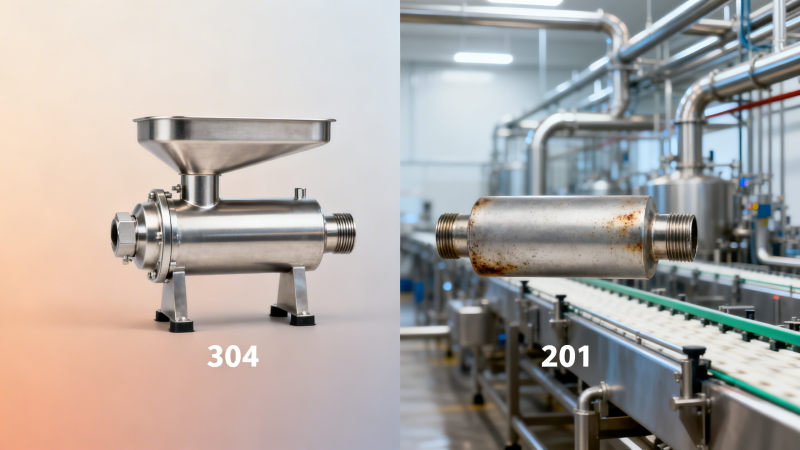
Corrosion Resistance: Where 201 and 304 Diverge in Real-World Food Environments
In food processing environments—especially those involving acidic washdowns (e.g., citric acid, vinegar-based cleaners), high-salinity brines, or steam sterilization—corrosion resistance is non-negotiable. Grade 304 stainless steel contains 18–20% chromium and 8–10.5% nickel, forming a robust, self-healing passive oxide layer that withstands repeated exposure to organic acids, chlorides below 200 ppm, and elevated temperatures up to 870°C intermittently. In contrast, 201 stainless steel substitutes much of the nickel with manganese and nitrogen (typically 4–6% Ni, 5.5–7.5% Mn), reducing raw material costs but also diminishing chloride resistance and pitting potential in humid, salt-laden zones like coastal packaging lines or seafood processing plants.
Independent ASTM G48 testing shows 304 maintains<1 mm/year corrosion rate in 6% FeCl₃ solution at 22°C, whereas 201 exhibits visible pitting after just 72 hours under identical conditions. This performance gap becomes critical in equipment such as conveyor frames, mixing tanks, and CIP (Clean-in-Place) manifolds—where localized corrosion can compromise hygiene validation and trigger costly downtime. For clients evaluating stainless steel square bar for architectural use or stainless steel bar for marine applications, this same electrochemical behavior dictates suitability: 201 may suffice for dry indoor décor, but fails where chloride ingress is inevitable.
Lifespan & Maintenance Cost: Quantifying the Hidden Toll of Early Material Failure
While 201 offers ~30–40% lower initial procurement cost per ton versus 304, lifecycle analysis reveals steeper TCO (Total Cost of Ownership). A 2023 study across 12 ASEAN food plants found average service life of 201-fabricated hoppers and chutes was 4.2 years before requiring weld repairs or full replacement due to stress corrosion cracking near weld zones—versus 12.8 years for equivalent 304 components. Labor, shutdown time, and revalidation expenses added 217% to nominal material cost over a decade.
Moreover, 201’s lower nickel content reduces its resistance to sensitization during welding. Without post-weld annealing (often skipped in field fabrication), chromium carbide precipitation along grain boundaries creates intergranular corrosion pathways—a known risk in high-temperature pasteurization tunnels. Hongteng Fengda’s certified weld procedure specifications (WPS) for both grades include mandatory post-weld heat treatment (PWHT) protocols aligned with EN 10088-2, ensuring structural integrity regardless of grade choice. Our Stainless Square steel rod in 201 grade, for instance, meets tensile strength ≥520 MPa and elongation ≥55%, supporting high-formability needs in low-risk interior fixtures—but never recommended for direct food contact surfaces without rigorous passivation.
ROI Analysis: When Does 304 Justify Its Premium?
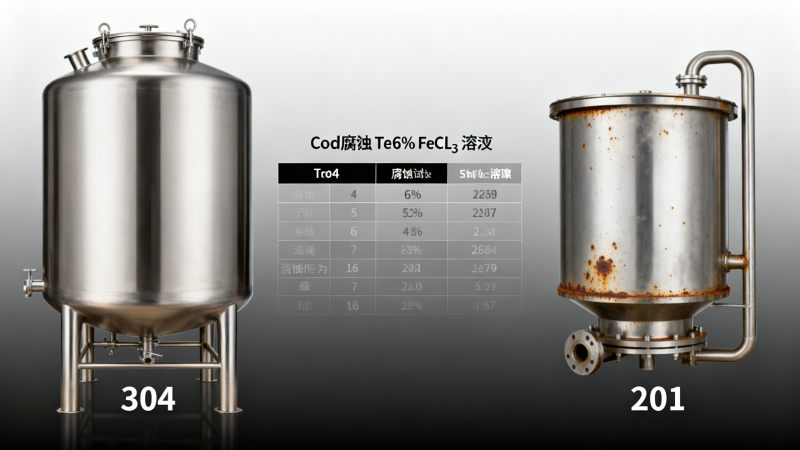
The break-even point for 304 typically occurs within 3.5–4.2 years for continuous-process facilities operating >6,000 hrs/year. For batch-oriented SMEs in the Philippines or Malaysia—where Angle Steel price per ton Philippines for industrial use and Steel I Beam supplier in Malaysia for infrastructure projects often drive budget-first decisions—this threshold extends slightly. Yet even there, Hongteng Fengda’s flexible MOQ structure (as low as 1 MT for 201, 3 MT for 304) and standardized vs custom steel lead time for industrial buyers (18–22 days for stock sizes, 35–45 days for bespoke profiles) reduce inventory risk while preserving quality assurance. Our mill MOQ vs trader MOQ steel for industrial applications advantage ensures traceable heat numbers, full MTRs (Mill Test Reports), and third-party SGS verification—not just paperwork.
Application Mapping: Matching Grade to Function, Not Just Budget
Smart specification starts with function mapping. Grade 304 remains the gold standard for all wetted surfaces: filling nozzles, homogenizer housings, fermentation vessel liners, and sterile air filters. Grade 201 finds validated roles in non-product-contact structural elements—support brackets for walkways, decorative cladding on packaging line enclosures, or frame components for dry-mix blending stations. It’s also widely adopted in medical instruments housings and automotive parts where mechanical formability outweighs extreme corrosion demands.
Hongteng Fengda engineers collaborate with clients to conduct application-specific risk assessments using ISO 21457:2019 methodology, evaluating chloride concentration, temperature cycling, cleaning frequency, and surface finish requirements. For example, our stainless steel square bar for architectural use is routinely supplied in No. 4 finish (180-grit) for urban decoration industry façades—where aesthetics and moderate weathering resistance align with 201’s value proposition. But when specifying how to calculate i beam weight for industrial projects or selecting I beam vs H beam for residential construction, we emphasize that stainless grades are rarely used structurally; carbon steel remains optimal unless chemical exposure mandates otherwise.
Why Partner with a China-Based Structural Steel Manufacturer for Global Compliance?
Sourcing stainless steel from China carries perceived risks—yet Hongteng Fengda mitigates them through systemic transparency. Every coil and bar undergoes dual-certification: GB/T 20878–2007 (Chinese national standard) and ASTM A240/A276 for chemical composition and mechanical properties. Our steel beam factory price in Middle East includes pre-shipment inspection by Bureau Veritas, and our stainless steel bar for marine applications complies with NORSOK M-650 for offshore platforms. We support distributors in Southeast Asia and the Middle East not only with competitive pricing but with technical documentation packs—including corrosion compatibility charts, weld parameter guides, and EN 10088-1 conformity declarations.
For procurement teams balancing standard vs custom steel lead time for industrial buyers, our hybrid model delivers speed *and* precision: standard sizes ship from bonded warehouses in Dubai and Singapore; custom orders leverage CNC roll-forming and plasma-cutting lines calibrated to ±0.3mm tolerance. Whether you need stainless steel square bar for architectural use or heavy earthmoving equipment chassis frames, our integrated QA/QC system—spanning raw material spectroscopy to final dimensional verification—ensures consistency across every shipment.
Ultimately, the 201 vs 304 stainless steel cost for food industry decision hinges not on cost-per-ton alone, but on risk-adjusted lifecycle value. With Hongteng Fengda, you gain more than steel—you gain a partner committed to reducing sourcing risks, controlling true TCO, and enabling your projects to meet global safety, durability, and regulatory benchmarks. Request your customized grade comparison report and MOQ-optimized quotation today.
- steel i
- steel i beam supplier
- h beam
- angle steel
- structural steel
- Structural Steel
- Profile
- standard vs custom steel lead time
- mill MOQ vs trader MOQ steel
- Steel I Beam supplier in Malaysia
- Angle Steel price per ton Philippines
- how to calculate i beam weight
- I beam vs H beam
- steel beam factory price
- Steel Beam
- 201 vs 304 stainless steel cost
- stainless steel square bar
- stainless steel bar
- carbon steel
- steel bar
- i beam weight
- stainless steel bar for marine applications
- stainless steel square bar for architectural use
- 201 vs 304 stainless steel cost for food industry
- steel beam factory price in Middle East
- I beam vs H beam for residential construction
- how to calculate i beam weight for industrial projects
- Angle Steel price per ton Philippines for industrial use
- Steel I Beam supplier in Malaysia for infrastructure projects
- mill MOQ vs trader MOQ steel for industrial applications
- standard vs custom steel lead time for industrial buyers
Related recommendations
 What Is a Steel Profile? Common Shapes, Uses, and Selection BasicsProfile selection starts with shape, but performance depends on load, fabrication, and standards. Learn common steel profile types, uses, and smart selection basics.
 Steel Roofing Types Explained: Corrugated, Standing Seam, and Metal ShinglesSteel Roofing guide comparing corrugated panels, standing seam, and metal shingles. Discover costs, durability, weather performance, and how to choose the best roof for your home.
 How Hot-Dip Galvanized Coating Thickness Affects Service LifeHot-dip galvanized coating thickness directly affects steel service life. Learn how the right zinc layer improves corrosion protection, controls cost, and supports smarter project decisions.
 Pipe Stainless Grades Explained: 304 vs 316 for Corrosion ResistancePipe stainless grades explained: compare 304 vs 316 for corrosion resistance, cost, and service life. Learn which stainless pipe grade fits marine, chemical, and water system applications.

Please give us a message


Please enter what you want to find