Corten Steel Plate: Weathering Limits, Drainage, and Staining Risks
Corten steel plate is often chosen because it can do two jobs at once: carry structural load and create a finished architectural surface. That combination is attractive on bridges, facades, retaining elements, screens, and industrial structures where owners want a durable material without conventional paint systems. But the material is frequently misunderstood. Weathering steel is not a “fit anywhere” solution, and many field problems come from detailing rather than from the plate itself.
For project teams, the real question is not whether corten steel plate can form a protective patina. It usually can under the right exposure conditions. The question is whether the actual site, drainage path, surrounding materials, and maintenance expectations allow that patina to stabilize instead of remaining active and messy. If those conditions are ignored, the result can be persistent runoff staining, accelerated corrosion at traps and joints, or disappointing appearance after installation.
That matters early in the specification stage, because once the material is on the building or structure, design corrections are much more expensive than material selection corrections.
Weathering steel works well, but only in the right exposure cycle
The basic principle is well known: a stable oxide layer develops on the surface and slows further corrosion. What is less appreciated is that this process depends on alternating wet and dry periods. If corten steel plate remains wet for long periods, the protective layer may not mature properly. Instead of a dense, adherent patina, the surface can continue to shed rust and lose section faster than expected.
This is why weathering steel is usually a stronger candidate for open atmospheric exposure than for locations with constant dampness, salt deposition, standing water, or trapped debris. Coastal projects, marine splash zones, tunnel-like enclosed areas, shaded drainage pockets, and deicing salt environments all require closer review. In some cases, weathering steel may still be used, but only with very deliberate detailing or with acceptance that appearance and maintenance will differ from the clean “aged patina” image often shown in concept renderings.
For bridge and infrastructure teams, local microclimate matters more than generic material popularity. A dry inland exposure behaves very differently from a humid site with repeated chloride contamination. The plate grade alone does not solve that.
Most failures begin at details: flat ledges, crevices, and blocked water paths
When weathering steel underperforms, the root cause is often simple: water stayed where it should have drained away. Horizontal surfaces, back-to-back plates, bolted lap joints, recessed fastener zones, and base connections can all collect moisture and contamination. Even small geometry decisions can change long-term behavior.
A practical review before approval should include questions like these:
- Will rainwater drain freely, or can it pond on a horizontal edge?
- Do stiffeners, returns, cover plates, or trim details create hidden moisture traps?
- Can debris accumulate and hold moisture against the steel?
- Will runoff pass over concrete, stone, glass, paint, or other visible surfaces?
- Are there sheltered areas that stay damp while the exposed face dries normally?
Those questions sound basic, but they often determine whether the patina becomes a benefit or a recurring defect item.
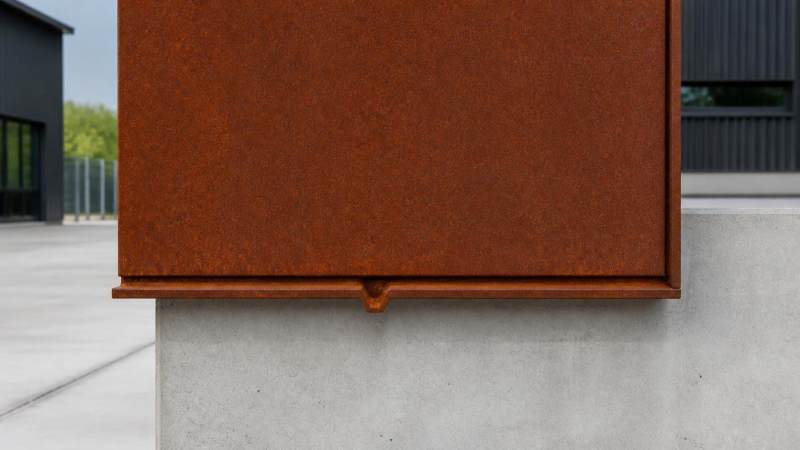
Drainage design is not a side issue
Drainage is sometimes treated as an architectural coordination detail. With corten steel plate, it is a material performance issue. Rust-colored runoff is normal in the early weathering stage, and sometimes it continues longer in slow-drying conditions. If water runs onto adjacent concrete, precast, natural stone, render, or paving, staining can be difficult or impossible to remove completely.
That means runoff paths should be designed, not left to chance. Drip edges, stand-off spacing, drainage gaps, projection geometry, and collection channels can all reduce visible staining. On facade work, even a small offset from the substrate can help prevent concentrated streaking behind panels. On landscape and civil work, keeping runoff away from light-colored surfaces usually avoids later arguments about whether the steel or the installer is to blame.
In mixed-material projects, it is often smarter to decide early which areas can tolerate rust runoff and which cannot. Once that map is clear, weathering steel can be limited to suitable zones while more corrosion-resistant materials are used where water chemistry or cleanliness matters more. For process, petroleum, or chemical sites, teams sometimes pair weathering steel structures with stainless components in critical service lines or corrosive utility areas, depending on exposure and media. In those cases, products such as 316L stainless steel pipe are selected not for appearance but for their stronger resistance in chlorine-, salt-, or corrosive-media environments, along with good fabrication performance for bending, welding, cutting, and forming.
Where staining risk is highest
Not every project has the same staining exposure. Some configurations create more complaints than others.
This is where project managers can save time: if staining would be unacceptable to the owner, do not assume cleaning later will solve it. Design to prevent it.
Specification decisions that deserve more attention
A good weathering steel specification is more than a plate grade callout. It should reflect service environment, fabrication method, finish expectations, connection details, and inspection logic. The plate may meet ASTM, EN, JIS, or GB-related procurement expectations, but project success still depends on how the fabricated assembly handles water and contaminants.
Fabrication and supply discipline matter here. Structural steel suppliers serving export markets usually see that the same nominal design can perform differently once local climate, erection sequence, and finishing expectations are factored in. Manufacturers such as Hongteng Fengda, which supply structural sections, beams, cold formed profiles, and customized steel components to projects across North America, Europe, the Middle East, and Southeast Asia, tend to support buyers best when discussions go beyond dimensions and tonnage. The useful conversation is about standards compliance, connection detailing, drainage assumptions, and how site conditions may affect long-term appearance.
For custom assemblies, it is also worth checking whether shop handling, temporary storage, and packing conditions could influence early surface behavior. Wet-stacked material or contaminated storage areas can create uneven initial weathering before the steel ever reaches the site.
What project managers should verify before approval
If corten steel plate is under consideration, a short review checklist can prevent long follow-up meetings later:
- Confirm whether the site has regular wet-dry cycling or prolonged dampness.
- Identify chloride sources such as marine atmosphere, deicing salts, or industrial contamination.
- Review all horizontal and hidden surfaces for water retention.
- Trace runoff onto nearby materials and ask what happens during the first year, not just after full weathering.
- Clarify appearance expectations: uniform patina is not immediate, and some variation is normal.
- Check whether maintenance access exists for cleaning debris from drainage paths and recesses.
That review is especially important on projects where the material is chosen for both engineering and visual reasons. Structural acceptance and owner acceptance are not always the same thing.
A realistic way to think about lifecycle cost
Weathering steel is often evaluated against painted carbon steel or stainless alternatives. The comparison should not stop at initial material price. For some structures, avoiding a full paint system is a real advantage. For others, drainage modifications, staining mitigation, more careful detailing, or future cleaning can offset part of that benefit.
That does not mean corten steel plate is risky by default. It means the cost case is strongest when exposure is appropriate and details are disciplined. In the wrong environment, a theoretically lower-maintenance material can become the one that creates the most discussion after handover.
Where corrosive media, salt, or process exposure exceed what weathering steel handles comfortably, mixing materials may be the more rational route. Structural framing and architectural screens may remain in weathering steel, while piping or utility components move to stainless grades such as 316L stainless steel pipe in round, square, or rectangular forms where corrosion resistance is the controlling requirement.
Use it deliberately, not decoratively
The appeal of corten steel plate is real, and in suitable conditions it can perform very well. But the material rewards disciplined project thinking. If the design allows drainage, avoids traps, respects local exposure, and protects adjacent finishes from runoff, weathering steel can be a durable and credible choice. If those basics are neglected, the same material can generate staining claims, appearance disputes, and avoidable rework.
Before release, it is worth asking three direct questions: Will this assembly dry properly? Where will the runoff go? And what nearby surfaces will show the consequences if the answer is wrong? If those are resolved early, material selection becomes much more reliable.
Please give us a message


Please enter what you want to find