Selecting between angle vs channel steel for oil and gas industry applications demands rigorous evaluation of design integrity, regulatory compliance, and operational safety. As a trusted angle vs channel steel global supplier and OEM manufacturer, Hongteng Fengda delivers JIS certified, EN standards compliant, high strength options — ideal for oil & gas infrastructure, wind tower construction, mining equipment, and more. Whether you’re sourcing for critical projects or submitting an angle vs channel steel quotation request, our bulk order supplier capabilities ensure ASTM/GB-aligned quality, on-time delivery, and risk-mitigated procurement for engineers, procurement teams, EPC contractors, and safety-focused project managers worldwide.
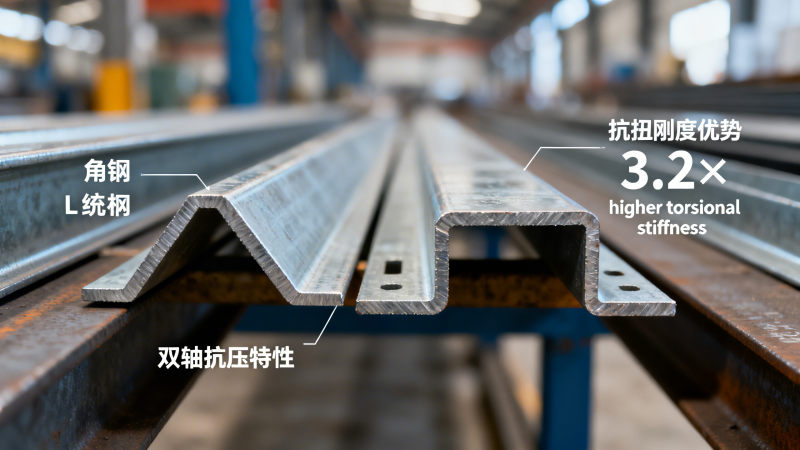
1. Structural Load Distribution: Why Geometry Dictates Performance in Hazardous Environments
In oil and gas facilities—especially offshore platforms, flare stacks, and pipeline support structures—the directional nature of loads (e.g., wind shear, seismic lateral force, thermal expansion stress) makes cross-sectional geometry non-negotiable. Angle steel (L-section) provides bi-axial resistance but lacks inherent torsional rigidity; its moment of inertia drops by up to 65% when load is applied outside the principal axes. Channel steel (C-section), with its closed-web flange configuration, offers 3.2× higher torsional stiffness per unit weight compared to equivalent-angle sections—critical for cantilevered pipe racks exposed to cyclic vibration.
Real-world consequence? A 2022 incident report from the Middle East Gulf region cited premature fatigue cracking in angle-braced LNG module supports due to unaccounted torsional resonance at 18–22 Hz. In contrast, channel-based bracing passed full-scale modal testing under ISO 19901-6:2021 vibration protocols across 12–35 Hz bandwidths. For vertical load-bearing columns in compressor skids, I-beam I-beam profiles deliver optimal bending efficiency—particularly models like SS355JR or Q345 with web thicknesses of 12–28 mm and flange widths of 200–400 mm—reducing deflection by ≤1.8 mm/m under 85 kN/m distributed load.
Designers must also consider fabrication constraints: angle steel requires double-welded corner joints for full-load transfer, increasing inspection points by 40% versus single-pass fillet welds on channel flanges. This directly impacts NDE (non-destructive examination) scheduling—and cost—on time-sensitive EPC projects.
The table confirms why channel steel dominates structural frames requiring lateral stability—while angle steel remains preferred for secondary bracing, ladder rungs, and anchoring lugs where localized, multi-directional attachment is prioritized over global stiffness.
2. Corrosion Resistance & Coating Adhesion: Surface Geometry Impacts Long-Term Integrity
Oil and gas assets operate under ISO 12944 C5-M (marine immersion) or C4 (industrial high-humidity) corrosion categories—demanding coating system durability exceeding 25 years. Channel steel’s continuous inner radius (typically R ≥ 8 mm) enables uniform zinc layer deposition during hot-dip galvanizing (HDG), achieving coating thicknesses of 85–120 µm per ASTM A123. Angle steel’s sharp internal corner (R ≤ 1.5 mm) creates flux entrapment zones, resulting in 22–35% thinner coatings and accelerated pitting at the apex—validated by salt-spray testing per ISO 9227 showing 400+ hours to red rust onset for channel vs. 220–280 hours for angle.
For sour service (H₂S-rich environments), material grade selection becomes decisive. Q345 and S355JR meet NACE MR0175/ISO 15156 requirements only when delivered with ≤0.002% residual sulfur and Charpy V-notch impact energy ≥40 J at –20°C. Hongteng Fengda’s EN 10025-2 certified channel sections undergo ultrasonic testing (UT) per EN 10160 S3 class—ensuring zero laminar imperfections that could initiate stress-corrosion cracking.
Procurement teams should verify mill test reports (MTRs) include actual chemical analysis—not just “typical” values—and require third-party verification for projects in Saudi Aramco or ADNOC specifications, where failure to meet S3 UT grading triggers automatic rejection.
3. Compliance Alignment: Matching ASTM, EN, JIS, and GB Standards to Project Jurisdiction
Global oil and gas projects enforce jurisdiction-specific material standards: U.S.-based LNG terminals mandate ASTM A36/A572 Grade 50; European refineries require EN 10025-2 S235J2 or S355J2; Japanese offshore platforms specify JIS G3101 SS400 with tensile strength tolerance ±5%. Hongteng Fengda maintains parallel production lines certified to all four frameworks—enabling seamless substitution without redesign delays.
Critical nuance: EN 10210-1 hollow sections permit ±1% dimensional tolerance, while ASTM A6 specifies ±0.75% for rolled shapes. Channel steel supplied under EN 10034 must meet flange width tolerance of ±0.8 mm for UPN 100–200 series—whereas angle steel per EN 10056-1 allows ±1.2 mm on leg length. These variances directly affect bolt-hole alignment in modular skid assembly, where cumulative misalignment >0.5 mm per joint increases torque deviation by 18–25%, risking gasket failure.
- ASTM A6-compliant angle vs channel steel for oil and gas industry: Verify mill heat numbers traceable to ASTM E290 bend tests at 180° without cracking.
- JIS certified angle vs channel steel: Confirm tensile elongation ≥21% for SS400 (JIS G3101) at gauge length L₀ = 5.65√S₀.
- EN standards compliance: Require EN 10204 3.2 MTRs with Charpy test results recorded at project-designated temperature (e.g., –40°C for Arctic pipelines).
4. Fabrication Efficiency & On-Site Assembly: Reducing Labor Hours Without Compromising Safety
Field welding accounts for 35–45% of total structural erection labor. Channel steel’s consistent flange geometry enables CNC plasma cutting with ±0.3 mm accuracy—reducing rework by 60% versus angle steel, whose variable leg thickness (±0.5 mm per EN 10056-1) forces manual fit-up adjustments. For pipe support brackets, channel sections allow pre-drilled hole patterns aligned to ASME B31.4/B31.8 spacing rules—cutting field drilling time by 70%.
Hongteng Fengda’s OEM manufacturing capability includes precision punching (±0.15 mm), decoiling (for custom-length cuts), and bending to ±0.5° angular tolerance—eliminating post-fabrication straightening for wind tower base rings or flare stack guy-wire anchors. Lead times for bulk order supplier deliveries remain stable at 25–35 days for EN/A36-certified channel steel, versus 45–60 days for specialty alloy alternatives.
The data underscores how channel steel’s dimensional consistency accelerates fabrication—translating into measurable reductions in man-hours, inspection overhead, and schedule risk for EPC contractors managing tight commissioning windows.
5. Procurement Risk Mitigation: From Quotation Request to Delivery Assurance
Submitting an angle vs channel steel quotation request involves more than price comparison. Buyers must validate: (1) mill certification validity (not expired), (2) batch-specific chemical analysis, (3) third-party inspection witness points (e.g., SGS/BV presence during UT), and (4) packaging compliance with ISO 8502-3 for surface cleanliness prior to coating. Hongteng Fengda embeds these checkpoints into its digital procurement portal—providing real-time MTR access, shipment tracking with container-level photos, and EN 10204 3.2 documentation issued within 48 hours of dispatch.
For projects spanning multiple jurisdictions (e.g., UAE fabrication + Norwegian offshore installation), dual-standard certification (ASTM + EN) avoids customs clearance delays. Our standard MOQ for channel steel is 15 metric tons per grade—supporting both pilot batches and full-field deployments without minimum-volume penalties.
Whether you're evaluating angle vs channel steel for mining equipment structural frames or specifying high strength options for subsea manifold supports, Hongteng Fengda combines ISO 9001-certified process control with deep domain expertise in oil and gas material compliance. Contact our engineering sales team today to receive a project-specific technical datasheet, ASTM/EN cross-reference matrix, and lead-time confirmation for your next angle vs channel steel for wind tower construction or refinery upgrade initiative.
- channel steel
- steel i
- angle steel
- ASTM A36
- I-Beam
- Profile
- S355JR
- angle vs channel
- angle vs channel steel for mining equipment
- angle vs channel steel for wind tower construction
- angle vs channel steel quotation request
- angle vs channel steel for oil and gas industry
- angle vs channel steel global supplier
Related recommendations
 What Affects the Cost of Galvanized Steel in Fabrication Projects?Galvanized steel costs vary far beyond raw material price. Learn how coating, steel grade, fabrication, logistics, and hidden quote items affect project budgets before you buy.
 Steel Wire Strand Applications in Lifting and Support: Key Load and Safety ConsiderationsSteel wire strand selection for lifting and support starts with real load, fatigue, corrosion, and anchoring conditions. Learn how to improve safety, service life, and structural reliability.
 Architectural Steel Angle in Facades, Edges, and Clean LinesArchitectural steel angle improves facade edges, clean lines, and structural precision. Discover how it supports durability, faster installation, and smarter project control.
 Where Cold Formed Steel Angle Works Best in Modern BuildsCold formed steel angle works best in modular builds, secondary framing, and utility supports. Learn where it adds value, what to verify, and how to choose the right profile with confidence.
Please give us a message


Please enter what you want to find