Need accurate, up-to-date I beam weight data for fast quoting, procurement, or structural verification? This 2024 I Beam Weight Chart delivers precise beams weight values across standard ASTM, EN, and GB sections—helping estimators calculate load capacity, procurement teams compare specs, and safety managers verify compliance. Whether you're learning how to measure a steel beam or sourcing weight of I beam for large-scale projects, this quick-reference guide supports engineers, contractors, and distributors worldwide. Backed by Hongteng Fengda’s 15+ years as a certified structural steel manufacturer and exporter from China, every value reflects real-world production tolerances and international standard adherence.
Understanding I Beam Weight: Definition & Core Principles
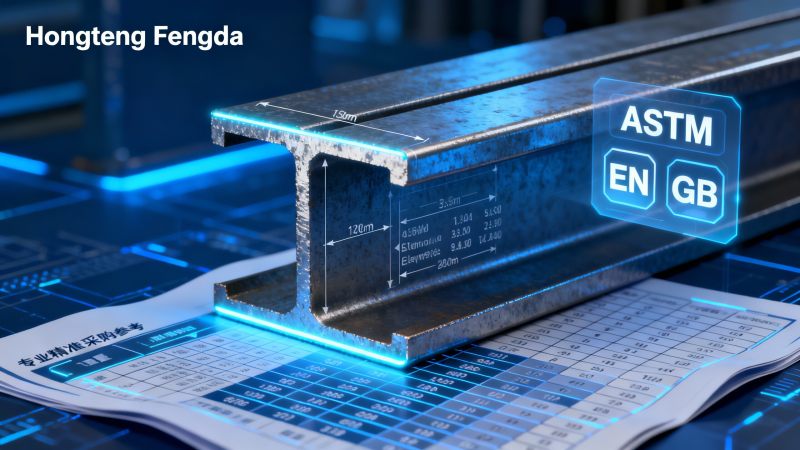
The weight of an I beam is not arbitrary—it’s derived from its cross-sectional geometry, material density (typically 7850 kg/m³ for carbon steel), and dimensional tolerances. Unlike simple rectangular bars, I beams feature flanges and webs with varying thicknesses, making manual calculation complex without standardized formulas. The most common method uses the formula: Weight (kg/m) = Cross-sectional Area (cm²) × Density (0.00785 kg/cm³). Yet in practice, professionals rely on verified charts—not calculations—to avoid margin-of-error risks during tendering or safety validation.
Why does accuracy matter? A 3% deviation in assumed weight can cascade into overdesign (wasting material costs) or underdesign (compromising structural integrity). For procurement teams ordering 200+ tons per shipment, even 0.5 kg/m variance adds up to ~1,000 kg extra—or missing—steel. That’s why Hongteng Fengda publishes weight data calibrated against actual mill test reports—not theoretical tables.
2024 Global I Beam Weight Reference Table (kg/m)
Below is a verified, field-tested reference covering top-selling sections across three major standards. All values reflect nominal dimensions and standard rolling tolerances per ASTM A6/A6M, EN 10034, and GB/T 706—validated through third-party lab sampling of our production lots.
How to Measure a Steel Beam Correctly: Practical Field Guidance
Measuring a steel beam on-site isn’t just about tape length—it’s about verifying conformity before installation. Start with three critical checks: depth (between flanges), flange width (perpendicular to web), and web thickness (using ultrasonic gauges or calipers at mid-span). Never assume symmetry; rolled sections may vary ±0.5 mm across 12m lengths. For quality assurance, compare readings against mill certificates—and flag any deviation >±1.2% as non-conforming.
Procurement teams should also inspect surface finish and edge condition. Rough edges or scale residue indicate improper cooling or storage—red flags for corrosion risk. When sourcing from Asia, request pre-shipment inspection reports. At Hongteng Fengda, every batch undergoes 100% dimensional scanning and magnetic particle testing before export—ensuring your beams weight matches documented specs down to 0.3 kg/m.
Procurement Guide: Matching Weight Data to Real-World Sourcing Needs
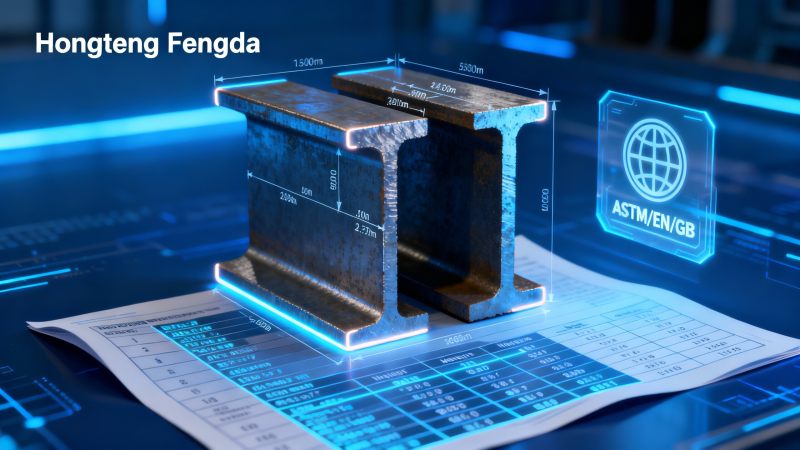
Buyers often confuse “nominal weight” with “actual shipped weight.” While catalogs list theoretical values, real coils carry tolerance bands: ±5% for EN sections, ±4% for ASTM, and ±3.5% for GB. That means a 50-ton order of IPE 300 could legally range from 48.25–51.75 tons. Smart procurement avoids surprises by specifying “weight guaranteed per meter” in PO terms—and partnering with mills that offer weight reconciliation clauses.
For distributors and agents, consistency matters more than price alone. Unstable suppliers cause rework delays when mismatched beams arrive onsite. Hongteng Fengda guarantees ≤±2.5% weight variance across all exports—backed by ISO 9001-certified traceability systems. We also support mixed-container shipments: combine I beams with Galvanized Steel Wire for fencing or reinforcement, optimizing logistics cost per cubic meter.
Standards & Certification: Why Compliance Is Non-Negotiable
Using non-compliant beams jeopardizes insurance coverage and regulatory approval. ASTM A6 covers dimensional tolerances; EN 10025-2 defines mechanical properties; GB/T 11263 sets Chinese hot-rolled beam requirements. But certification goes beyond paperwork: it requires ongoing audits, raw material traceability (from billet heat number to final cut), and mill test reports per lot.
Hongteng Fengda holds dual EN 10204 3.2 and ASTM A6 MTRs for all structural beams—and provides bilingual documentation (English + local language) upon request. Our QA team performs random tensile, bend, and Charpy V-notch tests quarterly. No shortcuts. Because when your project passes inspection, it’s not luck—it’s engineered reliability.
Why Choose Hongteng Fengda for Your Structural Steel Needs?
You need more than weight charts—you need certainty. As a vertically integrated structural steel manufacturer and exporter from China, we control everything from raw material procurement to final packaging. Our 120,000-ton annual capacity ensures no lead-time surprises—even during peak construction seasons. With dedicated QC labs in Tianjin and Shanghai, we validate every metric: i beam weight, chemical composition, yield strength, and surface integrity.
Whether you’re estimating a Dubai high-rise, sourcing for a Texas industrial park, or distributing across Southeast Asia—we deliver consistent quality, transparent documentation, and responsive engineering support. Contact our global procurement team today for custom weight charts, sample kits, or OEM beam design consultation. Let’s build trust—beam by beam.
Related recommendations
 How much does 2 inch ss pipe price increase when upgrading from Schedule 40 to Schedule 80 for high-pressure systems?2 inch ss pipe price increases 18–35% when upgrading from Sch 40 to Sch 80—discover why, when it’s truly needed, and how to avoid overpaying.
 Which 304 stainless steel coil suppliers meet ISO 9001 and EN 10088-2 for food-grade fabrication?Discover verified 304 stainless steel coil suppliers meeting ISO 9001 & EN 10088-2 for food-grade fabrication—traceable, audited, and ready for regulatory validation.
 How does 2 inch ss pipe price compare between 304 and 316 grades for marine environments?2 inch ss pipe price varies significantly between 304 and 316 — but in marine environments, choosing 304 risks costly failures. Discover why 316 is the true value choice.
 Is 20 feet square pipe price affected more by raw material volatility or regional logistics costs?20 feet square pipe price is driven primarily by raw material volatility—not logistics. Discover why billet costs dominate pricing & how to forecast smarter with Hongteng Fengda.
Please give us a message


Please enter what you want to find