Choosing the right I-beam is critical for industrial mezzanine floors—where load capacity, weight efficiency, and structural integrity directly impact safety, cost, and timeline. This I beam weight comparison chart (W12 vs. W14 vs. W16) delivers precise data on weight per foot, load capacity, and specifications tailored for warehouse construction, steel fabrication, and high-rise or bridge applications. As a trusted structural steel manufacturer & exporter from China, Hongteng Fengda provides ASTM/EN/GB-compliant beams with verified weight of I beam for industrial use—supporting procurement teams, project managers, and safety officers in making confident, standards-driven decisions.
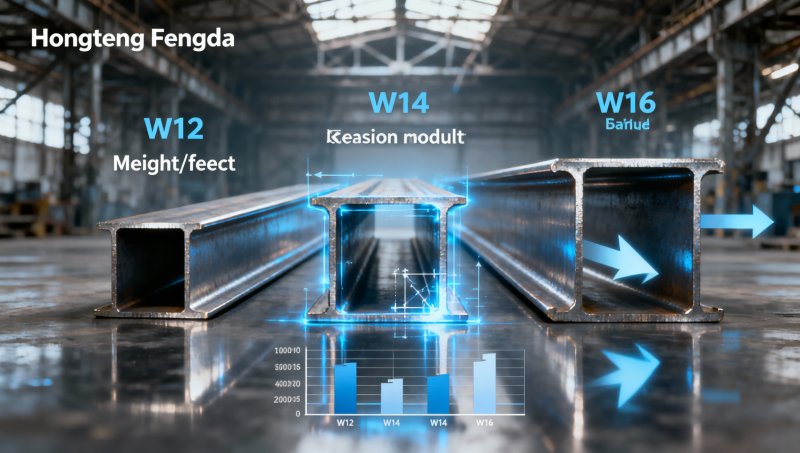
Understanding W-Shape Designations and Their Structural Relevance
The “W” in W12, W14, and W16 stands for “Wide-Flange,” denoting the American standard designation under ASTM A6/A6M. These sections are engineered for optimal bending resistance with balanced flange width-to-depth ratios—critical when designing multi-tiered industrial mezzanine floors where vertical clearance, column spacing, and live/dead load distribution must be precisely calculated. Unlike older S-shapes or HP piles, W-beams offer superior moment-of-inertia-to-weight ratios, enabling longer spans without compromising stiffness. For example, a W14×22 is not simply “heavier” than a W12×22—it carries higher section modulus (Sx), meaning greater resistance to bending stress at identical depths. This distinction becomes decisive in mezzanine systems supporting automated storage-and-retrieval equipment (AS/RS), where dynamic point loads exceed 5,000 lbs per wheel.
Hongteng Fengda’s production line adheres strictly to ASTM A992 (for structural steel) and EN 10025-2 S355JR standards, ensuring yield strength consistency across batches. Our mill-certified test reports include tensile strength, elongation, and Charpy V-notch impact values—all traceable to third-party labs accredited under ISO/IEC 17025. Such rigor matters especially when engineers reference the i beam weight load capacity chart during seismic zone assessments or fire-resistance rating calculations per ASTM E119.
Weight Per Foot & Load Capacity: A Comparative Analysis
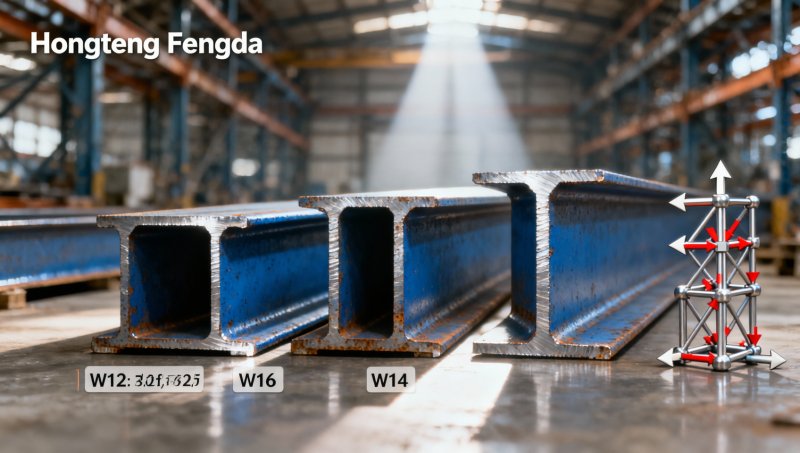
While nominal depth increases from W12 to W16, actual weight per foot does not scale linearly—and neither does load capacity. Below is a comparative snapshot of commonly specified sizes used in mezzanine framing, based on ASTM A6 dimensional tolerances and verified mill test data from Hongteng Fengda’s 2024 production runs:
*Based on AISC 360-22 LRFD design method; assuming simple supports, unbraced top flange, Fy=50 ksi.
Note how W14×26 gains +39% section modulus over W12×22 while adding only +18% weight—a key efficiency advantage. That makes it ideal for intermediate-level mezzanines requiring mid-span crane access. Meanwhile, W16×31 offers 33% more Sx than W14×26 but adds 19% mass—justifiable only where column-free spans exceed 18 feet or where future load upgrades are anticipated. This nuance is essential for procurement professionals evaluating total lifecycle cost—not just initial material spend.
Application-Specific Considerations Across Project Types
The weight of i beam for warehouse construction must account for both static and operational dynamics. In cold-storage facilities, thermal contraction can induce secondary stresses that reduce effective load capacity by up to 12% if beams lack proper end detailing. For high-rise retrofit mezzanines, the weight of i beam for high-rise buildings must be reconciled against existing slab load limits—often requiring lightweight composite solutions or post-tensioned connections. Bridge applications demand fatigue-resistant weldability, so our W14 beams undergo supplementary ultrasonic testing (UT) per AWS D1.5, particularly at flange-to-web junctions.
For steel fabrication shops, the i beam weight per foot for steel fabrication influences handling logistics: lighter W12s simplify shop-floor craning and reduce fixture wear, while heavier W16s may require hydraulic manipulators. Safety managers rely on our i beam weight specifications for industrial use to validate anchor bolt embedment depth and baseplate bearing pressure—especially critical in seismic Category D zones per ASCE 7-22. All certified dimensions and weights are cross-verified using coordinate measuring machines (CMM) calibrated to NIST-traceable standards.
Beyond Beams: Complementary Corrosion-Resistant Solutions
While structural beams form the skeleton, long-term durability hinges on corrosion protection—particularly in coastal warehouses, food-processing plants, or humid manufacturing environments. That’s why many of our global clients pair W-series beams with Galvanized Round Steel for railing posts, bracing rods, and anchoring components. With hot-dip galvanizing per ASTM A123 and zinc coating thickness ≥85 µm, these round bars deliver >50 years of service life in C3 atmospheric exposure categories (ISO 12944). Their tensile strength range of 570–820 MPa ensures compatibility with structural-grade bolting systems, while tight diameter tolerances (ISO h8/h9) enable precision fit in CNC-drilled connection plates.
Our galvanizing line integrates automated flux control, controlled immersion speed, and centrifugal spin-off—minimizing drips and ensuring uniform coverage even on complex geometries. Every coil undergoes spectrographic analysis pre- and post-galvanizing to verify alloy composition and coating adhesion. This level of process control supports the i beam weight calculator for steel structures used by engineering firms integrating hybrid steel-concrete systems—where consistent material properties are non-negotiable.
Trusted Data, Reliable Delivery: Why Global Projects Choose Hongteng Fengda
An i beam weight chart for construction is only as valuable as the source behind it. At Hongteng Fengda, every published weight value corresponds to actual mill test reports—not theoretical formulas. We maintain real-time dimensional databases linked to ERP systems, allowing buyers to download certified weight certificates alongside EN 10204 3.1 inspection documents. Our export portfolio includes over 240 container shipments annually to North America alone—each batch accompanied by heat number traceability, mill test reports, and packaging compliant with ASTM A6/A6M moisture-barrier requirements.
For project managers coordinating international deliveries, we offer consolidated documentation packages—including bilingual (English/Arabic/Spanish) packing lists, HS code verification, and pre-clearance support for customs brokers. Procurement teams benefit from our flexible MOQ structure: no minimum order for standard W12/W14/W16 stock lengths (20–40 ft), with custom cutting and punching available within 12 working days. Quality assurance isn’t delegated—it’s embedded: every beam undergoes magnetic particle inspection (MPI) on flanges and ultrasonic scanning on web sections before final bundling.
Whether you’re specifying the weight of i beam for bridge construction, optimizing mezzanine floor loading for e-commerce fulfillment centers, or validating load paths for automated guided vehicle (AGV) corridors, Hongteng Fengda delivers more than steel—we deliver confidence through verifiable data, repeatable quality, and responsive partnership. Download our full W-series i beam weight comparison chart with interactive filters—or contact our technical sales team today for a customized structural review.
- structural steel
- Structural Steel
- I-Beam
- S355JR
- Galvanized
- weight of i beam
- i beam weight
- i beam weight chart for construction
- i beam weight calculator for steel structures
- i beam weight specifications for industrial use
- weight of i beam for warehouse construction
- i beam weight comparison chart
- weight of i beam for bridge construction
- i beam weight per foot for steel fabrication
- weight of i beam for high-rise buildings
- i beam weight load capacity chart
Related recommendations
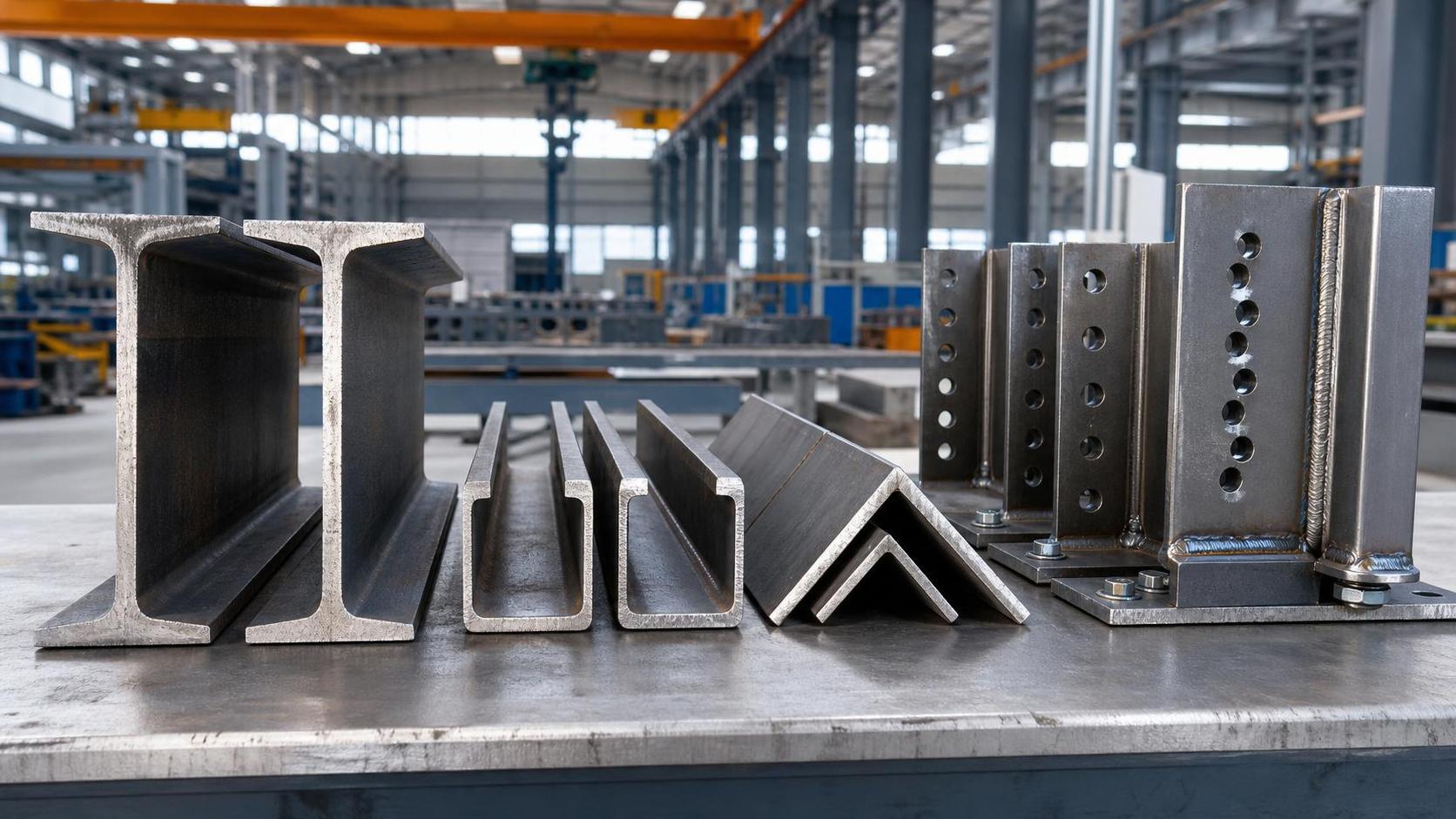
 How to Select a Steel Profile Based on Load, Span, and Fabrication NeedsProfile selection starts with load, span, and fabrication needs. Learn how to compare steel sections for strength, cost, workability, and sourcing efficiency.
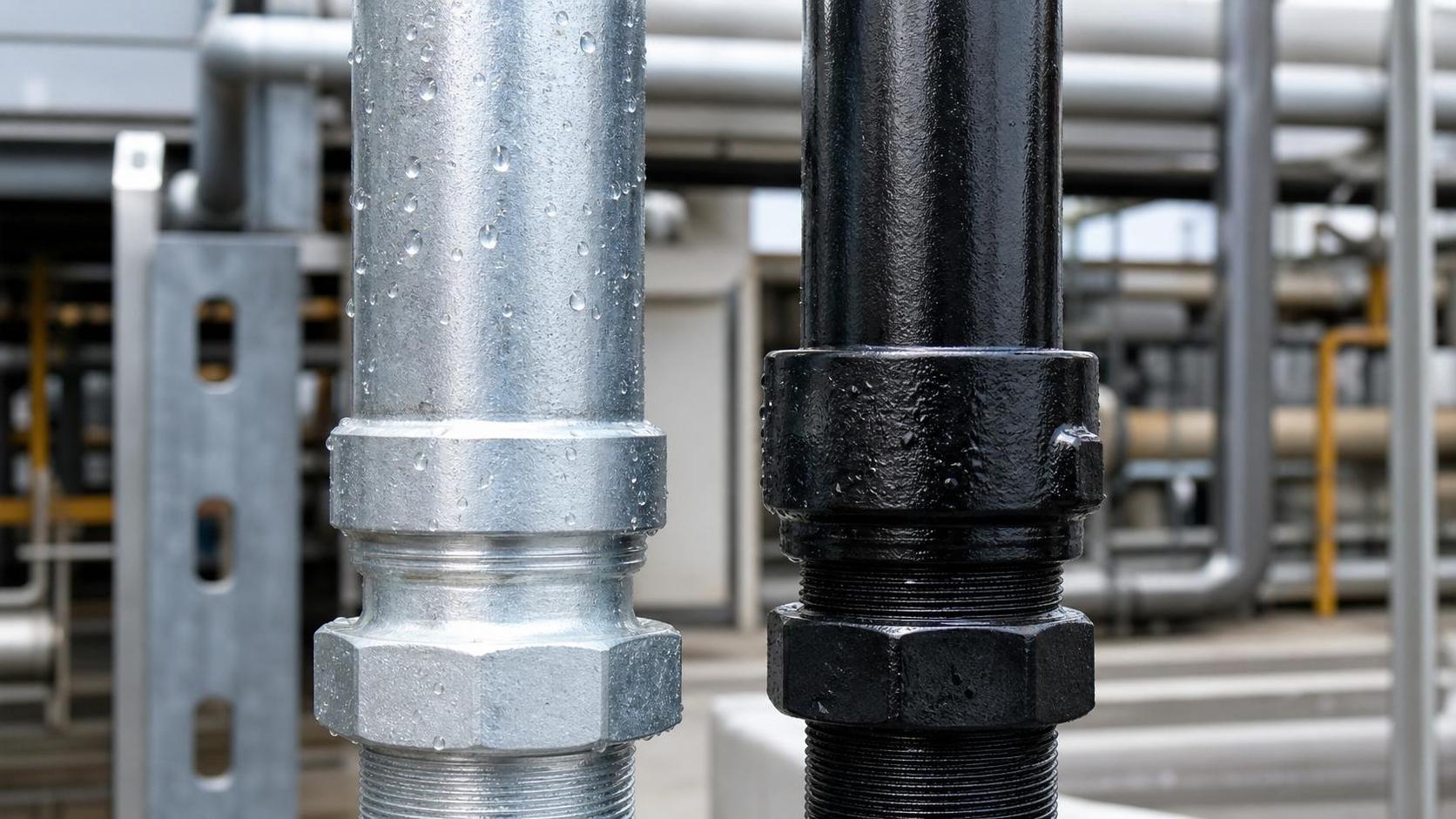
 Galvanized Pipe vs Black Pipe: Which One Fits Water, Gas, or Outdoor Lines?Galvanized pipe or black pipe? Compare the best choice for water, gas, and outdoor lines, with key insights on corrosion, codes, cost, and long-term performance.
 How to Choose Steel Roofing for Warehouses, Farms, and Residential BuildingsSteel Roofing selection depends on building type. Learn how warehouses, farms, and homes differ in corrosion, insulation, drainage, and cost for smarter roofing decisions.
 Hot-Dip Galvanized vs Pre-Galvanized Steel: Which Should You Specify?Hot-dip galvanized vs pre-galvanized steel: compare corrosion resistance, fabrication impact, cost, and standards to specify the right steel solution for durable, compliant projects.
Please give us a message


Please enter what you want to find