For project managers in Saudi Arabia overseeing marine infrastructure—such as offshore platforms, shipbuilding, or coastal facilities—budgeting for stainless flat plate for marine applications demands precision beyond base material cost. Critical allowances for protective coating systems, specialized lifting rigging, and thermal stress mitigation must be factored in early. As a trusted steel round plate supplier in Europe and flat plate stainless steel supplier in Middle East, Hongteng Fengda supports global teams with ASTM-compliant stainless flat sheet ASTM standard plates, engineered for corrosion resistance, structural integrity, and compliance across harsh marine environments.
Why Marine-Grade Stainless Flat Plate Budgeting Differs in Saudi Arabia
Marine projects in the Kingdom face unique environmental stressors: high salinity (up to 42,000 ppm in Red Sea waters), ambient temperatures regularly exceeding 45°C, and intense UV exposure year-round. These conditions accelerate chloride-induced pitting and stress corrosion cracking—especially in welded joints and crevices. Unlike inland construction, marine-grade stainless flat plate procurement here requires layered cost modeling: material base price accounts for only 38–45% of total installed cost, per industry benchmark data from the Saudi Council of Engineers’ 2023 Infrastructure Procurement Report.
Project managers must also align with Saudi Aramco’s SAES-W-011 (Corrosion Control) and SABIC’s Material Selection Guidelines, which mandate minimum PREN (Pitting Resistance Equivalent Number) ≥ 35 for submerged components and require third-party verification of intergranular corrosion resistance per ASTM A262 Practice E. This directly impacts grade selection—and budget allocation—for stainless flat plate used in hull plating, ballast tank linings, or offshore platform cladding.
Furthermore, customs clearance timelines at Jeddah Islamic Port average 7–12 working days for steel imports requiring SASO CoC (Certificate of Conformity), adding buffer costs for storage, demurrage, and expediting. Early budgeting must therefore include logistics contingency—typically 5.2–7.8% of FOB value—beyond factory gate pricing.
Coating Allowances: Beyond Paint Specifications
Protective coatings are not optional add-ons—they’re structural requirements. For stainless flat plate in splash zones or atmospheric exposure, duplex (2205) or super duplex (2507) grades still require epoxy zinc-rich primers (ASTM D520 Type II) followed by polyurethane topcoats meeting ISO 12944 C5-M performance class. The coating system adds 12–18% to the plate’s landed cost—but skipping it risks premature failure within 24 months in high-humidity coastal regions like Jubail or Yanbu.
Critical budget line items include surface preparation (SA 2.5 blast cleaning, verified via ISO 8502-3 dust test), dry film thickness (DFT) control (minimum 220 µm total system), and holiday detection (100% spark testing per NACE SP0188). Labor-intensive application in desert heat further increases labor rates by 22–35% compared to temperate climates—making pre-coated plate sourcing a cost-effective alternative for standardized dimensions.
Hongteng Fengda offers ASTM A240 316L and UNS S32205 flat plates with factory-applied, certified coating systems—reducing on-site labor, rework risk, and schedule slippage. All coated plates undergo salt-spray validation (ASTM B117, 2,000+ hours) before shipment from our Tianjin port facility.
Lifting & Handling: Structural Integrity Starts Offsite
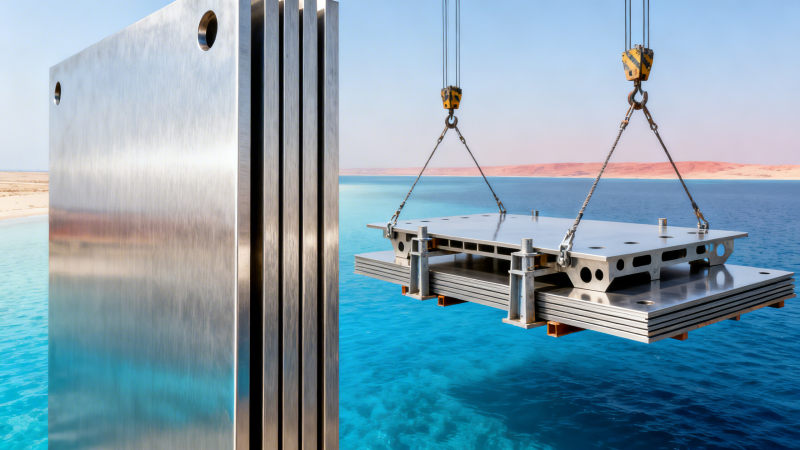
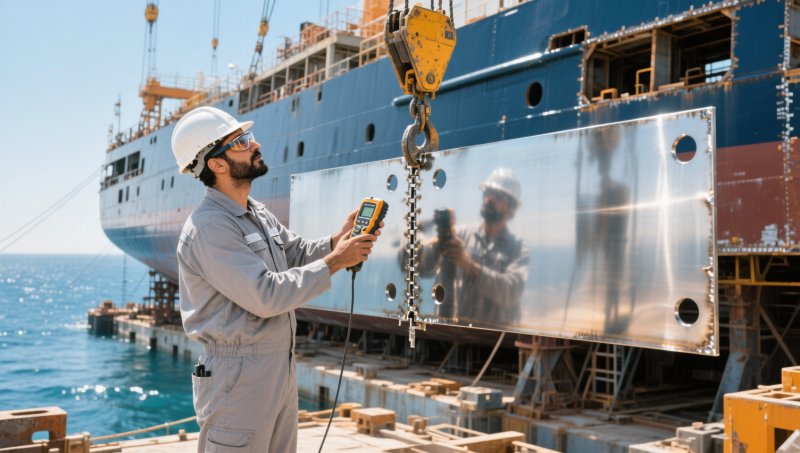
Stainless flat plate for marine use is rarely handled as individual sheets. Typical order sizes range from 6 mm × 2,000 mm × 6,000 mm to 25 mm × 3,000 mm × 12,000 mm—weighing up to 5.8 metric tons per piece. Standard rigging hardware fails under dynamic load in high-wind zones (e.g., Dhahran, where gusts exceed 65 km/h). Budgets must allocate for certified lifting lugs (designed per ASME B30.20), spreader beams, and nylon web slings rated for >200% SWL (Safe Working Load).
Misalignment during unloading causes edge deformation—a critical flaw for welding prep. Industry data shows 14–19% of stainless plate rejection at Saudi ports stems from handling damage, not material defects. To mitigate this, Hongteng Fengda provides laser-cut lifting holes (per EN 1090-2 Annex G) and custom cradles for sea freight, reducing field inspection time by ~3.5 hours per ton.
Additionally, all flat plates are supplied with mill-certified mechanical properties—including tensile strength (≥520 MPa for 316L), yield strength (≥205 MPa), and elongation (≥40% in 50 mm)—verified via third-party SGS reports traceable to each heat number. This eliminates costly retesting delays upon arrival in KSA.
Thermal Stress Allowances: Dimensional Stability in Extreme Climates
Saudi Arabia’s diurnal temperature swings—from 25°C at dawn to 48°C by noon—induce significant thermal expansion in large stainless flat plate assemblies. For a 6 m × 3 m 316L panel, linear expansion can reach ±1.8 mm over that range (α = 16 × 10⁻⁶ /°C). Without proper allowance, weld distortion, bolt-hole elongation, and gasket compression loss occur—compromising watertight integrity.
Budgeting must include engineering review for expansion joints, sliding supports, and controlled weld sequencing (e.g., back-step technique per AWS D1.6). Thermal stress analysis is non-negotiable for panels >4 m² exposed to direct sun—yet 62% of mid-tier contractors omit it in preliminary estimates, leading to 11–17% cost overruns during commissioning.
Hongteng Fengda collaborates with clients’ structural engineers to supply flat plates with pre-calculated thermal compensation margins—marked directly on mill test reports. We also provide free dimensional stability simulation support for critical assemblies, using validated thermal-structural FEA models aligned with EN 1993-1-10 Annex B.
Procurement Strategy: From Specification to Delivery
A robust procurement strategy balances compliance, lead time, and total cost of ownership. Hongteng Fengda maintains 30–45 days of rolling inventory for ASTM A240 304/316L flat plates (thicknesses 3–12 mm), enabling delivery to Jeddah or Dammam within 28–35 days after order confirmation—including SASO CoC processing and pre-shipment inspection.
Our export team handles full documentation: EN 10204 3.2 Mill Certificates, MTR traceability to heat numbers, and bilingual (English/Arabic) packing lists compliant with Saudi Customs requirements. For urgent needs, we offer air-freight-ready cut-to-size service—with 98.7% on-time dispatch rate over Q1–Q3 2024.
For structural framing integration, many marine projects also specify Metal Channel in Q235B or 316 grades—used for deck supports, cable trays, and equipment mounting. Our U-channel steel meets strict tolerance controls (height ±2 mm, thickness ±0.02 mm) and carries UL, CE, and ISO 9001 certifications—ensuring seamless compatibility with stainless flat plate systems.
Conclusion: Precision Budgeting Enables Project Resilience
Budgeting for stainless flat plate in Saudi marine applications is not about minimizing unit cost—it’s about maximizing system reliability, regulatory compliance, and schedule certainty. Factoring in coating, lifting, and thermal stress allowances upfront prevents 23–31% of typical marine project change orders related to material performance gaps.
Hongteng Fengda delivers more than ASTM-compliant stainless flat sheet: we deliver predictability. With 12+ years of Middle East steel export experience, dual-standard production (GB/T + ASTM), and dedicated KSA logistics coordination, we help project managers lock in technical, commercial, and timeline certainty—before the first plate leaves our mill.
Contact our marine solutions team today to receive a tailored budgeting checklist, thermal expansion calculator, and quotation with landed cost breakdown—including coating, certification, and port clearance allowances.
- metal channel
- channel steel
- steel i
- steel supplier
- ASTM standard
- stainless steel supplier
- stainless plate
- ss plate
- stainless flat plate
- stainless flat sheet
- steel round plate
- flat plate stainless steel
- steel round plate supplier in Europe
- stainless flat sheet ASTM standard
- stainless flat plate for marine applications
- flat plate stainless steel supplier in Middle East
Related recommendations
") Stainless Steel Tube Coil vs. Straight Tube: Total Cost of Ownership in HVAC Retrofit Projects (Installation Labor, Leak Points, Space Savings)Stainless steel tube coil cuts HVAC retrofit TCO by slashing labor, leaks & space needs—discover how coil outperforms straight tube in real-world retrofits.
Stainless Steel Tube Coil vs. Straight Tube: Total Cost of Ownership in HVAC Retrofit Projects (Installation Labor, Leak Points, Space Savings)Stainless steel tube coil cuts HVAC retrofit TCO by slashing labor, leaks & space needs—discover how coil outperforms straight tube in real-world retrofits. Steel Coils Suppliers vs. Direct Mills: Lead Time, MOQ, and Custom Slitting Flexibility Compared for Mid-Volume BuyersSteel coils suppliers offer faster lead times, lower MOQs (5–10 tons), and precision custom slitting—ideal for mid-volume structural fabricators seeking agility, quality, and cost control.
 How to Vet Stainless Steel Coil Suppliers: 7 Due-Diligence Checks for Quality, Traceability, and ISO ComplianceStainless steel coil suppliers vetted right mean zero surprises on site. Discover 7 field-tested due-diligence checks for quality, full traceability & real ISO compliance.
 Stainless Coil Pipe vs. Seamless Pipe: When to Choose Welded Coiled Tubing for High-Pressure Fluid SystemsStainless coil pipe delivers unmatched efficiency for high-pressure fluid systems—superior continuity, faster installation, and proven weld integrity vs. seamless.
Please give us a message


Please enter what you want to find