Choosing the right black steel plumbing pipe is critical for safety and performance in high-pressure irrigation systems—especially when deciding between Schedule 40 and Schedule 80. Unlike galvanized metal tubing or galvanized industrial pipe, black pipe offers superior strength and cost-efficiency where corrosion resistance isn’t the top priority. Whether you’re a project manager specifying materials, a procurement officer evaluating galv steel conduit vs. metal pipe black, or a safety manager assessing pressure ratings, understanding wall thickness, pressure tolerance, and application context ensures compliance and longevity. As a trusted structural steel manufacturer and exporter from China, Hongteng Fengda supplies ASTM-compliant black steel plumbing pipe and galvanised steel tubes for global irrigation, industrial, and infrastructure projects.
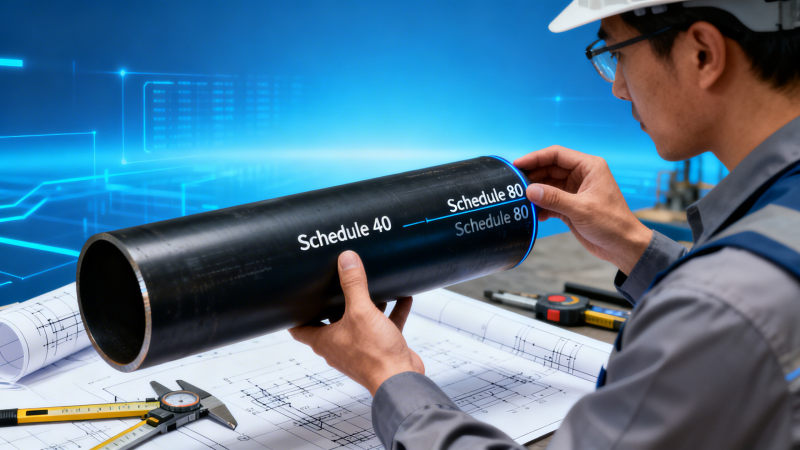
How Wall Thickness Determines Pressure Capacity in Irrigation Systems
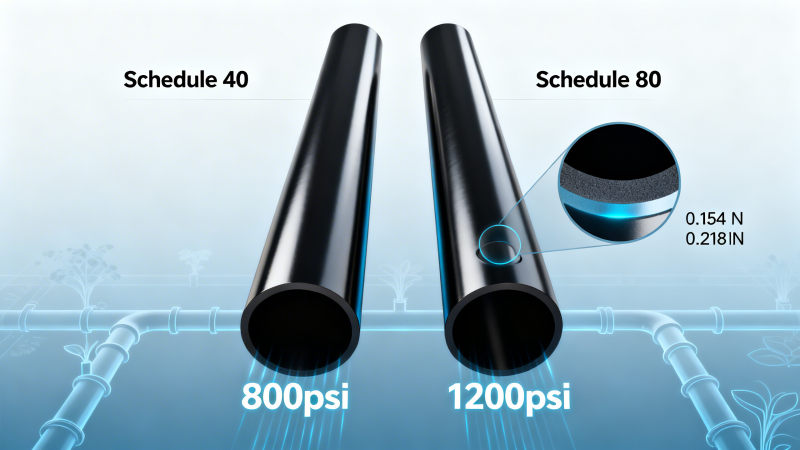
In high-pressure irrigation—especially in drip-line manifolds, booster stations, or pressurized pivot feed lines—the mechanical integrity of black steel pipe hinges on its nominal wall thickness. Schedule 40 and Schedule 80 are not arbitrary labels; they reflect standardized wall dimensions defined under ASTM A53 and ASTM A106. For example, a 2-inch black steel pipe has a wall thickness of 0.154 inches (Schedule 40) versus 0.218 inches (Schedule 80)—a 41% increase that directly translates to higher burst pressure and reduced risk of fatigue failure under cyclic loading.
Pressure rating isn’t solely dependent on diameter or material grade—it’s a function of wall thickness, yield strength, and service temperature. At ambient conditions, Schedule 80 black pipe typically sustains working pressures up to 1,200 psi for 1-inch NPS, while Schedule 40 maxes out around 800 psi. That differential becomes decisive when designing systems operating above 600 psi or exposed to frequent thermal cycling, such as solar-powered pressurization units or variable-frequency drive (VFD)-controlled pump stations.
For irrigation projects spanning arid zones or high-elevation farms—where static head alone may exceed 400 psi—specifying Schedule 40 without hydraulic modeling risks premature joint leakage or catastrophic rupture. Structural integrity must be validated against both short-term surge pressure (e.g., water hammer events exceeding 1.5× operating pressure) and long-term creep behavior over 15–20 years of continuous operation.
Key Pressure & Dimension Comparison (ASTM A53 Grade B)
This table shows how wall thickness scales with schedule designation—and why Schedule 80 is non-negotiable for high-head applications. Note that pressure ratings assume ASTM A53 Grade B (30,000 psi minimum yield), seamless construction, and full-penetration welds. Field welding quality, thread integrity, and gasket selection further influence real-world performance—factors Hongteng Fengda validates through third-party hydrostatic testing per EN 10204 3.1 certification.
When Schedule 40 Is Acceptable—and When It Isn’t
Schedule 40 black steel pipe remains widely used in low-to-moderate pressure irrigation zones—such as gravity-fed lateral distribution, surface drip headers below 150 psi, or temporary field installations with expected lifespans under 5 years. Its lower weight (up to 30% lighter than Schedule 80 for same NPS) reduces labor costs during trenching and alignment, especially across large-acreage farms in Southeast Asia or the Middle East where manual installation dominates.
However, three red-flag scenarios demand immediate upgrade to Schedule 80: (1) systems integrating chemical injection (e.g., fertigation pumps generating >500 psi pulses), (2) installations subject to soil settlement or seismic activity where pipe flexure increases stress concentration, and (3) projects requiring compliance with ASME B31.1 Power Piping Code—common for integrated agri-industrial complexes in North America and Europe. In these cases, Schedule 40 fails not just on pressure but on fatigue life: accelerated crack propagation begins after ~12,000 cycles at 75% of yield strength.
Procurement teams often overlook thermal expansion effects. Black steel expands at 6.5 × 10⁻⁶ in/in/°F—meaning a 100-meter Schedule 40 run exposed to 40°C diurnal swings experiences ~26 mm axial movement. Without proper anchoring or expansion loops, this induces bending stress that Schedule 80 resists more effectively due to its higher section modulus.
Beyond Pipe: How Roofing Materials Support Irrigation Infrastructure
Irrigation system longevity extends beyond piping—into supporting infrastructure like pump houses, chemical storage sheds, and control room enclosures. Here, Color Coated Galvalume Steel Sheet PPGL delivers unmatched value: its aluminized zinc coating (55% aluminum, 43.3% zinc, 1.6% silicon) provides corrosion resistance exceeding standard galvanized steel by 2–3× in high-humidity agricultural environments. With coating thicknesses ranging from 11–35 μm (top) and 5–14 μm (back), PPGL sheets maintain structural integrity for over 25 years—even in coastal or fertilizer-exposed barns.
Available in trapezoidal and wavy profiles (0.2–1.2 mm thickness, 600–1250 mm width), PPGL enables rapid, lightweight cladding for irrigation control centers—reducing foundation load by up to 40% versus concrete alternatives. Its heat resistance (>300°C) also safeguards electrical panels housed beneath roofs exposed to desert sun, a critical consideration for solar-powered irrigation hubs across the Middle East and North Africa.
Why Global Procurement Teams Choose Hongteng Fengda
As a certified structural steel manufacturer and exporter from China, Hongteng Fengda bridges specification rigor with supply chain reliability. We produce black steel plumbing pipe to ASTM A53/A106, with mill test reports (EN 10204 3.1), hydrostatic validation at 1.5× rated pressure, and traceable heat numbers for every coil or bundle. Our cold-formed steel profiles—including custom channel and angle sections for pipe support frames—are engineered for dimensional stability across temperature ranges from −20°C to +60°C.
Global buyers benefit from consistent lead times: standard black pipe orders ship within 15–25 days; OEM-specified lengths or threading configurations require 30–45 days. With production capacity covering 200,000+ tons annually and warehouses in Dubai, Rotterdam, and Los Angeles, we mitigate port delays and customs bottlenecks common in agricultural infrastructure projects.
Contact us today to: (1) validate your irrigation system’s pressure profile against ASTM-compliant pipe grades, (2) request cut-sheet samples of Color Coated Galvalume Steel Sheet PPGL for pump house cladding, (3) obtain EN/ASTM certification documentation, or (4) discuss bulk order pricing with CIF terms for shipments to your nearest regional hub.
- black steel pipe
- black pipe
- metal pipe black
- black steel plumbing pipe
- galv steel conduit
- galvanised steel tubes
- galvanized industrial pipe
- galvanized metal tubing
- steel pipe
- galvanized steel
- structural steel
- steel profiles
- Structural Steel
- Profile
- Galvanized
- steel sheet
- steel profile
- steel conduit
- steel tube
Related recommendations
 Galvanized Pipe Manufacturer Selection: Zinc Coating, Tolerance, and ComplianceGalvanized pipe manufacturer selection guide: compare zinc coating quality, tolerance control, and compliance to reduce risk and choose a supplier that delivers reliable steel products.
 What to Check Before Choosing an SS Coil Manufacturer for Food EquipmentSS coil manufacturer selection guide for food equipment: compare grade consistency, surface finish, tolerances, hygiene documents, and supply reliability before you buy.
 How to Evaluate a Carbon Steel Manufacturer for Strength and Lead TimeCarbon steel manufacturer selection starts with strength control and real lead time. Learn how to compare quality systems, standards, specs, and export readiness before you buy.
 Buy 304 Stainless Steel Wire 0.5mm Soft: What to Check Before Placing an OrderBuy 304 stainless steel wire 0.5mm soft with confidence. Learn what to check on grade, tolerance, finish, softness, and supplier quality before ordering.
Please give us a message


Please enter what you want to find