Selecting the right pipe for oil & gas projects is critical—API 5L steel pipe and ASTM A106 pipe are both widely used, yet differ significantly in application scope, chemical composition, and testing requirements. As a trusted structural steel manufacturer & exporter from China, Hongteng Fengda supplies API 5L pipe, ASTM A106 pipe, corrosion-resistant plate, S235JR steel, SPCE/SPCD steel, and other industrial pipes—including fluid pipe and API pipe—to global buyers. This guide helps procurement teams, project managers, and quality/safety personnel make informed decisions based on standards compliance, performance needs, and supply reliability.
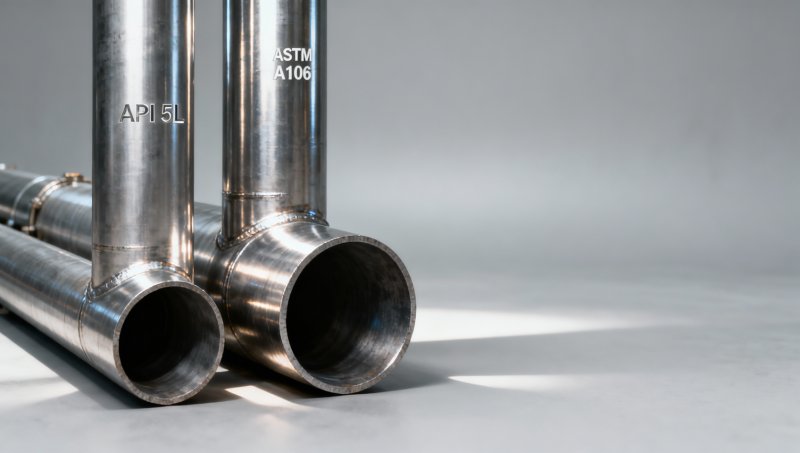
Definition & Scope: What Are API 5L and ASTM A106 Pipes?
API 5L steel pipe is governed by the American Petroleum Institute’s Specification 5L, designed explicitly for pipeline transportation systems in the petroleum and natural gas industries. It covers seamless and welded steel line pipe used in onshore, offshore, and subsea applications—including sour service (H₂S environments) when specified with additional toughness or corrosion resistance requirements.
ASTM A106 pipe, on the other hand, is a seamless carbon steel pipe standard published by ASTM International. It is intended primarily for high-temperature service—such as boiler tubes, process piping, and refinery feed lines—where mechanical strength at elevated temperatures is essential. While often used in oil & gas facilities, its scope does not extend to long-distance transmission pipelines like API 5L.
Both standards define strict dimensional tolerances, hydrostatic test pressures, and non-destructive examination (NDE) protocols—but their design philosophies diverge: API 5L emphasizes field weldability, fracture toughness, and pressure containment over distance; ASTM A106 prioritizes creep resistance and tensile stability under thermal cycling.
Technical Performance Comparison
Understanding material behavior under real-world conditions requires comparing key technical parameters. Below is a side-by-side summary of critical differences between API 5L pipe and ASTM A106 pipe:
Standards & Certification Compliance
Compliance isn’t optional—it’s foundational to safety, insurance coverage, and regulatory approval. API 5L pipes must conform to ISO 3183 (identical technical content), undergo third-party inspection per API RP 2X, and carry traceable mill test reports (MTRs) listing heat numbers, chemistry, and mechanical test results. For sour service, NACE MR0175/ISO 15156 certification is mandatory.
ASTM A106 pipes require full adherence to ASTM E29 for rounding practices, ASTM A751 for chemical analysis, and ASTM E8/E210 for tensile testing. Unlike API 5L, there’s no formal requirement for independent certification bodies—but many end users mandate SGS, BV, or TÜV verification before acceptance.
At Hongteng Fengda, every shipment of API 5L pipe and ASTM A106 pipe includes full documentation aligned with EN 10204 3.1 or 3.2, depending on client specification. We also support dual-certification batches (e.g., API 5L + ASTM A106) where cross-standard flexibility supports modular plant design—especially useful in integrated refineries or LNG terminals.
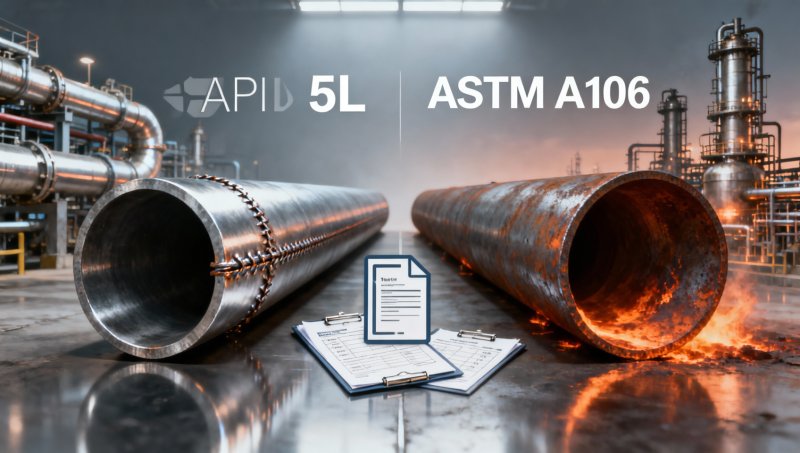
Procurement Guide: Key Selection Criteria for Oil & Gas Projects
Procurement professionals face layered trade-offs: cost vs. lead time, local availability vs. certification rigor, and standard compliance vs. field adaptability. Start with these five checkpoints:
- Project Phase: Early-stage FEED studies benefit from ASTM A106’s faster lead times; detailed engineering and construction demand API 5L’s proven field performance.
- Design Temperature: Above 425°C? ASTM A106 Gr. C is preferred. Below −20°C in arctic zones? API 5L X65N or X70Q offers superior Charpy impact values.
- Corrosion Environment: H₂S presence triggers NACE compliance—and only certain API 5L grades (e.g., L415MS) meet MR0175 without post-weld heat treatment.
- Welding Logistics: Field girth welding favors API 5L’s consistent chemistry and lower carbon equivalent (CEPcm < 0.25%).
- Supply Chain Resilience: Seamless pipe shortages have impacted ASTM A106 delivery globally since 2022—making welded API 5L alternatives more attractive for mid-size projects.
For structural integration, consider complementary components such as Z-beam, widely deployed in modular skid-mounted process units and prefabricated pipe rack supports. Its cold-formed precision and GB50018-2002 compliance ensure alignment with API and ASTM piping layouts.
Why Choose Hongteng Fengda?
As a certified structural steel manufacturer & exporter from China, Hongteng Fengda delivers more than product—we deliver predictability. Our API 5L pipe meets PSL1 and PSL2 requirements across Grades B, X42 to X80, including sour-service variants. Our ASTM A106 inventory spans Gr. A, B, and C in seamless sizes from 1/2″ to 24″, all backed by ISO 9001, CE, and BV certifications.
We serve procurement teams across North America, Europe, the Middle East, and Southeast Asia with fixed lead times, transparent MTRs, and bilingual engineering support. Whether you need dual-certified fluid pipe for an FPSO upgrade—or corrosion-resistant plate paired with S235JR steel for offshore platform cladding—we align production capacity with your critical path.
Contact Hongteng Fengda today for a customized quotation, mill test report sample, or technical consultation. Let’s build reliability—into every meter of pipe, every beam, and every project milestone.
Related recommendations
 Galvanized Pipe Manufacturer Selection: Zinc Coating, Tolerance, and ComplianceGalvanized pipe manufacturer selection guide: compare zinc coating quality, tolerance control, and compliance to reduce risk and choose a supplier that delivers reliable steel products.
 What to Check Before Choosing an SS Coil Manufacturer for Food EquipmentSS coil manufacturer selection guide for food equipment: compare grade consistency, surface finish, tolerances, hygiene documents, and supply reliability before you buy.
 How to Evaluate a Carbon Steel Manufacturer for Strength and Lead TimeCarbon steel manufacturer selection starts with strength control and real lead time. Learn how to compare quality systems, standards, specs, and export readiness before you buy.
 Buy 304 Stainless Steel Wire 0.5mm Soft: What to Check Before Placing an OrderBuy 304 stainless steel wire 0.5mm soft with confidence. Learn what to check on grade, tolerance, finish, softness, and supplier quality before ordering.
Please give us a message


Please enter what you want to find