Choosing between S235JR steel and SPCD steel for cold-formed industrial components demands clarity on strength, formability, and compliance—especially amid evolving 2024 project requirements. As a leading structural steel manufacturer & exporter from China, Hongteng Fengda supplies both S235JR steel and SPCD steel alongside API 5L pipe, ASTM A106 pipe, SPCE steel, corrosion-resistant plate, and industrial pipes—ensuring full traceability and EN/ASTM/GB certification. Whether you’re a procurement professional, project manager, or quality controller, this comparison cuts through technical ambiguity to guide optimal material selection for durability, cost-efficiency, and cold-forming performance.
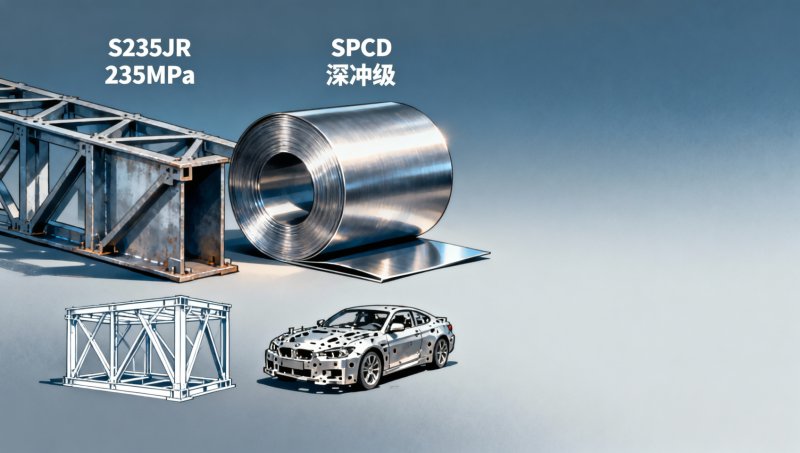
Definition & Core Material Identity
S235JR steel is a non-alloy structural steel defined under EN 10025-2:2019. Its designation breaks down as follows: “S” for structural steel, “235” for minimum yield strength (MPa), and “JR” indicating Charpy V-notch impact energy of ≥27 J at +20°C. It’s widely used in welded, bolted, and riveted structures where moderate strength and good weldability are essential.
SPCD steel, per JIS G 3141:2019, is a cold-rolled, low-carbon deep-drawing quality steel. The “SPC” stands for Steel Plate Cold-rolled, and “D” denotes deep-drawing capability—making it ideal for high-precision stamping, bending, and progressive die forming. Unlike S235JR, SPCD is not intended for load-bearing structural applications but excels where surface finish, dimensional stability, and repeatability matter most.
Both grades serve distinct roles in the cold-formed steel supply chain—and confusing them can compromise component integrity, increase scrap rates, or trigger costly rework. For example, using SPCD in place of S235JR for load-bearing brackets may lead to premature deformation under static load, while substituting S235JR for precision enclosure panels often results in springback issues and poor edge definition.
Technical Performance Comparison
The following table highlights key mechanical and processing parameters critical to cold-formed industrial component design in 2024:
Note that SPCD’s lower yield strength enables superior ductility—critical for parts requiring >3× bend ratios or zero-radius internal corners. Meanwhile, S235JR offers higher stiffness-to-weight ratio and better fatigue resistance in cyclic loading scenarios—such as conveyor frame supports or automated assembly jigs.
Application Scenarios & Real-World Fit
S235JR steel shines in structural cold-formed profiles: C/Z purlins, roof truss chords, machine guards, and modular equipment frames. Its compatibility with hot-dip galvanizing (per EN ISO 1461) and powder coating makes it ideal for outdoor industrial enclosures exposed to humidity, dust, or chemical vapors.
SPCD steel dominates high-volume, precision-critical applications: automotive sensor housings, HVAC duct flanges, electrical control panel blanks, and robotic end-effector components. Its uniform grain structure and tight thickness tolerance (±0.02 mm) ensure consistent press brake repeatability—reducing tool wear and improving first-pass yield.
For hybrid projects—e.g., a smart factory line integrating load-bearing conveyors (S235JR) and micro-precision mounting plates (SPCD)—Hongteng Fengda provides coordinated mill certifications and batch-traceable documentation across both grades. We also supply Wire rod in HRB400 and Q235 grades for in-house fastener fabrication or reinforcement integration.
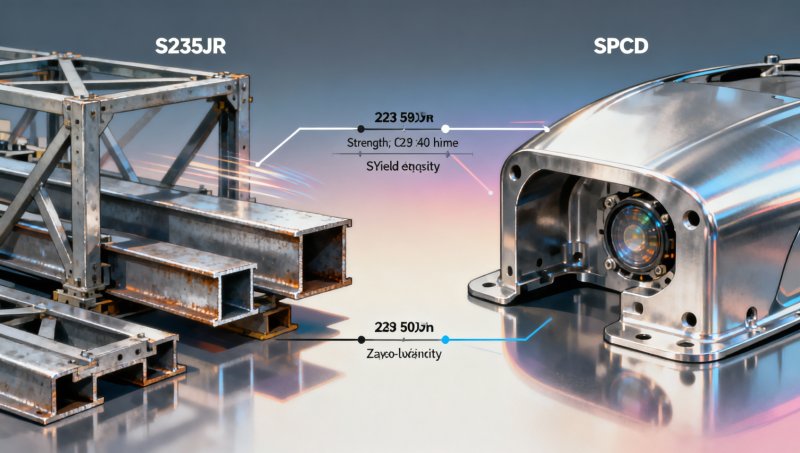
Standards, Certification & Global Compliance
All S235JR and SPCD coils and sheets supplied by Hongteng Fengda undergo third-party verification per EN 10204 3.2 and ISO 9001:2015. Mill test reports include tensile curves, hardness mapping, and surface defect inspection logs—fully aligned with ASTM A6/A6M for dimensional conformity and EN 10143 for cold-rolled strip tolerances.
We maintain parallel production lines certified to EN, JIS, GB/T, and ASTM standards—eliminating re-certification delays when exporting to EU, Japan, or North America. Our API 5L pipe and ASTM A106 pipe portfolios are routinely audited by DNV-GL and TÜV Rheinland, reinforcing trust in cross-material sourcing strategies.
Corrosion-resistant plate and industrial pipes are stocked alongside S235JR and SPCD to support integrated solutions—for instance, pairing S235JR chassis with API 5L pipe manifolds in mobile hydraulic systems, or combining SPCE steel (a close cousin to SPCD) with corrosion-resistant plate for marine-grade instrumentation cabinets.
Why Choose Hongteng Fengda?
As a structural steel manufacturer & exporter from China, Hongteng Fengda bridges global specification rigor with agile local execution. With over 18 years of OEM experience, we offer rapid prototyping for cold-formed components—from single-batch validation to 500-ton monthly volume commitments.
Our value proposition is threefold: First, material traceability—every coil carries QR-coded heat numbers linked to real-time lab data. Second, process flexibility—we perform decoiling, slitting, leveling, and precision shearing in-house to reduce logistics friction. Third, commercial reliability—we honor fixed lead times even during peak season, backed by 99.2% on-time delivery across 2023.
Whether you need S235JR steel for seismic-rated framing, SPCD steel for medical device enclosures, or bundled quotes covering Wire rod, API pipe, and corrosion-resistant plate—we deliver engineered confidence, not just steel.
Contact our engineering sales team today for free grade selection consultation, sample kits, and customized packaging options—including export-ready ISPM-15 pallets and REACH-compliant oil coatings.
Related recommendations
 How to Select Structural Steel Products by Grade, Section, and CoatingStructural steel products selection guide: compare grades, sections, coatings, certifications, and total delivered value for safer, cost-effective projects.
 When Is Structural Steel Bending Better Than Welding for Curved Members?Structural steel bending vs. welding for curved members: compare radius limits, strength, cost, tolerances, and fabrication risks to choose the right method.
 Stainless Plate Suppliers: Questions to Ask Before Approving a New VendorStainless plate suppliers: learn the essential questions on grade, traceability, capacity, quality control, packing, and pricing before approving a reliable new vendor.
 Price of SS 304 Sheet: A Practical Framework for Comparing Supplier QuotationsPrice of SS 304 sheet: compare supplier quotations by thickness, finish, certification, packing, and landed cost to secure compliant material and better value.
Please give us a message


Please enter what you want to find