What matters first
If you are evaluating an ss coil manufacturer for food equipment, the first question is not price. It is whether the coil will stay consistent through fabrication, cleaning, and long service in a sanitary environment. For food machinery, small material defects turn into real problems: uneven forming, visible surface flaws, contamination risk, or premature corrosion after repeated washdowns.
The right supplier should give you confidence in five areas: grade control, surface finish, dimensional tolerance, traceability, and delivery stability. If any of those is weak, the sourcing decision is already shaky.
In practice, a lot of buyers get distracted by broad claims like “food grade” or “high quality stainless steel.” Those phrases mean little unless the manufacturer can show what alloy was supplied, how it was finished, and how it was tested. That is especially true when the coil will be used for tabletops, countertops, kitchenware, food and beverage packaging, conveyor parts, or formed equipment covers.
Check the grade, not just the name
For food equipment, the base alloy has to match the actual working condition. A coil that looks fine on paper can still be the wrong choice if the corrosion requirement, forming method, or cleaning exposure is underestimated. That is why technical evaluators should ask for mill test certificates, heat numbers, and the exact specification behind the coil.
One example is 201 Stainless Steel Coil. It is often considered when buyers need good formability, a relatively low nickel content, and reliable cold-working performance. In a project where cost pressure matters and the part will be heavily formed, that can be a sensible option. But it is not a substitute for higher corrosion resistance where aggressive chemicals, salt exposure, or harsh wash cycles are expected.
That distinction matters. A material can be mechanically workable and still be a poor fit for a food line if the service environment is too demanding. So the question is not “Is stainless steel enough?” The question is “Is this grade enough for this exact use case?”
Surface finish is a hygiene issue, not a cosmetic one
Food equipment surfaces are judged quickly by end users, but the real concern is what the eye does not catch. Scratches, pits, inclusions, and inconsistent polishing create places where residue can sit. If the finish is uneven, cleaning becomes harder and the risk of contamination rises.
When reviewing an ss coil manufacturer, ask what finishes are available and which one is actually controlled in production. BA, 2B, NO.1, NO.4, HL, and 8K all signal different surface conditions. The finish should match the downstream process, not a catalog photo.
For visible panels and countertops, a uniform finish matters because defects are obvious. For hidden food-contact structures, cleanability matters even more. If a supplier cannot explain how it controls surface consistency from coil to coil, that is a warning sign.
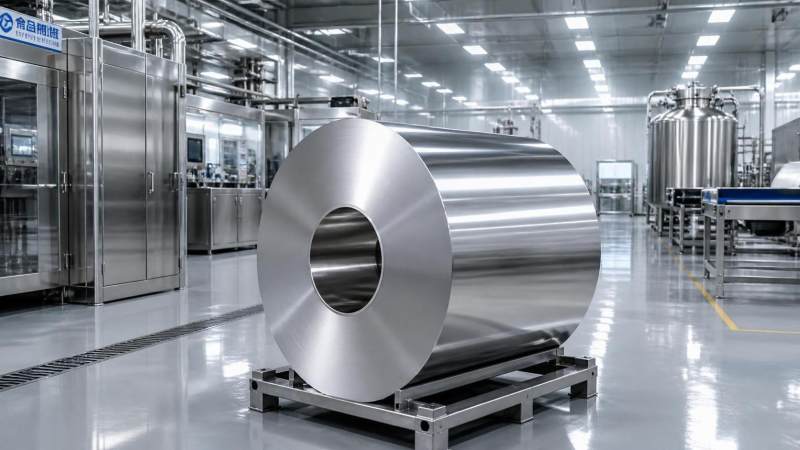
Dimensional tolerance affects fabrication more than many teams expect
Food equipment parts often get stamped, bent, welded, or deep-formed in tight production windows. If thickness or width varies too much, the problem shows up downstream as unstable forming, inconsistent springback, weld distortion, or rejected parts. That is why dimensional control belongs in the first round of evaluation, not the last.
For a technical buyer, the useful question is simple: can this manufacturer hold the coil dimensions consistently enough for your process? If your tooling was designed around a narrow tolerance band, a cheap coil that drifts outside that range will cost more after scrap, rework, and downtime.
This is where a supplier’s production discipline matters more than sales language. Ask for the actual tolerance window, the inspection method, and whether the manufacturer can support repeat orders without shifting the spec.
Look for hygiene and compliance evidence
Food equipment sourcing has a compliance layer that should not be guessed. If the coil is used in equipment that touches food, touches packaging, or sits in a sanitary processing area, you need a supplier who can support documentation, traceability, and testing discipline. ISO, SGS, and BV certification can help indicate basic process control, but they do not replace project-specific verification.
The right ss coil manufacturer should be able to show how the material is identified, packed, and shipped, and how the lot can be traced back if there is a later issue. That is not paperwork for its own sake. It is the difference between a controllable quality event and a production problem that spreads across an entire batch.
For buyers working across North America, Europe, the Middle East, or Southeast Asia, this matters even more because the acceptance standard is rarely identical from one customer to another. A supplier with broad export experience is useful only if that experience translates into consistent documentation, stable quality, and predictable lead times.
Ask whether the manufacturer understands the forming route
Many food equipment parts are not used as flat sheet. They are cut, bent, rolled, or stretched into finished components. This is where a coil’s mechanical behavior becomes more important than its brochure language. Yield strength, elongation, hardness, and work-hardening response all affect how the part behaves in real fabrication.
201-grade material is often chosen when higher formability is needed and cold-working will be part of the process. That can be useful for kitchen supplies, conveyor-related parts, or formed covers where shaping matters more than extreme corrosion resistance. But if the application depends on repeated chemical exposure or a more aggressive sanitary environment, the grade selection should be reviewed again before ordering.
The practical test is this: can the supplier explain how the coil behaves during forming, not just what the chemical composition is? If they cannot, they may be a trader, not a manufacturing partner.
Delivery reliability is part of quality
Technical teams often separate quality from supply, but food equipment projects punish that separation. A coil that arrives late can delay fabrication, assembly, testing, and final shipment. A coil that arrives with inconsistent finish can stop an entire production run.
So when assessing an ss coil manufacturer, look at capacity, order response time, and consistency across repeat lots. Stable production is not a soft advantage. It is part of project control. For OEM buyers and industrial fabricators, dependable lead times often matter as much as the sheet itself.
Hongteng Fengda positions itself as a structural steel manufacturer and exporter from China, with modern manufacturing facilities, strict quality control, and supply support for global buyers. That background is more relevant than it may first appear: a manufacturer used to export discipline, standard compliance, and customized production is usually better prepared to handle specification checks and batch consistency than a supplier working only to spot demand.
What to verify before you place the order
If you need a short checklist, keep it practical. Confirm the grade and heat number. Confirm the finish and whether it fits cleaning and appearance requirements. Confirm thickness and width tolerances. Confirm the certification trail. Confirm whether the manufacturer can support the forming method you plan to use. Then confirm lead time in writing.
That sounds basic, but most sourcing mistakes happen when one of those items is assumed instead of checked.
There is also a useful split between “acceptable for general fabrication” and “acceptable for food equipment.” A coil can be fine for tabletops, kitchenware, or decorative panels and still be the wrong call for a hygienic processing line. Technical evaluators should make that distinction early, before tooling and procurement lock the project in.
Final decision rule
Choose the ss coil manufacturer that can prove consistency, not the one that speaks most confidently. For food equipment, the best supplier is usually the one that answers material, finish, tolerance, traceability, and delivery questions without drifting into vague claims. If a manufacturer can do that, you are much closer to a reliable sourcing decision.
FAQ
Is 201 stainless steel suitable for food equipment?
It can be suitable for some formed parts and lower-corrosion-demand applications, but it should be checked against cleaning chemicals, humidity, and direct food-contact requirements.
What documents should I ask from an ss coil manufacturer?
At minimum: mill test certificate, heat number traceability, coating or finish details if relevant, and quality certificates tied to the shipment.
Why does surface finish matter so much?
Because scratches and rough areas can hold residue and make cleaning less effective, which affects hygiene and appearance.
Should I choose the lowest-cost coil if the spec looks similar?
Usually no. If tolerance, finish, or traceability is unstable, the hidden cost shows up in scrap, rework, and delays.
Anchor text ideas
- Stainless steel coil grade comparison: material selection guide
- Food equipment metal surface finish: inspection checklist
- Stainless steel coil tolerances: fabrication buying guide
- Stainless steel export inspection: quality document guide
- Cold-formed stainless steel applications: selection notes
External source directions
- Food equipment hygiene and sanitation guidance from a government food safety agency
- Stainless steel material standards from ASTM, EN, JIS, or GB standard bodies
- Industry association documents on stainless steel corrosion and fabrication practice
Please give us a message


Please enter what you want to find