Galvanized Pipe Manufacturer Selection: Zinc Coating, Tolerance, and Compliance
Choosing the right galvanized pipe manufacturer is rarely a price-only decision. For evaluation teams comparing suppliers across regions, the real question is whether the manufacturer can deliver pipe that performs the same way on site as it does on paper. That usually comes down to three things: zinc coating quality, dimensional tolerance, and compliance with the standards your project actually uses.
If any one of those is weak, the procurement risk goes up quickly. A pipe with uneven coating may fail early in corrosive conditions. A pipe with poor roundness or wall thickness variation can create installation issues, threading problems, or welding inconsistencies. A supplier that cannot clearly support ASTM, EN, JIS, or local documentation requirements may delay approvals even if the product itself is usable.
That is why a serious review of a galvanized pipe manufacturer should focus less on generic claims and more on process control, inspection discipline, and export execution. In steel sourcing, consistency matters more than one perfect sample.
Zinc coating is not just about thickness
Buyers often start with coating weight or thickness, and that makes sense, but it is only part of the picture. Galvanized pipe is selected because the zinc layer protects the steel substrate from corrosion. The practical issue is whether that protection is uniform, adherent, and suitable for the service environment.
A manufacturer should be able to explain the galvanizing route being used, such as hot-dip processing, and how the coating is controlled across the pipe body, ends, and internal surface where required by the relevant standard. In business evaluation, it helps to ask how the plant handles surface preparation before galvanizing, how bath chemistry is controlled, and what inspection methods are used to verify the coating after production. A thick layer on one section does not compensate for thin or bare spots elsewhere.
This is also where intended application matters. Galvanized pipe used in outdoor structural frames, fencing, general water conveyance, or industrial support systems may face very different exposure conditions. Coastal atmosphere, standing water, abrasion, and cut-end treatment all affect service life. A capable supplier should not treat every galvanized order as interchangeable.
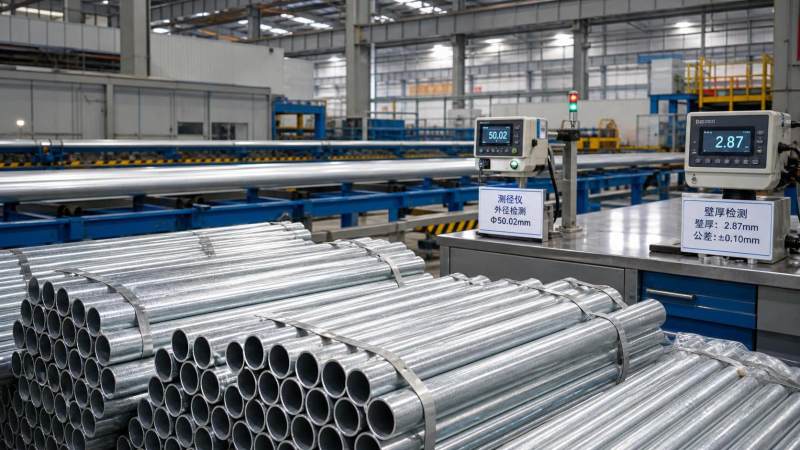
When reviewing quotations, it is worth checking whether the supplier discusses coating requirements in relation to standards and end use, not only price per ton. That conversation often reveals how mature the manufacturer really is.
Tolerance control tells you a lot about manufacturing discipline
Dimensional tolerance is one of the quickest ways to separate a trading offer from a dependable manufacturing capability. Many downstream problems do not appear in laboratory reports; they show up during installation. Pipe outside tolerance can affect fit-up, joint integrity, coating performance after fabrication, and even transport efficiency when bundled or containerized.
The basics include outside diameter, wall thickness, length tolerance, straightness, and end condition. Depending on the application, you may also need to check ovality, mass per meter, and thread compatibility. For structural or fabricated assemblies, consistency across batches is often more important than hitting the nominal size on a few test pieces.
A good galvanized pipe manufacturer should be ready to show how these dimensions are measured, how often in-process inspection is performed, and what happens when readings drift toward the limit. That sounds operational, but it directly affects commercial risk. If the answer is vague, the supplier may still be able to produce steel, but not necessarily with the control needed for repeat orders or project schedules.
This is one reason many international buyers prefer partners that already export structural steel products under multiple standards. Hongteng Fengda, for example, operates as a structural steel manufacturer and exporter from China, supplying angle steel, channel steel, steel beams, cold formed profiles, and customized components for overseas markets. That type of export background does not automatically prove galvanized pipe capability, but it usually means the supplier is familiar with tolerance control, document flow, and the practical demands of ASTM, EN, JIS, and GB-based orders.
Compliance should be checked against the project, not the brochure
One common sourcing mistake is assuming that a factory with “international standards” on its website is automatically compliant with your project specification. In reality, compliance needs to be matched to the exact standard edition, test scope, marking requirement, and documentation package requested by the buyer, consultant, or local authority.
For galvanized pipe, that may involve material grade, coating requirement, mechanical properties, hydrostatic or non-destructive testing depending on product type, mill test certificates, and traceability. In some markets, packaging labels, country-of-origin documents, and pre-shipment inspection records are just as important as the mill certificate itself.
Ask suppliers a simple but revealing question: can they provide a sample document set from a previous export order with sensitive details removed? Serious manufacturers usually understand this request. It shows whether they can support not just production, but approval and customs processes as well.
The same discipline matters across other steel categories. In foundation and waterfront work, for instance, buyers comparing pipe suppliers often also review complementary products such as Hot Rolled Steel Sheet Pile. Where retaining wall or water retaining wall applications are involved, the discussion naturally shifts to standards like EN10248, EN10249, JIS5528, JIS5523, and ASTM, along with steel grades such as S275, S355, S390, S430, SY295, SY390, or ASTM A690. That comparison is useful because it shows whether a supplier can work across steel systems with the same attention to certification, interlock configuration, dimensional flexibility, and inspection requirements.
Questions that expose real supplier capability
The best evaluations usually come from practical questions rather than broad requests for a company profile. A few examples tend to be more revealing than a long checklist.
- How is zinc coating measured and recorded for each lot?
- What tolerance items are checked during production, and which are only checked at final inspection?
- Can the supplier align production and test documentation to ASTM, EN, JIS, or project-specific formats?
- How are non-conforming pieces isolated and reported?
- What is the usual lead time for standard sizes versus customized dimensions or end finishes?
- Can the factory support mixed steel procurement if the project includes pipe plus structural sections or fabricated components?
These questions matter because many delays in steel sourcing come from coordination gaps rather than from melting or rolling capacity. A factory may produce acceptable pipe but struggle with customized markings, special length control, third-party inspection scheduling, or export packing details. Evaluation teams should treat those issues as part of product quality, not as administrative extras.
A low quote can hide expensive uncertainty
In galvanized pipe purchasing, the cheapest offer often looks attractive because the specification appears simple. But if coating consistency is weak, tolerances are loose, or compliance documents arrive incomplete, the cost moves downstream. Rework, site delays, rejected lots, and additional inspection can easily erase an initial price advantage.
That does not mean the highest-priced manufacturer is safer. It means price needs context. Evaluation teams should compare offers on the basis of production scope, coating process, testing, packaging, standard coverage, and delivery reliability. If one supplier has a stable export history and another relies heavily on outsourced steps, that difference should be visible in the risk assessment.
For projects that involve multiple steel items, there is also a sourcing efficiency angle. A partner with broader structural steel manufacturing capability may simplify coordination across pipe, sections, and customized components. Hongteng Fengda’s position in structural steel export is relevant here: buyers handling international construction or industrial procurement often benefit when one supplier can align quality control, documentation, and shipment planning across several product categories rather than splitting every item among unrelated vendors.
What to verify before approving a manufacturer
Before making a final supplier decision, it is usually worth confirming a few points in writing. Not because paperwork replaces engineering judgment, but because unclear assumptions tend to surface at the worst moment.
This level of clarity is especially useful when orders include customized lengths, mixed destinations, or additional fabricated steel items. It reduces the chance that one department approves a technical proposal while another discovers a documentation or logistics problem later.
The right supplier is the one that removes uncertainty
A dependable galvanized pipe manufacturer is not defined by a polished catalog. The more useful measure is whether the supplier can repeatedly deliver the required coating protection, maintain dimensional control, and support compliance without constant clarification. For business evaluation teams, that is what lowers sourcing risk.
If you are comparing suppliers, move the discussion beyond nominal size and price early. Ask for the inspection logic behind the product, not just the product list. Confirm which standards really apply. Check whether the factory can support the same discipline across adjacent steel needs, from structural sections to customized components and, where relevant, products such as long-length U sheet pile systems with flexible dimensions and certified production routes.
That approach usually leads to a better decision than chasing the lowest quote. In steel procurement, certainty has value, even when it does not appear on the first page of the offer.
Please give us a message


Please enter what you want to find