Choosing a carbon steel manufacturer is often harder than it looks. On paper, several suppliers may promise the same grades, the same standards, and similar delivery windows. In practice, a buyer can still run into delayed shipments, inconsistent mechanical performance, unclear certificates, or a coil that looks fine until it reaches the fabrication shop.
That is why the decision is rarely just about price. If you are sourcing for a project where strength matters and lead time is already tight, the real question is whether the supplier can keep material quality stable while still producing and shipping on schedule. A weak choice here can affect fabrication, installation, and the timing of everything that depends on the steel arriving as expected.
Start with the end use, not the product name
Many procurement teams begin by asking for a quote before they have fully defined the application. That usually creates confusion later. A supplier may offer a material that matches the name on the request but not the actual working conditions. For structural and industrial uses, the buyer should first clarify whether the steel will be cut, formed, welded, exposed to moisture, or used in a load-bearing part.
This matters because a carbon steel manufacturer should be able to explain which grades fit the job and which ones are better left out. If the answer is vague, or the sales team only repeats stock availability, that is a sign to slow down. A reliable partner should be able to connect grade selection with the real use case, not just list products.
Look at strength control as a process, not a promise
Strength is easy to mention and harder to prove. Buyers often focus on a single value on the certificate, but that is only one part of the picture. What you want to know is how the mill controls raw materials, rolling consistency, and testing before shipment. Small changes in process can affect yield strength, tensile strength, and elongation, especially when the order needs to perform consistently across multiple batches.
Ask how the supplier tracks coil or batch traceability, what tests are done in-house, and whether the reported values match the standard you need. For galvanized products used in fabrication or building applications, the surface condition and zinc coating also matter because they affect both corrosion resistance and downstream processing.
If the supplier cannot clearly explain test methods, it becomes hard to trust the numbers on the paperwork.
Use specification details to judge whether the supplier is organized
One practical way to evaluate a manufacturer is to compare how they handle ordinary requests versus customized ones. A supplier that can manage different thicknesses, widths, lengths, and coating requirements without confusion usually has a better production system behind it.
For example, some buyers need galvanized material in different formats and standards, such as DX51D+Z, SGCC, or S350GD+Z, depending on the downstream application. A product like Galvanized Steel Coil Sheet can be relevant in this stage because it shows whether the manufacturer offers multiple thickness ranges, width options, custom cutting lengths, and zinc coating levels suited to different uses. When a supplier can discuss those details without drifting off topic, it usually signals stronger internal coordination.
That said, a broad catalog alone is not enough. What matters is whether the manufacturer can keep the specification stable from order to order. If every quote comes back with a different interpretation of the same requirement, lead time risks tend to grow later.
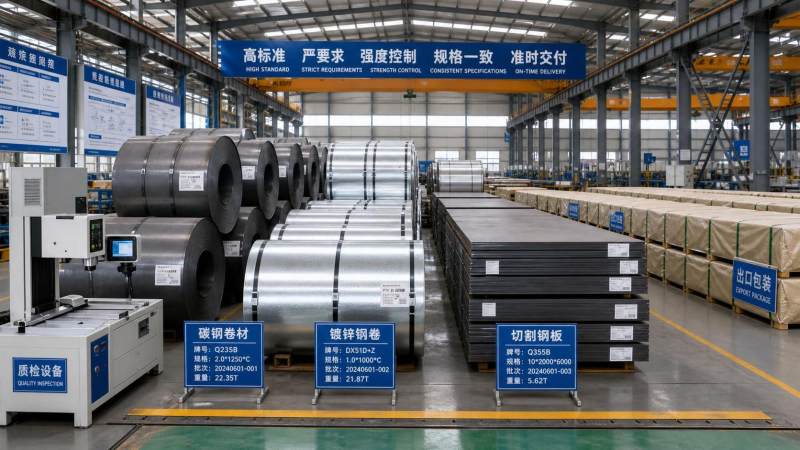
Separate real lead time from estimated lead time
Lead time is one of the easiest areas for misunderstanding. Some suppliers quote what sounds like a fast schedule, but the number may only cover production, not raw material preparation, testing, packing, or export handling. Others may quote conservatively but then keep the schedule more stable.
When evaluating a carbon steel manufacturer, ask for the full workflow instead of a single delivery date. You want to know whether they hold stock, whether production is made to order, how they manage peak periods, and what happens if an order requires non-standard dimensions. For export buyers, shipping arrangements and document preparation can matter just as much as rolling capacity.
A useful sign is how the supplier responds when the specification changes. If a small revision causes confusion, the promise of short lead time may not hold up once the order starts.
Check standards, but do not stop at the certificate
International standards such as ASTM, EN, JIS, and GB are useful reference points, but they should not be treated as proof by themselves. A certificate can tell you what was claimed; it does not tell you how carefully the material was produced or whether the shipment matches the order details.
Better practice is to review the standard along with the material grade, coating requirement, dimensional tolerance, and mechanical properties. If a supplier serves different markets, it should be able to explain how it aligns production with common specifications used in those markets. That is especially important when the steel will be reprocessed by another plant after import.
Ask whether the documents are prepared consistently and whether the factory can support inspection before shipment. This is often where weaker suppliers become visible.
Judge export experience by the questions they ask back
A manufacturer with export experience usually asks more precise questions. They may want to know the destination market, packaging preference, port requirements, tolerance needs, and whether the buyer needs OEM support. That is not a sales trick; it is often a sign that they understand how order details affect loading, compliance, and delivery.
Suppliers that regularly export structural steel and related products tend to be more familiar with international buying habits. They are also more likely to have a steadier process for customs documents, labeling, and batch identification. None of this guarantees smooth delivery, but it reduces avoidable friction.
If the buyer is comparing several quotes, this is one of the clearest ways to separate a trading response from a manufacturing response.
When the order is urgent, narrow the risk before you commit
Urgent sourcing tends to expose weak spots quickly. Buyers often accept the first supplier who says yes, then discover problems later in specification control or shipment readiness. A better approach is to ask for a sample of the paperwork flow, a clear production timeline, and confirmation of which dimensions are standard and which need customization.
It also helps to keep the first order simple if possible. That does not mean lowering requirements. It means avoiding unnecessary complexity until the supplier has proven that they can handle the core spec reliably. Once the relationship is established, customized lengths, coatings, or grades are easier to manage.
In many buying situations, the safest supplier is not the one with the loudest claims. It is the one that answers clearly, documents carefully, and does not blur the line between available stock and true production capacity.
Common questions buyers ask
What is the fastest way to screen a carbon steel manufacturer?
Start with three things: material traceability, export documentation, and whether they can explain the difference between standard and custom specifications without hesitation.
Should I choose a supplier mainly by price?
Price matters, but it should come after strength control, standards compliance, and lead time reliability. A low quote is not useful if the material arrives late or does not fit the application.
Why do two suppliers give different answers for the same grade?
They may be using different production routes, coating methods, or interpretation of tolerances. That is why it helps to compare the full specification, not just the grade name.
In the end, evaluating a carbon steel manufacturer is mostly about reducing uncertainty. If the supplier can show stable production, clear standards alignment, and realistic lead times, the buying process becomes much easier to manage.
Please give us a message


Please enter what you want to find