If you plan to buy 304 stainless steel wire 0.5mm soft for industrial or manufacturing use, checking key factors before ordering can help you avoid quality risks, delivery delays, and unnecessary costs. For procurement teams, understanding material standards, surface finish, softness, tolerance, and supplier reliability is essential to making a safe and cost-effective sourcing decision.
What “0.5mm soft 304 stainless steel wire” really means in procurement terms
In sourcing discussions, “304 stainless steel wire 0.5mm soft” sounds straightforward, but buyers often discover that the real issue is not the diameter alone. The wire may be used for weaving, binding, forming, spring-related light duty applications, filtration, or general manufacturing. In each case, the tolerance, elongation, surface quality, and coil condition can matter as much as the alloy grade.
For procurement, the word “soft” deserves close attention. Suppliers may use it to describe annealed wire, low-hardness wire, or wire with improved flexibility after drawing and heat treatment. These are not always identical. If the end use depends on bendability or stable forming performance, the supplier should specify the treatment route rather than only saying “soft.”
Check the material grade before discussing price
304 is one of the most widely used stainless steel grades because it offers good corrosion resistance, formability, and broad industrial usability. But in buying decisions, grade confirmation should go beyond the label on a quotation. Procurement teams should ask for heat number traceability, mill test certificate details, and whether the chemical composition aligns with the relevant standard the project follows, such as ASTM, EN, JIS, or GB.
Many cost problems start when buyers compare offers only by unit price. A cheaper quotation may reflect looser quality control, less consistent wire surface, or uncertain batch stability. For export-oriented projects, a low initial price can become expensive if the wire fails forming tests, causes line stoppages, or is rejected at inspection.
Diameter tolerance is not a small detail
For 0.5mm wire, even a small deviation can affect downstream processing. If the wire is used in automatic feeding, weaving, or precision forming, poor diameter consistency can create jamming, unstable tension, or product rejection. Buyers should ask for tolerance range, measurement method, and whether the supplier checks diameter across the full coil length or only at sample points.
Soft wire also needs consistent mechanical behavior. Two coils that look similar may perform differently if one has uneven annealing. That is why a procurement team should request both dimensional and mechanical data when the application is sensitive to flexibility.
Surface finish affects more than appearance
Surface quality often receives too little attention during sourcing. For stainless steel wire, scratches, oil residue, discoloration, and inconsistent shine can all indicate process issues or handling damage. In some applications, the issue is cosmetic. In others, it can affect friction, contamination risk, or corrosion resistance at contact points.
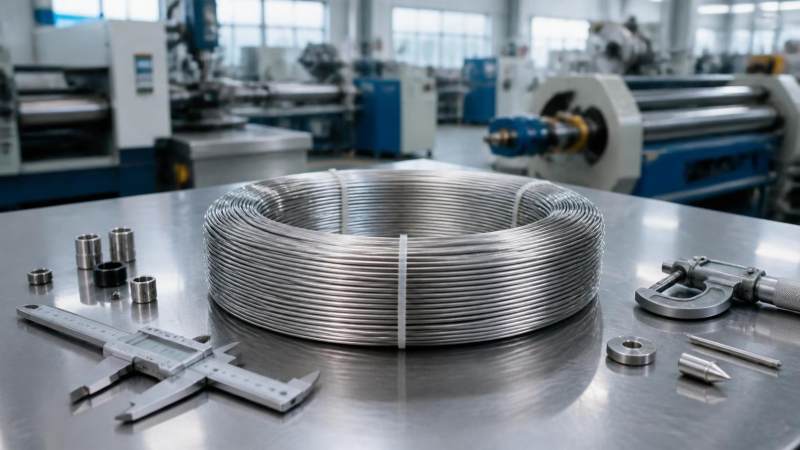
Buyers should define acceptable surface condition before placing the order. If the wire will be used in visible assemblies, medical-adjacent parts, filtration systems, or clean manufacturing environments, the acceptance standard needs to be clearer than “good surface.” Ask for sample photos from the actual batch, not generic product images.
Softness should be tested against the real application
The right level of softness depends on how the wire will be used. A wire that is too hard may crack or spring back during forming. A wire that is too soft may lose shape, deform too easily, or cause problems in automated handling. Procurement teams should avoid treating softness as a marketing description and instead connect it to the end-use requirement.
For example, if the wire is used for bundling, light forming, or manual assembly, a softer annealed condition may be acceptable or even preferred. If it is used in applications requiring repeated tension or geometric stability, the buyer may need a more controlled balance between flexibility and strength. This is where sample testing matters more than brochure claims.
Order terms should include coil condition, packing, and traceability
One of the most common hidden cost points is packaging. Fine wire is easy to deform, tangle, or surface-damage during transit if the coils are not packed properly. Before confirming an order, procurement teams should clarify inner coil diameter, outer packing method, moisture protection, labeling, and whether each coil can be traced back to a production batch.
Traceability is especially important for export supply chains or projects with incoming inspection requirements. If a quality issue appears later, batch traceability makes claim handling and root-cause analysis much easier. Without it, the buyer may lose both time and negotiation leverage.
Supplier capability matters as much as the spec sheet
For a commodity-like product, it is tempting to assume that any supplier offering 304 stainless steel wire can meet the same requirements. In practice, consistency is usually the deciding factor. Procurement teams should look at whether the supplier can hold stable lead times, provide repeatable softness, and support custom packing or coil requirements.
Supplier reliability also includes response speed, document quality, and willingness to confirm details in writing. If a supplier avoids answering questions about tolerance, annealing condition, or inspection process, that is a sign the quoted price may not reflect the real delivered value.
When buyers need broader steel sourcing support, it is worth evaluating suppliers that understand both standard products and project-specific requirements. For example, some manufacturers also supply structural components such as Z-beam, which indicates a more mature production and export management capability. That does not replace wire-specific qualification, but it can be a useful signal when reviewing a supplier’s overall industrial experience.
Cost control starts with asking the right questions
Procurement teams often focus on negotiating the unit price, but the real cost of buying 304 stainless steel wire 0.5mm soft includes scrap rate, rework, inspection time, shipping damage, and delivery delay risk. A slightly higher price from a better-controlled supplier may produce a lower landed cost if it reduces rejection and production disruption.
Before placing an order, the buyer should at least confirm the following points: the exact grade standard, diameter tolerance, softness condition, surface finish, coil packing, test certificate availability, and lead time commitment. If the wire will be used in a critical production line, sample approval and pre-shipment inspection are worth the extra time.
Common procurement mistakes to avoid
One frequent mistake is assuming “304” means the same thing from every supplier. Another is accepting “soft” without defining what softness means in measurable terms. A third is comparing offers without checking whether the packaging and delivery terms are comparable. These mistakes often show up only after the goods arrive, when correction costs are much higher.
Another issue is underestimating the impact of application mismatch. Wire that performs well in one process may fail in another if the feeding method, bending radius, or surface contact conditions are different. Procurement and technical teams should review the actual usage scenario together before releasing the PO.
Buying 304 stainless steel wire 0.5mm soft is not just a material purchase. It is a risk decision about consistency, process fit, and delivery reliability. The best sourcing outcome usually comes from clear specifications, verified samples, and suppliers that can explain how they control quality from production to packing.
Please give us a message


Please enter what you want to find