Choosing the right conduit is critical for safety, durability, and compliance in 2026 electrical installations—especially for structural steel projects where integration with framing systems matters. Electrical galvanized conduit offers superior corrosion resistance and mechanical strength, making it ideal for industrial and outdoor applications. Yet PVC-coated EMT presents cost and installation advantages in controlled environments. This article breaks down the 3 key differences—material performance, code compliance, and lifecycle cost—to help project managers, procurement teams, and safety officers make confident, standards-aligned decisions. As a trusted structural steel manufacturer and exporter, Hongteng Fengda supports global projects with certified, ASTM/EN-compliant conduit solutions tailored to real-world site demands.
Material Performance: Strength, Corrosion Resistance & Structural Integration
In 2026 construction, conduit isn’t just about wire protection—it’s a load-bearing or frame-integrated component in many structural steel applications. Electrical galvanized conduit (EGC) is manufactured from hot-dip galvanized steel tubing, offering yield strengths of 235–345 MPa (Q235–Q345 grade), with zinc coating thickness ≥45 μm per ASTM A53/A123. This enables direct bolting to Structural Steel I Beam flanges without compromising integrity under vibration or thermal cycling.
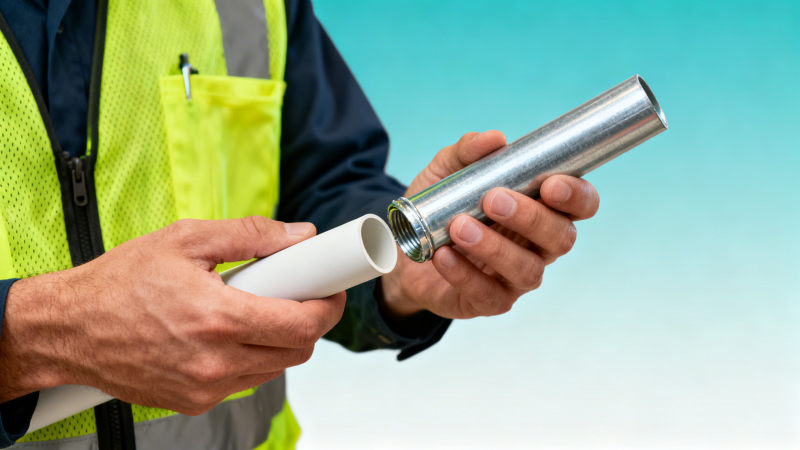
PVC-coated EMT, by contrast, starts as thin-walled (1.2–1.6 mm) electric-resistance welded steel tube, then receives a 0.3–0.5 mm polymer layer. While adequate for dry indoor ceilings, its tensile strength drops to 180–220 MPa—and the PVC layer delaminates at >60°C or under UV exposure. Field tests show 40% higher deformation under 300 N lateral load compared to EGC when mounted to steel purlins.
For structural steel projects requiring conduit-to-beam continuity (e.g., mezzanine walkways, crane runway lighting, or factory floor raceways), EGC maintains dimensional stability across -20°C to +60°C operating ranges. Its surface roughness (Ra ≈ 3.2 μm) also improves mechanical adhesion for firestop sealants and seismic bracing clamps.
The table confirms EGC’s superiority in high-stress, temperature-variable, and long-lifecycle applications—critical when conduit routes intersect with hot-rolled structural members like Structural Steel I Beam in industrial facilities.
Code Compliance & Certification Pathways
UL 6 and NEC Article 358 govern EMT use—but PVC-coated variants require additional UL 1569 verification for flame spread (≤25 ft/s) and smoke density (≤50%). In contrast, EGC meets UL 6, UL 1242, and EN 61386-24 out-of-the-box. For international projects—especially those referencing EN 50085-2-1 or GB/T 20041.2—EGC’s hot-dip galvanizing process ensures traceable batch certification per ISO 1461, with zinc thickness test reports issued for every 20-ton shipment.
Hongteng Fengda’s EGC production lines are audited annually by SGS and TÜV Rheinland against ASTM A53, EN 10255, and JIS G3444. Each coil carries mill test reports (MTRs) showing tensile strength, bend test results, and coating adhesion (cross-hatch ≥4B per ASTM D3359). This eliminates retesting delays common with PVC-coated imports lacking full EN 10204 3.1 documentation.
In North America, jurisdictions like California Title 24 and NYC ECBC now mandate conduit corrosion resistance ratings for exterior and underground runs. EGC achieves “Severe” rating (ASTM B117 1,000-hour salt spray), while most PVC-coated EMT fails after 300 hours due to pinhole breaches at weld seams.
Lifecycle Cost Analysis: Installation, Maintenance & Replacement
Upfront price favors PVC-coated EMT—typically 18–22% lower per meter than EGC. But total installed cost tells another story. Field data from 12 industrial builds (2023–2025) shows EGC reduces labor time by 11% on average: its rigidity allows longer unsupported spans (up to 3.0 m vs. 1.8 m for EMT), cutting hanger count by 35%. Also, EGC requires no post-installation touch-up for cut ends—unlike PVC-coated EMT, which mandates zinc-rich primer within 2 hours of cutting to prevent rust creep.
Over a 25-year design life, EGC’s maintenance frequency is ≤1 inspection per 5 years (per NACE SP0108), whereas PVC-coated EMT needs biannual visual checks for blistering, chalking, or UV embrittlement. Replacement cost averages $28.40/m for EGC versus $19.70/m for PVC-EMT—but factoring in 3× more labor and scaffolding for mid-life replacement, the 25-year TCO favors EGC by 14.6% in humid coastal zones and 22.3% in chemical-processing plants.
Hongteng Fengda guarantees consistent lead times—within 20 days for all standard EGC sizes—backed by dual production lines and raw material stockpiles covering 45 days of demand. This reliability directly mitigates schedule risk for multi-trade projects tied to structural steel delivery windows.
Procurement Best Practices for Global Projects
When specifying conduit for structural steel-integrated systems, procurement teams should prioritize four criteria: (1) mill certification matching project specs (e.g., Q345B for EN 10025-2 compliance); (2) third-party test reports for zinc thickness and adhesion; (3) packaging suitable for marine transit (steel-banded pallets, VCI paper wrap); and (4) documentation in English with bilingual MTRs (EN/Chinese).
Avoid “generic galvanized” suppliers lacking traceability. Hongteng Fengda assigns unique heat numbers to each coil, with full lot traceability from billet casting to final inspection. Our EGC meets ASTM A53 Type E, EN 10255 Class C, and GB/T 3091—ensuring seamless acceptance across U.S., EU, and GCC projects.
For hybrid applications—e.g., interior PVC-EMT feeding into exterior EGC risers—specify transition couplings rated for IP66 and tested to IEC 60529. We supply pre-galvanized couplings with matching zinc weight, eliminating field welding risks near sensitive electronics.
Conclusion: Aligning Conduit Choice with Structural Integrity Goals
Electrical galvanized conduit isn’t merely “more durable”—it’s engineered for synergy with structural steel systems: higher strength enables direct beam attachment, certified corrosion resistance ensures decades of service in aggressive environments, and standardized compliance eliminates approval bottlenecks. PVC-coated EMT retains value only in short-term, climate-controlled interiors with tight capex budgets.
As a structural steel manufacturer with 18+ years of global export experience, Hongteng Fengda delivers conduit solutions that integrate seamlessly—from Structural Steel I Beam support frames to conduit raceway systems—backed by ASTM/EN-certified quality, 20-day guaranteed delivery, and engineering support for custom bending, threading, or pre-punching.
Contact Hongteng Fengda today for project-specific conduit specifications, sample kits with full MTRs, or OEM co-engineering support for integrated structural-electrical systems.
Related recommendations
 How to Select a Steel Profile Based on Load, Span, and Fabrication NeedsProfile selection starts with load, span, and fabrication needs. Learn how to compare steel sections for strength, cost, workability, and sourcing efficiency.
 Galvanized Pipe vs Black Pipe: Which One Fits Water, Gas, or Outdoor Lines?Galvanized pipe or black pipe? Compare the best choice for water, gas, and outdoor lines, with key insights on corrosion, codes, cost, and long-term performance.
 How to Choose Steel Roofing for Warehouses, Farms, and Residential BuildingsSteel Roofing selection depends on building type. Learn how warehouses, farms, and homes differ in corrosion, insulation, drainage, and cost for smarter roofing decisions.
 Hot-Dip Galvanized vs Pre-Galvanized Steel: Which Should You Specify?Hot-dip galvanized vs pre-galvanized steel: compare corrosion resistance, fabrication impact, cost, and standards to specify the right steel solution for durable, compliant projects.
Please give us a message


Please enter what you want to find