Introduction
As global demand for metal packaging shifts, procurement and plant managers must decide whether to outsource 3-piece can production or invest in in-house equipment. This analysis by Shandong Hongteng Fengda will compare total cost, break-even timelines and operational risks for can making machine investments versus outsourcing tin can production lines. We examine capital and OPEX of metal packaging equipment — from aerosol can making line and food can sealing machine to welding machine for tin can and 2-piece can equipment — and outline implications across procurement, quality control, project management and after-sales support. In the steel industry context, the choice between outsourcing and in-house manufacturing for 3-piece can production is not purely financial: it affects supply security, product quality, traceability, and integration with upstream steel coil and plate inputs. Procurement teams and plant managers face competing pressures — reducing unit cost, shortening lead times, maintaining food-grade sealing standards, and ensuring compliance with export markets across North America, Europe, Middle East and Southeast Asia. For packaging buyers of aerosol cans, food cans or industrial containers, considerations include the maturity of the tin can forming process, the availability of reliable can making machine China suppliers, and after-sales service for complex systems such as welding machine for tin can and automated food can sealing machines. This introduction frames the central questions the rest of this paper addresses: what are the total cost components (CAPEX and OPEX) when bringing a tin can production line inside, what is a realistic break-even timeline under conservative production assumptions, and how do quality control and maintenance challenges influence the decision? We will use industry-informed cost ranges, scenario modeling, and risk assessments tailored to stakeholders including procurement personnel, project managers, quality and safety officers, maintenance teams, and channel partners. The goal is practical guidance for steel companies and converters evaluating investments in metal packaging equipment while maintaining focus on the realities of working with steel plates, coils and related logistics in 2025.
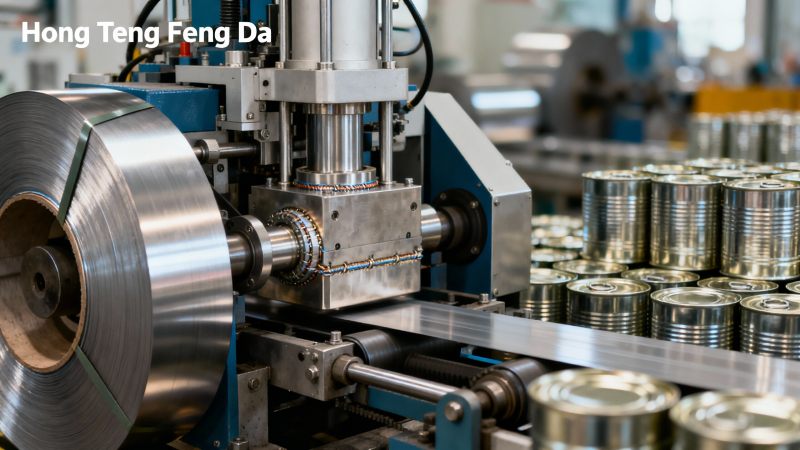
Cost components: CAPEX and OPEX breakdown for in-house 3-piece can production
A thorough assessment of the total cost for in-house 3-piece can production must separate upfront capital expenditure (CAPEX) from ongoing operational expenditure (OPEX). CAPEX typically includes the can making machine line itself (forming, seaming, welding and coating subsystems), civils and utilities upgrades, automation controls, material handling and integration with coil feed and decoiler systems. For a medium-capacity 3-piece tin can line suitable for food and aerosol containers, machine procurement and commissioning can range from modest configurations at several hundred thousand dollars to fully automated production cells in the low millions depending on specifications. When sourcing can making machine China suppliers or European OEMs, expect variation driven by automation level, local customization, and inclusion of equipment such as an aerosol can making line or specialized food can sealing machine. OPEX elements include raw-material costs (tinplate or galvanized steel coils, coatings), energy and compressed air consumption, consumables (seaming rings, welding electrodes, seals), labour, routine maintenance, spare parts inventory, and metallurgical quality control. In steel-centric operations the cost of tinplate or galvanized substrate and the tin can forming process precision can materially affect yield and rework rates — thus raising effective per-unit cost. Labour costs depend on automation; well-automated lines reduce headcount but increase requirements for skilled maintenance technicians and PLC programmers. Utilities and environmental controls (fume extraction for welding, waste treatment for coatings) are often under-budgeted but critical to continuous operation and regulatory compliance. A realistic financial model allocates CAPEX depreciation over equipment life (commonly 7–12 years for high-capex metal packaging equipment), and it itemizes fixed and variable OPEX per produced unit. For example, if a facility invests in a combined can making machine and welding machine for tin can cells costing $1.2M, with annual fixed costs (depreciation, facility overhead, insurance) at $200k and variable costs at $0.03–$0.08 per can depending on material choice and energy pricing, procurement teams can compare these in-house unit costs to prevailing outsourcing prices. Outsourcing suppliers price for finished can supply inclusive of logistics and minimum order quantities; these external rates vary by region, order size and required compliance (e.g., food-grade standards), and should be benchmarked against the derived in-house unit cost to inform investment decisions.
Break-even analysis and production scenarios for 3-piece can production
A practical break-even analysis requires scenario building around realistic production volumes, pricing, and margin assumptions. Start with a baseline: determine the annual can volume the plant needs to internalize to justify CAPEX. Suppose an outsourced tin can production line supplier quotes $0.065 per can delivered for a food-grade 3-piece can at volumes of 50 million units annually. If the in-house analysis, after including depreciation, maintenance, material and labour, yields a variable plus allocated fixed cost of $0.045 per can, the in-house option saves $0.02 per can. With a CAPEX of $1.2M and additional commissioning costs of $150k, the simple payback on CAPEX would approximate (1,350,000 / 0.02) = 67.5k cans, which translates to roughly 67,500,000 cans to recover the full CAPEX — clearly showing the sensitivity to the per-unit delta and volume. That example highlights the importance of accurate unit-cost modeling specific to the steel inputs used and the tin can forming process yield. A second scenario examines a lower-volume plant (20 million cans annually) where outsourcing unit price might be slightly higher due to smaller order sizes. If outsourcing costs are $0.07 per can and in-house unit costs remain $0.05, the per-unit saving is $0.02, but lower volumes extend payback to beyond a decade. Sensitivity analysis should include variations in raw material costs (zinc/tin coated coil price volatility), energy price shifts, labour rate increases and line uptime assumptions. Downtime is particularly impactful: an in-house line with 90% annual uptime produces 10% less output than planned, stretching payback. Conversely, higher automation that achieves >95% uptime and lower scrap rates shortens payback. It is also important to consider mixed-line strategies: investing in modular can making machine cells that can run both 2-piece and 3-piece can formats, or scaling incrementally by outsourcing peak volumes while running core production in-house. For many steel processors and packagers, building flexibility into the line specification and planning for phased CAPEX allows earlier partial returns and lowers risk. A decision matrix that quantifies break-even with conservative, basecase and optimistic inputs (material price, uptime, labour efficiency, outsourced price) gives stakeholders a transparent basis for approving investments or maintaining outsourcing contracts.
Operational risks, quality control and after-sales considerations
Operational risk assessment must be central to any make-or-buy decision for tin can production. Quality control challenges in the tin can forming process include maintaining seam integrity, coating adhesion, and compliance with food-contact standards — issues that directly link to the steel substrate quality (surface finish of tinplate or galvanized coils), machine setup precision and ongoing tooling wear. Investing in robust inspection equipment (laser gauges, seam analyzers) and establishing SPC procedures increases OPEX but reduces costly recalls and rework. Outsourcing partners often bring standardized QC protocols and certification, which may be attractive to procurement teams seeking to minimize compliance burden. However, outsourcing introduces counterparty risk: supplier capacity constraints, lead-time variability, and geopolitical shipping disruptions. For steel-centric businesses that already manage coil procurement and rolling operations, bringing can making in-house can strengthen vertical integration and supply continuity. After-sales service and spare parts availability are practical concerns when sourcing a can making machine or aerosol can making line. A supplier’s local presence, availability of critical spares for welding machine for tin can assemblies, and the ability to provide timely training and remote support are all factors that reduce downtime risk. When evaluating can making machine China manufacturers, validate service agreements, mean time to repair commitments, and stocking strategies for wear parts. Maintenance planning should include preventive schedules, stocking of fast-moving spares, and cross-training of maintenance staff to handle mechanical, pneumatic and control-system faults. Warranty terms, parts pricing and local service partner networks should be negotiated as part of the purchase to protect lifecycle economics. Health, safety and environmental compliance must also be considered: welding fumes, solvent-based coatings, and tinplate handling require appropriate extraction, filtration and waste management systems. These add to initial fit-out costs and ongoing compliance OPEX, but failing to budget for them risks production stoppages and regulatory penalties. For many projects a hybrid approach works best: keep strategic volumes and high-complexity SKUs in-house to maintain quality control while outsourcing commodity runs or overflow demand to vetted contractors with proven QC processes and reliable lead times.
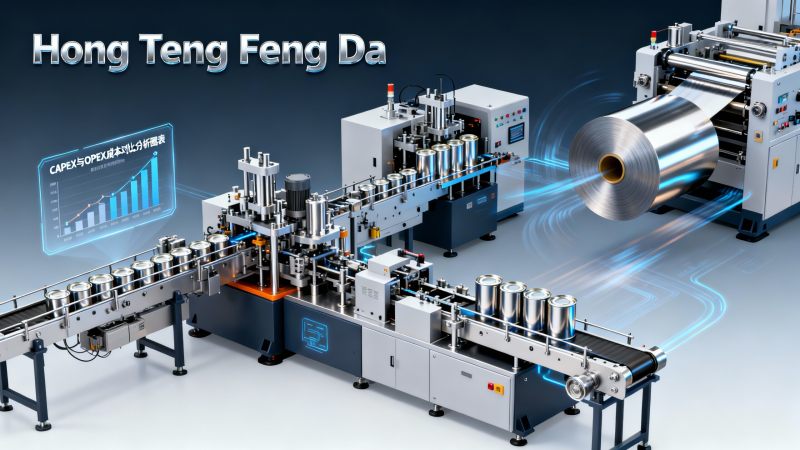
Decision framework and recommended approaches by stakeholder role
A structured decision framework helps diverse stakeholders — procurement, plant management, quality control, project leads and after-sales teams — reach alignment. Step one is to conduct a total cost of ownership (TCO) analysis that aggregates CAPEX, OPEX, risk-adjusted contingency and working capital for both in-house and outsourced scenarios. Procurement should focus on supplier benchmarking for can making machine, tin can production line capability, lead time, and contractual flexibility; plant managers should weight throughput, uptime guarantees and integration complexity; quality teams must quantify acceptance criteria, testing frequency and traceability requirements for food or aerosol cans. Project managers should evaluate timelines for civil works, utility upgrades, commissioning and validation. The matrix should include likelihood-weighted risk scores for supply interruptions, quality failures and regulatory non-compliance. For companies with stable high-volume demand and reliable upstream access to tinplate or galvanized coils, in-house investment often delivers lower long-term unit costs, greater control over the tin can forming process and faster response to product changes. For firms with fluctuating demand or limited capital, outsourcing to established metal packaging equipment suppliers or toll manufacturers can be a pragmatic choice. Distributors and channel partners should evaluate after-sales partnership models to offer maintenance contracts and spare parts pools that reduce buyer risk. Maintenance teams should push for remote diagnostics capability and standardization of critical spares. In some cases, auxiliary steel products such as lifting and handling components are relevant to line infrastructure; for example, cranes and hoists used in coil handling may utilize specialized wire ropes. To support heavy lift and rigging needs in the production hall, consider sourcing certified galvanized wire rope models that meet GB/T and ISO standards, such as 0.7mm 0.8mm 1.2mm 1.6mm 1.8mm 2mm diameter Galvanized Steel Wire Rope, which are available in multiple constructions and zinc coating classes suitable for different corrosion environments. Such steel-grade specificity ties upstream material handling reliability to downstream packaging quality. Ultimately, a phased approach that begins with a pilot line, validated against real product SKUs and rigorous QC checks, reduces capital exposure and provides empirical data for scaling. For procurement and decision-makers, asking suppliers for lifecycle cost models, reference installations and measurable uptime metrics is essential to reaching a defensible decision that aligns with corporate quality and delivery commitments.
Conclusion and recommended next steps
Choosing between outsourcing 3-piece can production and investing in in-house can making machine assets is a strategic decision that balances cost, quality, flexibility and risk. Our analysis shows that for mid-to-high volume operations with stable demand and in-house capabilities for handling steel inputs, targeted investment in automated tin can production lines, including food can sealing machine and welding machine for tin can cells, can reduce unit costs and improve control over product specifications. However, the decision must be grounded in a detailed TCO model, conservative uptime assumptions and contingency planning for raw material price volatility and spare parts availability. For lower-volume or variable demand profiles, maintaining relationships with reliable tin can production line subcontractors preserves capital and transfers operational risk. We recommend the following practical next steps: 1) commission a preliminary TCO and break-even model tailored to your specific volumes and product mix; 2) perform supplier due diligence focusing on service network, parts availability and reference sites for can making machine China and other OEMs; 3) pilot a small automated line or modular cell to validate the tin can forming process and quality metrics; 4) negotiate service level agreements and spare parts packages up front; and 5) build cross-functional project governance that includes procurement, quality, engineering and maintenance stakeholders. These steps will create a defensible pathway to either scale in-house production or optimize outsourcing for strategic resilience. If you would like a customized financial model, supplier shortlist, or an on-site capability assessment from an experienced steel and metal packaging team, contact Shandong Hongteng Fengda Metal Materials Co. Ltd. to discuss how our production experience, technical resources and global logistics network can support your project. Immediate next steps: request a detailed cost comparison, arrange a factory visit for the equipment line, or ask for a pilot production plan to validate assumptions. Contact us to learn more and start the evaluation.
- can making machine
- tin can production line
- metal packaging equipment
- aerosol can making line
- food can sealing machine
- welding machine for tin can
- 3-piece can production
- 2-piece can equipment
- tin can forming process
- can making machine China
- steel i
- galvanized steel coil
- galvanized coils
- galvanized coil
- galvanized steel wire
- galvanized wire
- steel coil
- galvanized steel
- steel plate
- Profile
Related recommendations
 Key Structural Steel Properties That Affect Load Capacity and DurabilityStructural steel properties determine load capacity, deflection, fatigue resistance, and corrosion durability. Explore key factors for safer, longer-lasting steel designs.
 Structural Steel Benefits: Comparing Lifecycle Value in Commercial BuildingsStructural steel benefits for commercial buildings: compare lifecycle value, speed, adaptability, maintenance, and sourcing risks to make smarter investment decisions.
 Where Are Structural Steel Applications Most Effective in Industrial Facilities?Structural steel applications deliver clear spans, crane support, adaptable warehouses, and durable process platforms—discover where steel adds the most value in industrial facilities.
 How to Select Structural Steel Products by Grade, Section, and CoatingStructural steel products selection guide: compare grades, sections, coatings, certifications, and total delivered value for safer, cost-effective projects.
Please give us a message


Please enter what you want to find