When evaluating structural materials for long-term infrastructure projects, an angle vs channel steel comparison is essential—yet many buyers overlook critical differences that directly impact ROI, safety, and lifecycle costs. This FAQ explores angle steel vs channel steel differences in load capacity, fabrication flexibility, corrosion resistance, and installation efficiency—key considerations for project managers, procurement teams, and structural engineers. As a trusted structural steel manufacturer & exporter from China, Hongteng Fengda delivers ASTM/EN-compliant angle and channel sections with precision tolerances and consistent quality—helping global clients make data-driven, cost-optimized material decisions.
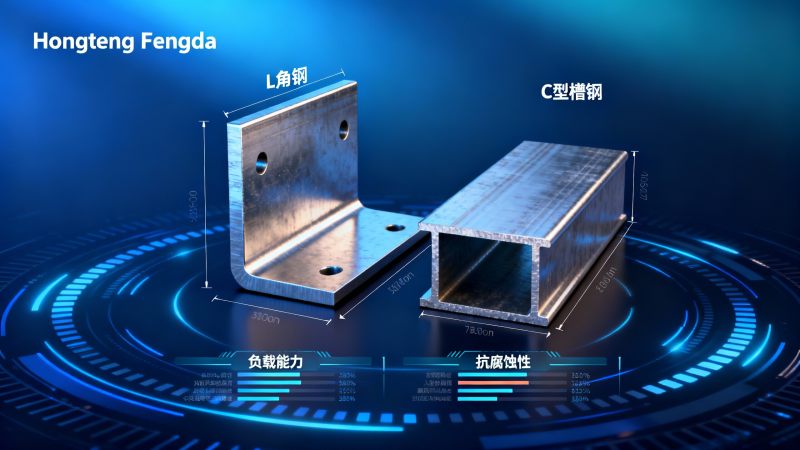
Definition & Structural Identity
Angle steel (L-section) consists of two perpendicular legs forming an “L” shape—available in equal or unequal leg configurations. Its simplicity enables efficient welding, bolting, and bracing in open-frame structures. Channel steel (C-section), by contrast, features a “C”-shaped cross-section with parallel flanges and a web connecting them—offering higher moment of inertia about its major axis and superior resistance to bending in one plane.
Both are hot-rolled carbon or stainless structural steels—commonly produced per ASTM A6/A6M (US), EN 10025 (EU), GB/T 706 (China), and JIS G3101 (Japan). While angle steel excels in tension-dominated or secondary framing roles, channel steel is preferred where unidirectional flexural rigidity and torsional stability matter—such as purlins, girts, and rail supports. Understanding this fundamental distinction prevents misapplication during early design phases.
Technical Performance Comparison
Performance divergence becomes evident under real-world loading conditions. Below is a comparative analysis of key mechanical and geometric parameters for standard 100×100×10 mm angle steel versus 100×48×5.3 mm channel steel (both ASTM A36 grade):
Note the channel’s 24% higher Ix and 118% greater torsional constant—critical for minimizing deflection in long-span cladding supports. Meanwhile, angle steel offers more uniform strength distribution across axes, supporting multi-directional bracing without reorientation.
Application Scenarios & Lifecycle Fit
Angle steel dominates in lattice towers, transmission poles, stair stringers, and seismic bracing—where multidirectional load paths and ease of field connection matter most. Its symmetrical geometry simplifies prefabrication logistics and reduces on-site alignment time.
Channel steel shines in primary framing components: roof purlins, wall girts, crane rails, and modular platform edges. Its closed-flange profile provides inherent resistance to lateral-torsional buckling—a frequent failure mode in slender beams. For marine terminals or coastal wastewater plants, both benefit from galvanizing or stainless upgrades—such as our 304 Stainless Steel Welded Mesh, which complements structural systems with corrosion-resistant screening for ventilation, filtration, and safety guarding.
Procurement Guide: What Decision-Makers Should Verify
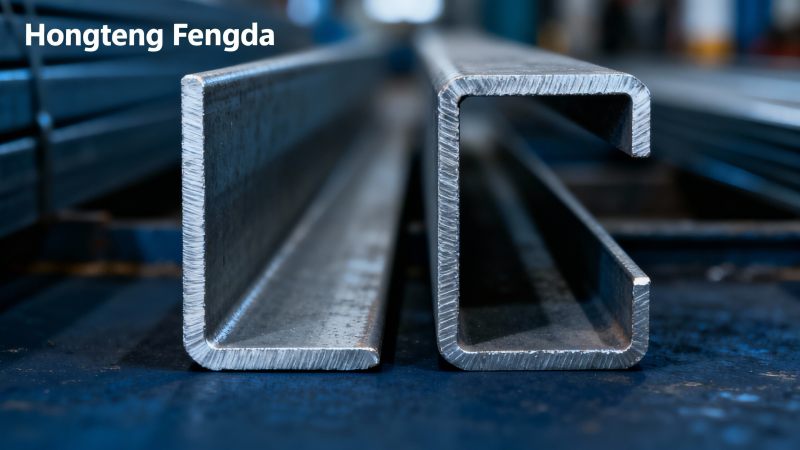
Procurement teams must go beyond nominal size and grade. Key verification points include:
- Dimensional tolerance compliance (e.g., EN 10056-1 ±0.4 mm on leg thickness for angles; ASTM A6 ±0.3 mm on flange width for channels)
- Yield strength consistency across batch heats—verified via mill test reports (MTRs) traceable to ASTM E29 or ISO 17025 labs
- Surface finish suitability for intended coating (e.g., hot-dip galvanizing requires clean scale-free surfaces)
- Availability of certified cold-formed variants for lightweight, high-strength retrofit applications
Hongteng Fengda maintains full traceability from billet to finished section—including ultrasonic testing (UT) for critical infrastructure orders—and issues EN 10204 3.1 or 3.2 MTRs upon request. Our ERP-integrated production tracking ensures zero mix-ups between angle vs channel steel comparison batches—even across mixed-container shipments to Europe or North America.
Why Choose Hongteng Fengda?
As a structural steel manufacturer & exporter from China, we bridge global standards with local responsiveness. With over 18 years serving contractors in Saudi Arabia, Canada, Vietnam, and Germany, we’ve refined what truly drives ROI: not just lower unit price—but predictable lead times (avg. 25 days for LCL exports), zero tolerance deviations (<±0.25 mm on critical dimensions), and seamless OEM support—from custom punching patterns to dual-standard certification (ASTM + EN).
Whether you’re comparing angle steel vs channel steel differences for a 50-year port expansion or optimizing material specs for a solar farm mounting system, our engineering team co-develops solutions—not just supplies steel. Contact us today for a free technical consultation and sample pack—including dimensional validation reports and corrosion test summaries.
Related recommendations
 Is acero galvanizado para exterior vulnerable to white rust formation during monsoon storage?Acero galvanizado para exterior *is* vulnerable to white rust in monsoons — but it’s preventable. Discover proven storage & handling strategies that protect your structural steel.
 Does ASTM A 36 plate meet impact toughness requirements for low-temperature bridge girders?Does ASTM A 36 plate meet low-temp bridge requirements? Short answer: no—unless specially tested. Discover why toughness matters more than strength in cold climates.
 Does ASTM A653 certification cover both zinc-coated and zinc-iron alloy coated steels?ASTM A653 covers both zinc-coated and zinc-iron alloy coated steels—but they’re not interchangeable. Learn key differences in testing, performance & certification.
 Does acero prepintado require surface pretreatment before welding or cutting?Does acero prepintado require pretreatment before welding or cutting? Discover when grinding is essential—and when it’s not—for safety, weld integrity & corrosion resistance.
Please give us a message


Please enter what you want to find