When fabricators receive pre-painted steel—acero prepintado—for structural use, one of the first practical questions on the shop floor is: Does it require surface pretreatment before welding or cutting? The short answer is: Yes—but not always the same kind, and not for the same reasons. What matters most isn’t whether pretreatment is “required” in theory, but whether skipping it introduces measurable risk to weld integrity, operator safety, or long-term corrosion performance in your specific application.
No universal “yes” or “no”—it depends on three operational conditions
The need for pretreatment hinges on three interdependent factors: coating chemistry, process energy input, and end-use environment. Pre-painted steel isn’t a single material—it’s a system. A polyester-coated EN 10169 cold-formed channel used in an interior warehouse partition behaves very differently under arc welding than a high-gloss PVDF-coated ASTM A792 angle beam destined for coastal infrastructure. Confusing the two leads to either unnecessary labor (grinding entire weld zones on low-risk parts) or dangerous oversights (welding through zinc-rich primers without fume extraction).
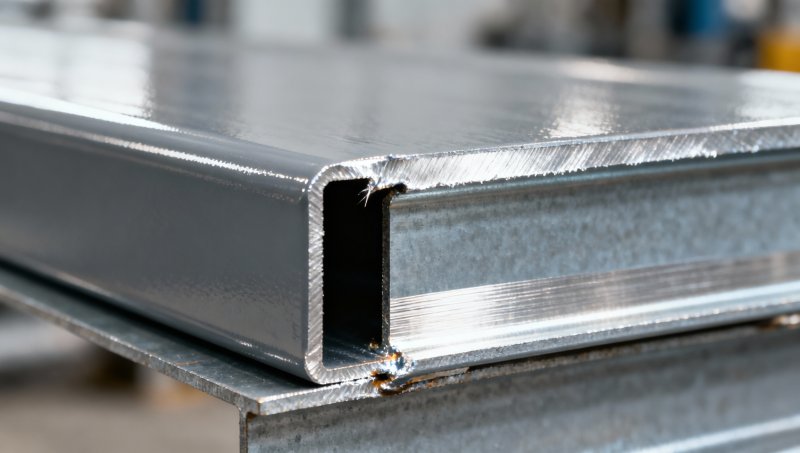
For Hongteng Fengda’s ASTM- and EN-compliant pre-painted structural profiles—angles, channels, beams, and cold-formed sections—the standard coating systems fall into two main categories:
- Organic-coated base metal: Typically polyester (PE), silicone-modified polyester (SMP), or polyvinylidene fluoride (PVDF) applied over galvanized (Zn) or galvalume (Zn-Al) substrates. These coatings are engineered for weather resistance—not thermal stability.
- Primed-only surfaces: Often epoxy or zinc-rich primers applied directly to hot-dip galvanized steel, intended as a base for field-applied topcoats—not a finished architectural surface.
Welding or plasma cutting through either type releases volatile organic compounds (VOCs), metal oxide fumes (especially zinc), and potentially hydrogen cyanide if nitrocellulose-based primers are present. But the severity—and whether pretreatment is operationally justified—depends on where and how the part will be used post-fabrication.
When pretreatment is non-negotiable
Pretreatment isn’t optional when any of these apply:
- You’re welding near critical load paths: Heat-affected zones (HAZ) under organic coatings suffer rapid charring, carbonization, and micro-cracking. This compromises fusion quality and creates preferential corrosion paths. Even with post-weld touch-up, the underlying substrate may have suffered localized zinc depletion—leaving bare steel exposed at the weld toe. In structural applications governed by EN 1993-1-8 or AWS D1.1, this can invalidate weld procedure specifications (WPS) unless validated with coated base material.
- Workplace exposure limits are enforced: OSHA PEL for zinc oxide fume is 5 mg/m³ (as Zn); NIOSH REL is stricter at 2 mg/m³. Cutting or welding unprepared acero prepintado routinely exceeds both—especially in confined spaces or poorly ventilated shops. Respiratory protection alone isn’t sufficient; engineering controls (local exhaust ventilation) and surface removal are required upstream.
- The part will serve in aggressive environments: Coastal, industrial, or high-humidity settings accelerate corrosion at coating breaches. A weld made through intact polyester film may appear sound visually, but the heat-softened resin retracts from the HAZ, exposing mill scale or incomplete zinc coverage beneath. That microscopic gap becomes the nucleation site for red rust within months—not years.
In these cases, pretreatment means targeted removal—not full stripping. Grinding 15–20 mm beyond each weld edge (or cut line) to expose clean, bright galvanized or bare steel is standard practice. Solvent wiping alone is insufficient: it removes oils but not polymer residue or charred organics that interfere with arc stability and fusion.
When limited or no pretreatment may be acceptable
Not every fabrication step demands grinding. Consider skipping pretreatment only when:
- It’s a secondary, non-structural cut: E.g., trimming excess length from a pre-painted channel used as a non-load-bearing bracket in an indoor mechanical room. No weld is involved, and the cut edge won’t be exposed to moisture or abrasion.
- You’re using low-heat processes with verified compatibility: Some laser cutting systems (fiber lasers, ≤2 kW) can cleanly sever thin-gauge (<3 mm) pre-painted sheet without significant coating degradation—provided assist gas (N₂ or compressed air) is optimized and nozzle standoff is controlled. But this requires process validation per batch, not assumption.
- The coating system is explicitly qualified for welding: A small number of specialty primers (e.g., certain zinc-rich epoxies per ISO 12944 C3–C4 service classes) carry manufacturer-certified weld-through ratings. These are rare in standard structural profiles—and never assumed. Always request test reports, not datasheet claims.
Note: “No pretreatment” here means *no mechanical removal*—not “no precautions.” Fume extraction, operator training, and post-process inspection remain mandatory regardless of coating type.
A practical workflow for field and shop teams
Here’s what works on real job sites—not just in manuals:
- Identify coating type first: Check mill test reports (MTRs) or supplier documentation. If unavailable, perform a simple solvent rub test (MEK or acetone on a hidden area): PE/SMP softens visibly; PVDF does not. Zinc-rich primers leave a gray metallic residue.
- Map weld locations against service class: Use ISO 12944 or ASTM G101 corrosion classification maps—not guesswork—to assign risk level to each joint.
- Define removal zone by process: For SMAW or GMAW, grind 20 mm beyond weld start/end. For plasma cutting, remove coating 10 mm from cut line. For laser, verify with a trial cut and macro-etch inspection.
- Validate post-weld finish: Touch-up isn’t cosmetic. Use zinc-rich cold-galvanizing compound (≥92% Zn by weight) applied to bare HAZ areas—not generic paint. Verify coverage with a copper sulfate test per ASTM B571.
One related point often overlooked: wire rope integration
While pre-painted structural steel handles static loads, dynamic tension elements like lifting or anchoring components demand different metallurgical assurance. For example, Galvanized Steel Wire Rope used in cranes, tower cranes, or foundation pile drivers relies on precise zinc coating mass (75–260 g/m² for severe conditions) to maintain fatigue life under cyclic stress. Its pretreatment logic differs entirely: no grinding is done on the rope itself—but anchor points, thimbles, and termination hardware *must* be compatible with the rope’s coating integrity. Mismatched materials (e.g., welding a painted structural lug directly to a galvanized eye splice without isolating the heat path) can cause accelerated galvanic corrosion at the interface. This reinforces a broader principle: pretreatment decisions must align across *all* joined components—not just the primary structural member.
Bottom line: Pretreatment is a risk-control decision—not a checklist item
Treating acero prepintado as “just steel with paint” invites failure. The coating is part of the corrosion system, the thermal barrier, and the emission source—all at once. Your decision to grind, mask, or skip pretreatment should flow from a clear assessment of load function, environmental exposure, and regulatory scope—not from habit, speed, or cost alone. When in doubt, default to removal: it’s faster than rework, safer than respiratory illness, and cheaper than premature corrosion failure. And if your project involves mixed-material assemblies—like pre-painted beams supporting galvanized wire rope systems—coordinate pretreatment logic across disciplines early. Because in structural fabrication, the weakest link isn’t always the thinnest section—it’s the least considered interface.
Please give us a message


Please enter what you want to find