Is acero galvanizado para exterior vulnerable to white rust formation during monsoon storage?
Yes — *acero galvanizado para exterior* **is vulnerable to white rust formation during monsoon storage**, but not because the zinc coating is inherently flawed. It’s because white rust isn’t a failure of the galvanizing process — it’s a symptom of how the material is handled *after* coating and *before* installation.
For maintenance professionals managing structural steel projects across Southeast Asia, India, or the Gulf — regions where humidity regularly exceeds 85% and rainfall can persist for weeks — this distinction matters deeply. You’ve specified *acero galvanizado para exterior*, expecting decades of corrosion resistance. Yet when crates arrive at site with chalky, white-gray streaks on flanges and webs, doubt creeps in: Was the galvanizing substandard? Was the steel improperly coated? Or worse — is this an early sign of premature degradation?
The truth is quieter, more practical — and entirely preventable.
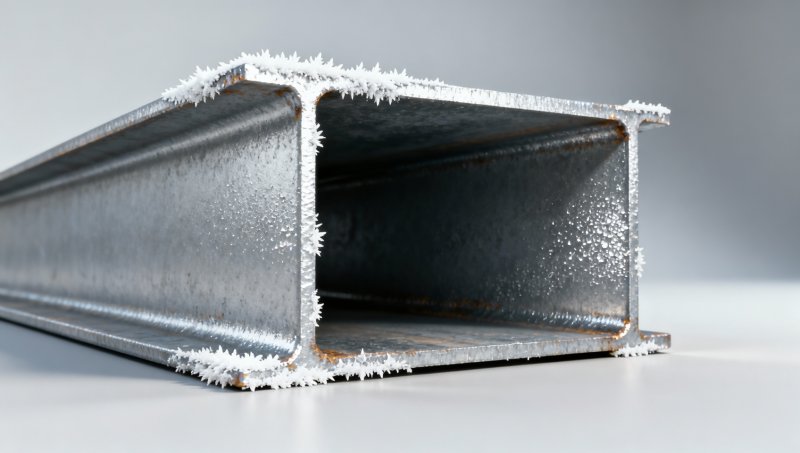
White rust (zinc hydroxide, Zn(OH)₂, sometimes mixed with zinc carbonate) forms when freshly galvanized steel is exposed to moisture *without adequate airflow*. During monsoon season, ambient air holds extraordinary amounts of water vapour. When galvanized components — especially large, heavy sections like H Shape Beam — are stacked tightly in covered yards, stored under plastic sheeting without ventilation gaps, or left sealed in non-breathable packaging, condensation develops overnight. That trapped moisture reacts with the outermost layer of zinc, initiating rapid oxidation. The result? A soft, powdery deposit that looks alarming — but crucially, *does not penetrate the underlying steel*.
What makes this especially relevant for structural steel maintenance teams is timing: white rust most commonly appears within the first 30–60 days post-galvanizing, precisely when materials are often in transit or staged on-site awaiting erection. And while it rarely compromises long-term performance if removed properly, its presence signals a break in the chain of care — one that could foreshadow more serious issues if left unaddressed.
Let’s be clear: Galvanizing *works*. Hot-dip galvanized steel used in bridges, transmission towers, and coastal industrial facilities routinely delivers 50+ years of service in aggressive environments. But that longevity assumes two things — consistent coating quality *and* responsible handling between factory and final placement. In monsoon climates, the second condition is where many projects quietly unravel.
Consider an H Shape Beam with a flange width of 300 mm and web thickness of 12 mm — typical for mid-rise commercial framing. Its surface area is substantial; its mass retains coolness overnight, promoting dew-point condensation. If stored flat on concrete with adjacent beams touching side-to-side, airflow is nearly zero. Add high humidity, intermittent rain, and no scheduled inspection — and within days, white rust begins forming along the lower flange edges, then migrates upward along vertical surfaces.
 This isn’t theoretical. At Hongteng Fengda, we’ve observed this pattern across dozens of shipments to Bangladesh, Vietnam, and Oman over the past five monsoon seasons. What separates the batches that arrived pristine from those requiring on-site remediation wasn’t zinc bath chemistry or immersion time — it was packaging strategy and storage guidance shared *with the buyer*, not just assumed.
We use ventilated wooden skids — never solid pallets — and separate layers of H Shape Beam with spacers that maintain ≥50 mm clearance on all sides. Each bundle is wrapped in VCI (volatile corrosion inhibitor) paper, not standard polyethylene — which traps vapour — and topped with breathable, UV-stabilized mesh tarps anchored to allow lateral air movement. Crucially, we include bilingual (English + local language) storage cards with simple icons showing “Do” and “Don’t”: stack height limits, minimum ground clearance, recommended orientation (vertical vs. horizontal), and re-inspection intervals.
None of this replaces field vigilance — but it shifts responsibility from reactive cleaning to proactive coordination.
And here’s what many maintenance leads overlook: white rust isn’t always uniform. On heavier sections like S355JR or Q460C grade beams, deposits may appear only in micro-crevices — bolt holes, weld seams, or tight radius transitions — where moisture lingers longest. A visual sweep won’t catch it. You need tactile inspection: lightly rub suspect areas with a clean cloth. If residue transfers, it’s active white rust — not dried salt or dust.
Removal is straightforward, but method matters. Abrasive blasting or wire brushing risks damaging the zinc layer, especially near edges where coating thickness is naturally thinner. We recommend pH-neutral, non-acidic cleaners applied with soft nylon brushes, followed by thorough rinsing and *immediate* drying using compressed air or low-heat fans — not sunlight alone, which can bake residues deeper into pores.
Importantly, once cleaned and dried, the surface should be inspected for bare steel exposure. If the base metal is visible beneath the white deposit — rare, but possible with prolonged wet storage — touch-up with zinc-rich paint meeting ASTM D6386 is appropriate. But in >95% of monsoon-related cases, the zinc remains fully intact underneath; the white layer is merely cosmetic and superficial.
That said, repeated cycles of wetting-and-drying *without intervention* do accelerate zinc consumption. One study tracking galvanized angle steel stored outdoors in Mumbai showed up to 12% faster zinc loss in bundles with untreated white rust versus those kept dry and ventilated — not catastrophic, but enough to shorten design life by 3–5 years in marginal marine zones.
So — is *acero galvanizado para exterior* vulnerable? Yes. But vulnerability isn’t destiny. It’s a design parameter — like wind load or seismic coefficient — that must be factored into logistics planning, not ignored until it shows up as a white smear on your beam web.
At Hongteng Fengda, we don’t treat galvanizing as a finish line. We treat it as the first mile of a longer journey — one that includes climate-aware packaging, real-time humidity logging during sea freight, and post-arrival support protocols tailored to regional monsoon calendars. Because for maintenance professionals, reliability isn’t measured in lab reports — it’s measured in how little you have to do before bolting the first piece into place.
When monsoon clouds gather, the best protection isn’t thicker zinc. It’s clearer communication, smarter staging, and knowing exactly where — and how — moisture will pool before it ever touches the surface.
This isn’t theoretical. At Hongteng Fengda, we’ve observed this pattern across dozens of shipments to Bangladesh, Vietnam, and Oman over the past five monsoon seasons. What separates the batches that arrived pristine from those requiring on-site remediation wasn’t zinc bath chemistry or immersion time — it was packaging strategy and storage guidance shared *with the buyer*, not just assumed.
We use ventilated wooden skids — never solid pallets — and separate layers of H Shape Beam with spacers that maintain ≥50 mm clearance on all sides. Each bundle is wrapped in VCI (volatile corrosion inhibitor) paper, not standard polyethylene — which traps vapour — and topped with breathable, UV-stabilized mesh tarps anchored to allow lateral air movement. Crucially, we include bilingual (English + local language) storage cards with simple icons showing “Do” and “Don’t”: stack height limits, minimum ground clearance, recommended orientation (vertical vs. horizontal), and re-inspection intervals.
None of this replaces field vigilance — but it shifts responsibility from reactive cleaning to proactive coordination.
And here’s what many maintenance leads overlook: white rust isn’t always uniform. On heavier sections like S355JR or Q460C grade beams, deposits may appear only in micro-crevices — bolt holes, weld seams, or tight radius transitions — where moisture lingers longest. A visual sweep won’t catch it. You need tactile inspection: lightly rub suspect areas with a clean cloth. If residue transfers, it’s active white rust — not dried salt or dust.
Removal is straightforward, but method matters. Abrasive blasting or wire brushing risks damaging the zinc layer, especially near edges where coating thickness is naturally thinner. We recommend pH-neutral, non-acidic cleaners applied with soft nylon brushes, followed by thorough rinsing and *immediate* drying using compressed air or low-heat fans — not sunlight alone, which can bake residues deeper into pores.
Importantly, once cleaned and dried, the surface should be inspected for bare steel exposure. If the base metal is visible beneath the white deposit — rare, but possible with prolonged wet storage — touch-up with zinc-rich paint meeting ASTM D6386 is appropriate. But in >95% of monsoon-related cases, the zinc remains fully intact underneath; the white layer is merely cosmetic and superficial.
That said, repeated cycles of wetting-and-drying *without intervention* do accelerate zinc consumption. One study tracking galvanized angle steel stored outdoors in Mumbai showed up to 12% faster zinc loss in bundles with untreated white rust versus those kept dry and ventilated — not catastrophic, but enough to shorten design life by 3–5 years in marginal marine zones.
So — is *acero galvanizado para exterior* vulnerable? Yes. But vulnerability isn’t destiny. It’s a design parameter — like wind load or seismic coefficient — that must be factored into logistics planning, not ignored until it shows up as a white smear on your beam web.
At Hongteng Fengda, we don’t treat galvanizing as a finish line. We treat it as the first mile of a longer journey — one that includes climate-aware packaging, real-time humidity logging during sea freight, and post-arrival support protocols tailored to regional monsoon calendars. Because for maintenance professionals, reliability isn’t measured in lab reports — it’s measured in how little you have to do before bolting the first piece into place.
When monsoon clouds gather, the best protection isn’t thicker zinc. It’s clearer communication, smarter staging, and knowing exactly where — and how — moisture will pool before it ever touches the surface.
Next page: Already the last one
Please give us a message


Please enter what you want to find