Accurate beams weight calculation for structural steel is critical—from designing industrial warehouses and bridge projects to ensuring compliance for I beam weight specifications in warehouse construction. Whether you're a construction engineer using an I beam weight calculator, a steel manufacturer consulting a beams weight chart, or a European buyer sourcing weight of I beam supplier in Europe, choosing between manual formulas and digital tools impacts safety, cost, and timeline. As a trusted structural steel manufacturer & exporter from China, Hongteng Fengda supports global buyers—from North America to Southeast Asia—with precise weight data, ASTM/EN/GB-compliant I beams, and expert guidance on how to measure a steel beam for industrial use, bridge projects, or heavy-duty construction.
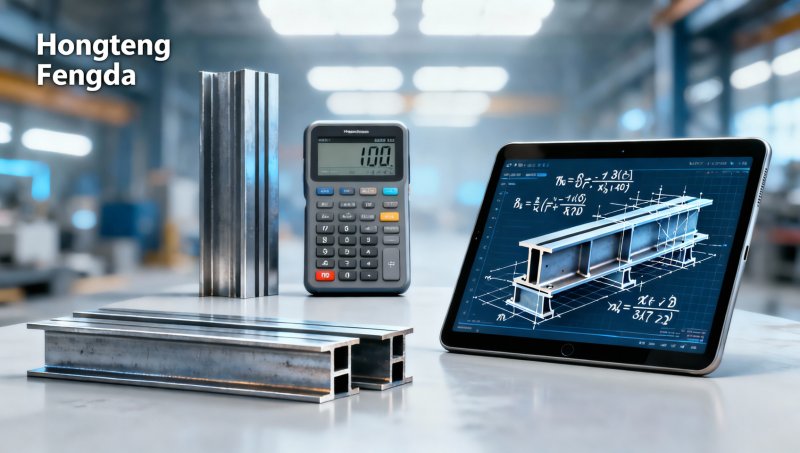
Why Beams Weight Calculation Matters Across Project Lifecycles
Weight estimation isn’t just about logistics—it’s foundational to structural integrity, load path design, crane selection, foundation sizing, and even fire-rating compliance. Underestimating the weight of I beam in USA or EU-sourced projects may lead to under-designed connections; overestimation inflates transportation costs and delays procurement. For project managers overseeing industrial warehouse builds, accurate how to measure a steel beam for industrial warehouse workflows directly affect BIM coordination accuracy and just-in-time delivery schedules.
From a quality control perspective, consistent weight verification validates dimensional tolerances per EN 10034 or ASTM A6. Deviations beyond ±3% often signal rolling inconsistencies—critical red flags for safety managers auditing fabrication records. Likewise, distributors evaluating a weight of I beam supplier in Europe must cross-check mill test reports against theoretical mass tables to avoid contractual disputes.
Manual Formulas vs. Digital Tools: A Practical Comparison
Manual calculations rely on standardized geometric formulas: for an I-beam, weight (kg/m) = Cross-sectional Area (mm²) × Density of Steel (7.85 g/cm³) ÷ 1,000,000. While transparent and auditable, this method demands precision in measuring flange width, web thickness, and overall depth—especially challenging with corroded or non-standard sections like tapered beams used in bridge projects.
Digital tools—including cloud-based I beam weight calculator for construction engineers, BIM-integrated libraries (e.g., Revit’s structural families), and OEM-specific apps—automate unit conversions, apply real-time density corrections for galvanized or coated profiles, and flag outliers against standard catalogs. Yet they introduce dependency on input accuracy and software versioning—making them powerful only when paired with verified source data.
Standards, Certifications, and Real-World Validation
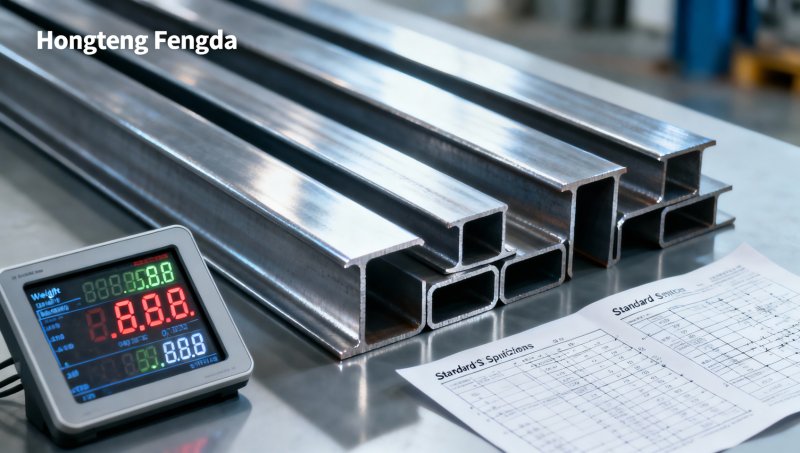
Global standards define acceptable tolerances that influence weight assumptions. ASTM A6 permits ±7.5% variation in nominal weight for rolled shapes—a margin that matters when calculating total tonnage for a 50,000-beam warehouse. EN 10024 tightens this to ±5%, while GB/T 706 specifies ±4.5% for Chinese-manufactured hot-rolled I-sections. At Hongteng Fengda, every batch undergoes third-party verification against these benchmarks—and we provide certified beams weight chart for steel manufacturers tied to actual mill test reports, not generic databases.
For bridge projects requiring high fatigue resistance, weight consistency also correlates with uniform grain structure. Our cold-formed steel profiles—used in seismic-resistant bracing systems—undergo ultrasonic testing to confirm homogeneity, ensuring that calculated dead loads match as-built behavior. This rigor supports both how to measure a steel beam for bridge projects and long-term maintenance planning for operators.
Why Choose Hongteng Fengda for Precision & Partnership
As a structural steel manufacturer and exporter from China, Hongteng Fengda bridges engineering precision with supply chain resilience. We deliver ASTM/EN/GB-compliant I beams with documented weight variance ≤ ±2.3%—well within international tolerance bands. Our digital portal provides downloadable I beam weight specifications for warehouse construction, live inventory dashboards, and custom-cutting reports traceable to heat numbers.
Need corrosion-resistant support frames? Our Hot diped-Galvanized Pipe integrates seamlessly into structural subframes for trestle piles or mining pit supports—extending service life without compromising load-bearing calculations. With facilities certified to ISO 9001 and production capacity scaling across 12+ export markets, we help distributors reduce lead-time risk, empower engineers with trusted data, and enable contractors to meet aggressive deadlines—without sacrificing safety or compliance.
Contact Hongteng Fengda today for your next beams weight calculation for structural steel consultation—or request a customized weight verification report aligned with your project’s ASTM, EN, or GB requirements.
- steel i
- galvanized pipe
- structural steel
- steel profiles
- Structural Steel
- I-Beam
- Profile
- Hot diped-Galvanized Pipe
- Galvanized
- Steel Beam
- steel profile
- weight of i beam
- i beam weight
- how to measure a steel beam
- beams weight
- How to measure a steel beam for industrial use
- Weight of I beam in USA
- Beams weight calculation for structural steel
- I beam weight specifications for warehouse construction
- How to measure a steel beam for bridge projects
- Weight of I beam supplier in Europe
- Beams weight chart for steel manufacturers
- I beam weight calculator for construction engineers
- How to measure a steel beam for industrial warehouse
Related recommendations
 Is acero galvanizado para exterior vulnerable to white rust formation during monsoon storage?Acero galvanizado para exterior *is* vulnerable to white rust in monsoons — but it’s preventable. Discover proven storage & handling strategies that protect your structural steel.
 Does ASTM A 36 plate meet impact toughness requirements for low-temperature bridge girders?Does ASTM A 36 plate meet low-temp bridge requirements? Short answer: no—unless specially tested. Discover why toughness matters more than strength in cold climates.
 Does ASTM A653 certification cover both zinc-coated and zinc-iron alloy coated steels?ASTM A653 covers both zinc-coated and zinc-iron alloy coated steels—but they’re not interchangeable. Learn key differences in testing, performance & certification.
 Does acero prepintado require surface pretreatment before welding or cutting?Does acero prepintado require pretreatment before welding or cutting? Discover when grinding is essential—and when it’s not—for safety, weld integrity & corrosion resistance.
Please give us a message


Please enter what you want to find