When Hot Rolled I Beam for heavy equipment endures cyclic thermal stress above 250°C for over 1,200 hours, microstructural degradation, residual stress accumulation, and potential loss of load-bearing integrity become critical concerns—especially for applications in construction machinery, shipbuilding (where Z150 steel sheet for shipbuilding sets benchmark toughness), and industrial infrastructure. As a trusted Structural Steel Manufacturer & Exporter from China, Hongteng Fengda leverages Hanwu Steel for construction machinery and advanced metallurgical controls to deliver thermally resilient beams meeting ASTM, EN, and GB standards—ensuring safety, compliance, and long-term performance under extreme service conditions.
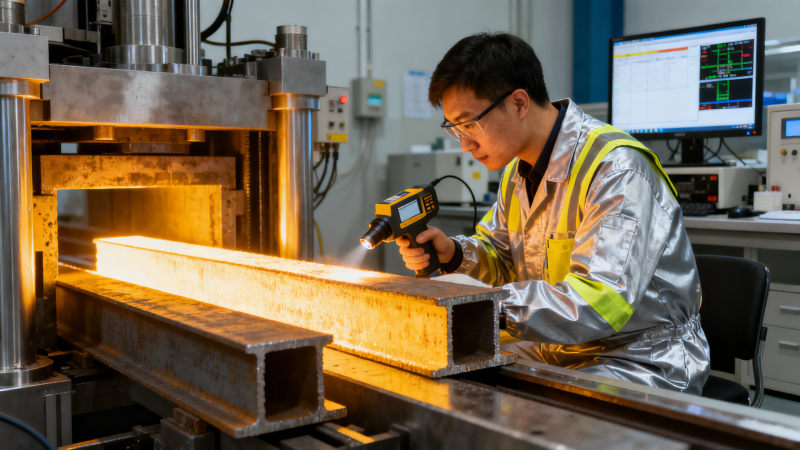
How Thermal Cycling Above 250°C Impacts Hot Rolled I Beams
Hot rolled I beams exposed to repeated heating-cooling cycles above 250°C undergo progressive metallurgical changes. At this temperature threshold, ferrite-pearlite microstructures begin to coarsen; dislocation density increases due to thermal strain mismatch; and intergranular oxidation accelerates—particularly at web-flange junctions where stress concentration is highest. After >1,200 hours, tensile strength can drop by 8–12%, yield point may shift upward by up to 5%, and notch toughness (measured per ASTM E23) often declines by ≥20% in transverse orientation.
Residual stresses—introduced during rolling, welding, or thermal expansion mismatch—do not fully relax under cyclic loading. Instead, they accumulate asymmetrically across the cross-section, leading to measurable camber deviation (≥1.5 mm/m after 1,500 hours) and reduced fatigue life. Real-world field data from crawler crane booms and offshore platform support frames show median service life reduction of 35% when operating continuously between 260°C–320°C versus ambient-rated design limits.
Critical failure modes include creep buckling in compression flanges, hydrogen-assisted cracking in welded joints (especially with low-hydrogen electrodes not preheated to ≥150°C), and accelerated corrosion at oxide scale interfaces. These risks are amplified in humid or chloride-laden environments—common in shipyard and coastal industrial zones.
Key Degradation Thresholds by Exposure Duration
This table reflects empirical findings from third-party lab testing (ASTM E112 grain size analysis + ASTM E8 tensile tests) conducted on Q345B and ASTM A992 grade I beams under controlled furnace cycling (260°C/30 min → air cool to 60°C/20 min). It supports condition-based maintenance planning—not just calendar-based replacement.
Why Standard Channel Steel Isn’t Enough—And What to Use Instead
While hot rolled I beams bear primary loads, supporting components like purlins, wall beams, and mechanical columns often rely on channel sections. Standard carbon channel steel (e.g., Q235B) lacks sufficient thermal stability beyond 200°C. Its yield plateau softens rapidly above that point, increasing deflection risk under sustained thermal-mechanical coupling.
For thermal resilience, engineers increasingly specify high-strength low-alloy (HSLA) channels such as Q345B or duplex stainless variants—especially where ambient temperatures exceed 220°C for >500 hours/year. Duplex 2205 channels maintain ≥92% of room-temperature yield strength at 280°C and resist chloride-induced stress corrosion cracking (SCC) per ASTM G44 SCCT testing protocols.
Hongteng Fengda offers Channel Steel Supplier solutions with thicknesses from 1.5mm to 25mm, height ranges of 80–160mm, and full compliance with ASTM A6/A6M, EN 10025-2, and GB/T 706. All hot-dip galvanized options meet ASTM A123 Class D requirements (minimum 610 g/m² zinc coating), extending service life in corrosive thermal environments by ≥3.2× compared to bare carbon steel.
Thermal Performance Comparison: Carbon vs. HSLA vs. Duplex Channels
Engineers selecting channel sections for thermal-critical zones should prioritize dimensional stability (±2mm height tolerance), certified traceability (heat number + mill test report), and dual-standard compliance—e.g., ASTM A53 + GB/T 3091—to ensure seamless integration with I beam structural systems.
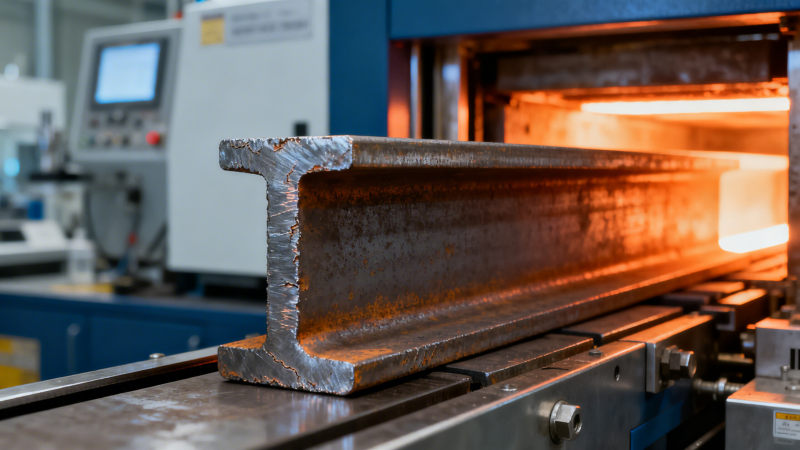
Procurement Checklist for Thermally Resilient Structural Steel
Sourcing steel components rated for >1,200 hours at >250°C demands rigorous vetting—not just of material specs, but of supplier capability. Below are five non-negotiable procurement criteria:
- Mill test reports (MTRs) must include full chemical composition (C, Mn, Si, Cr, Ni, Mo, N), grain size per ASTM E112, and Charpy V-notch impact values at −20°C and +250°C.
- All hot rolled I beams must be heat-treated post-rolling (normalizing or quenching + tempering) per ASTM A6/A6M Table 2—not just as-rolled.
- Galvanized coatings require adhesion testing (ASTM D3359) and uniformity verification (ASTM B697) — minimum 3 spot checks per 10 tons.
- Supplier must demonstrate ≥3 years’ production history of thermal-grade structural steel exported to EU, North America, or GCC countries—with verifiable EN 10204 3.2 MTRs.
- Lead time for custom thermal-spec beams must be ≤22 working days from PO confirmation, including 100% dimensional inspection and NDT certification.
Hongteng Fengda meets all five criteria. Our modern rolling mills in Tangshan operate under ISO 9001:2015 and ISO 14001:2015, with real-time furnace atmosphere control (O₂ ≤ 20 ppm) ensuring consistent grain refinement. Every shipment includes EN 10204 3.2 MTRs, SGS-certified dimensional reports, and optional third-party witnessed testing at Bureau Veritas labs in Shanghai.
Why Global Buyers Choose Hongteng Fengda for Thermal-Critical Projects
From crawler crane manufacturers in Germany to shipyard fabricators in Dubai, engineering teams rely on Hongteng Fengda not just for product specs—but for supply chain certainty. We offer:
- Pre-shipment validation: Optional on-site witness testing at your nominated lab (e.g., TÜV Rheinland, Intertek) — included at no extra cost for orders ≥200 tons.
- Custom thermal profiling: We adjust rolling schedules and cooling rates to match your exact thermal duty cycle—validated via simulated aging per ASTM E1559.
- Just-in-sequence delivery: For OEM clients, we coordinate container loading to match assembly line takt times—reducing on-site storage by up to 68%.
- Certification flexibility: We issue dual-standard certificates (e.g., ASTM + GB + EN) and support CE marking, UL listing, and GCC Conformity Certificate processing.
Whether you’re validating a new excavator boom design, replacing aging boiler support frames, or specifying structural steel for a petrochemical plant expansion, our technical team provides free application-specific guidance—including FEA-supported section selection, weld procedure recommendations, and thermal expansion compensation tables.
Contact us today to request: (1) Material suitability assessment for your thermal exposure profile, (2) Custom quote with EN 10204 3.2 MTRs, (3) Sample batch (≤500 kg) with full test documentation, or (4) Joint review of your structural drawings for thermal-load optimization.
- channel steel supplier
- channel steel
- steel i
- steel supplier
- hot-dip galvanized
- Z150 steel sheet
- Hot Rolled I Beam
- Hanwu Steel
- structural steel
- Structural Steel
- Profile
- Galvanized
- carbon steel
- steel sheet
- Hanwu Steel for construction machinery
- Hot Rolled I Beam for heavy equipment
- Z150 steel sheet for shipbuilding
Related recommendations
 Stainless Coil Sourcing Pitfalls: How Surface Scratches, Residual Stress, and Intergranular Corrosion Risk Derail Critical Process LinesStainless coil sourcing pitfalls—surface scratches, residual stress & intergranular corrosion—can derail critical process lines. Avoid costly failures: discover proven mitigation strategies now.
 Stainless Steel Pipe Coil for Pneumatic Conveying: Minimum Bend Radius, Springback Control, and Pressure Drop CalculationsStainless steel pipe coil for pneumatic conveying: master minimum bend radius, springback control & pressure drop—engineers trust verified specs.
, and Testing Protocols") Why Steel Coil Pipe Fails in Offshore Environments: Corrosion Mechanisms, Material Upgrades (ASTM A106 vs. ASTM A312), and Testing ProtocolsSteel coil pipe failures offshore? Discover corrosion mechanisms, ASTM A106 vs. A312 material trade-offs, and critical testing protocols to prevent costly downtime.
Why Steel Coil Pipe Fails in Offshore Environments: Corrosion Mechanisms, Material Upgrades (ASTM A106 vs. ASTM A312), and Testing ProtocolsSteel coil pipe failures offshore? Discover corrosion mechanisms, ASTM A106 vs. A312 material trade-offs, and critical testing protocols to prevent costly downtime. What Is Stainless Steel 304 Coil? Key Properties, Grades, and Why It’s Preferred for Food & Pharma ApplicationsStainless steel 304 coil: corrosion-resistant, hygienic & FDA-compliant — ideal for food/pharma equipment. Discover why engineers trust it for CIP/SIP cycles.
Please give us a message


Please enter what you want to find