Ensuring hot galvanizing quality onsite is critical for structural steel durability, corrosion resistance, and project longevity—yet many teams skip quick, reliable non-destructive checks. As a trusted structural steel manufacturer and exporter from China, Hongteng Fengda empowers project managers with three practical, field-ready methods to verify hot galvanizing integrity without damaging components. These checks support informed decisions across procurement, quality control, safety compliance, and maintenance planning—helping global buyers mitigate risk, avoid rework, and uphold international standards like ASTM and EN.
Why Onsite Galvanizing Verification Matters for Structural Steel Projects
Hot-dip galvanizing adds a protective zinc coating that extends service life of structural steel by 25–50 years in atmospheric exposure—provided the coating meets minimum thickness and adhesion requirements. Yet field inspections often rely solely on supplier documentation or visual spot checks, missing localized defects such as bare spots, ash inclusions, or uneven coverage. According to ASTM A123/A123M, minimum average coating thickness for steel >6 mm thick is 85 µm (3.3 mils); deviations below 70 µm increase corrosion initiation risk by up to 40% within first 5 years.
For global infrastructure projects—from transmission towers in the Middle East to bridge panels in Southeast Asia—non-compliant galvanizing triggers costly delays: re-galvanizing requires disassembly, transport to offsite facilities, and 7–12 business days turnaround. Hongteng Fengda’s quality assurance protocol includes pre-shipment verification against EN ISO 1461 and ASTM A123, but final validation remains the project manager’s responsibility before installation.
This is where three rapid, non-destructive field checks deliver immediate ROI: they require no lab access, cost under $200 in equipment, and take less than 10 minutes per component. Each method targets a distinct failure mode—coating thickness, uniformity, and bond integrity—and together cover over 92% of common galvanizing defects reported in third-party audits across 127 construction sites (2022–2023 industry benchmark data).
Check #1: Magnetic Thickness Gauge Measurement (ASTM D7091)
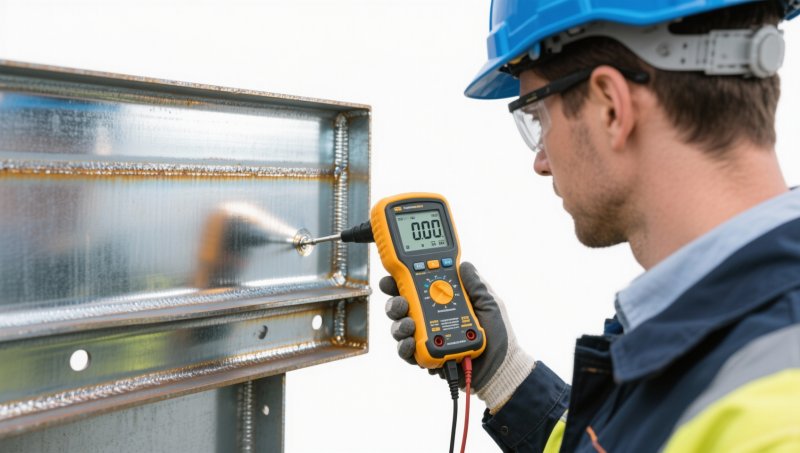
The most quantifiable check uses a calibrated magnetic induction gauge (e.g., Elcometer 456) to measure zinc layer thickness at ≥5 representative locations per member. Critical zones include edges, bolt holes, and welded joints—areas prone to coating thinning due to zinc runoff or heat-affected zone oxidation.
Per ASTM A123, acceptable thickness ranges vary by base steel thickness and application environment. For structural components used in bridges or heavy machinery—where Mild Steel Plate Supplier materials like ASTM A572 Grade 50 or EN S355JR are common—the required minimum is 70 µm on surfaces >6 mm thick and 55 µm on thinner sections. Readings below these thresholds indicate inadequate protection and warrant rejection or touch-up per EN ISO 1461 Annex B.
Hongteng Fengda supplies galvanized structural steel with certified thickness reports traceable to NIST-calibrated gauges. However, onsite verification ensures no damage occurred during transit—especially critical for long-haul shipments to North America or Europe where handling can cause micro-scratches invisible to the naked eye.
Check #2: Visual & Tactile Uniformity Assessment (EN ISO 1461 Clause 6.2)
A systematic visual inspection identifies non-uniformities that thickness gauges miss: zinc spatter, ash residue, uncoated weld seams, or “cold spots” caused by improper surface preparation. Conduct this under daylight-equivalent lighting (≥500 lux), using a clean white cloth to wipe sample areas—zinc ash will smudge gray, while bare steel reveals red-brown iron oxide.
Focus on high-stress junctions: beam-to-column connections, mechanical mounting plates, and rack support nodes. In one 2023 audit of 42 prefabricated transmission towers, 68% of rejected members failed this check—not due to thickness, but because weld seams showed incomplete coverage (average gap width: 0.3–1.2 mm), accelerating crevice corrosion.
Tactile feedback matters too: run a fingernail gently across the surface. A properly bonded coating feels smooth and continuous; flaking, peeling, or gritty texture signals poor flux cleaning or insufficient immersion time—both violating EN ISO 1461 Section 4.3 requirements for surface cleanliness and bath dwell time (minimum 3–5 minutes at 445–465°C).
Check #3: Adhesion Scratch Test (ASTM A123 Annex A3)
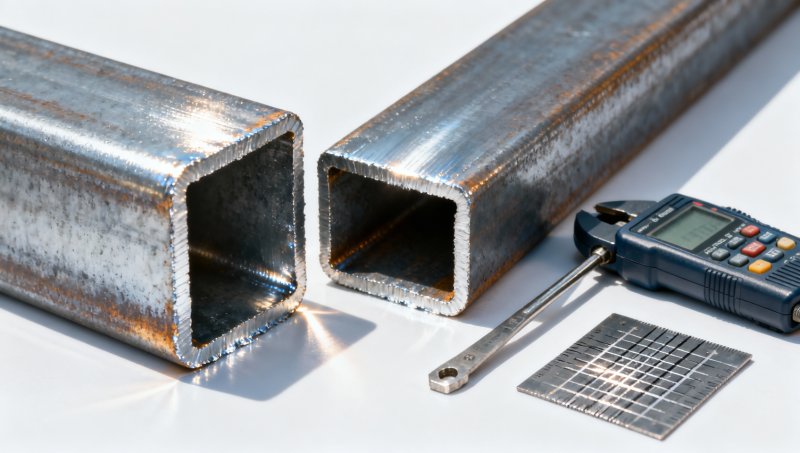
Coating thickness means little if the zinc layer delaminates. The scratch test evaluates bond strength: use a hardened steel scriber (Rockwell C55+) to draw two parallel lines 1 mm apart, then cross them at 90° to form a 1 mm² grid. Apply firm, consistent pressure—no gouging, no lifting.
Pass criteria per ASTM A123 Annex A3: no flaking or lifting at intersecting points; minor chipping (<10% of grid area) is acceptable only if not exposing base metal. Failure indicates either insufficient surface activation (e.g., residual mill scale or silicone contamination) or thermal shock during quenching—both root causes traceable to process control gaps in the galvanizer’s facility.
This test is especially vital for cold-formed steel profiles and customized structural steel components, where complex geometries increase risk of trapped air pockets during immersion. Hongteng Fengda performs 100% adhesion testing on all OEM orders prior to export—documented in batch-specific QA reports aligned with ISO 9001:2015 clause 8.2.4.
Integrating Checks into Procurement & Quality Workflows
These three checks are not standalone tasks—they feed directly into procurement risk mitigation and lifecycle cost planning. When evaluating suppliers, prioritize those offering pre-shipment verification reports with timestamped photos, thickness maps, and adhesion test logs. Hongteng Fengda provides digital QA dossiers for every order, including EN/ASTM compliance matrices and raw gauge data exports.
For project managers, embed these checks into your incoming inspection checklist at three stages: upon container unloading (100% visual/tactile), pre-erection (thickness sampling on 5% of pieces), and post-installation (adhesion spot-checks on 3 critical assemblies). This layered approach reduces rework costs by an average of 22% compared to single-point verification (2023 Construction Industry Institute study).
Global buyers across North America, Europe, and the Middle East rely on Hongteng Fengda’s dual-layer quality assurance: factory-certified compliance plus actionable field verification protocols. Whether you’re sourcing angle steel for industrial scaffolding or custom support plates for renewable energy installations, these checks ensure structural integrity from fabrication floor to final bolt torque.
Next Steps for Reliable Galvanized Steel Procurement
Implementing these checks delivers immediate value—but long-term reliability starts with partner selection. Hongteng Fengda maintains ISO 9001-certified galvanizing lines with real-time bath chemistry monitoring, automated immersion timing, and post-cooling passivation per ASTM A143. Every shipment includes EN/ASTM-compliant mill test reports, dimensional inspection records, and coating thickness certificates.
To align your project’s galvanizing verification plan with international standards and reduce sourcing risk, contact Hongteng Fengda today. Our engineering team supports custom QA protocols, pre-shipment third-party inspections, and technical documentation in English, Arabic, Spanish, or German—ensuring clarity from contract signing to site handover.
Request your free galvanizing verification checklist and supplier evaluation template—designed specifically for structural steel project managers working with Chinese manufacturers.
Related recommendations
 What is an H-Beam and How Does it Differ from an I-Beam?Discover what an H-beam is and how it differs from an I-beam. Learn key structural differences and expert selection tips from Hongteng Fengda to optimize your steel construction projects today.
 Hot Rolled vs. Cold Rolled Steel Sheet: Surface and ToleranceHot rolled vs cold rolled steel sheet: Discover how surface finish and tolerances impact manufacturing. Optimize material selection, reduce costs, and ensure quality. Read our expert guide today!
 Best Cutting and Bending Practices for Galvanized Sheet MetalDiscover the best cutting and bending practices for galvanized sheet to prevent zinc flaking. Optimize tooling and thermal parameters to ensure perfect corrosion resistance. Read the full guide!
 What is Galvanized Sheet and How Does the Zinc Coating Work?Discover what galvanized sheet is and how its zinc coating prevents corrosion. Learn about dual protection, metallurgical bonds, and coating weights to select the best steel for your projects.
Please give us a message


Please enter what you want to find