Accurately calculating I beam weight is essential for structural integrity, logistics planning, and cost control in industrial projects — whether you're a project manager sizing beams for Malaysian infrastructure, a procurement officer comparing standard vs custom steel lead time for industrial buyers, or an engineer evaluating I beam vs H beam for residential construction. This step-by-step guide breaks down the precise formula, unit conversions, and real-world variables — all backed by Hongteng Fengda’s expertise as a trusted Steel I Beam supplier in Malaysia and global structural steel manufacturer. Learn how to optimize specs, avoid over-ordering, and align with mill MOQ vs trader MOQ steel requirements — without compromising safety or budget.
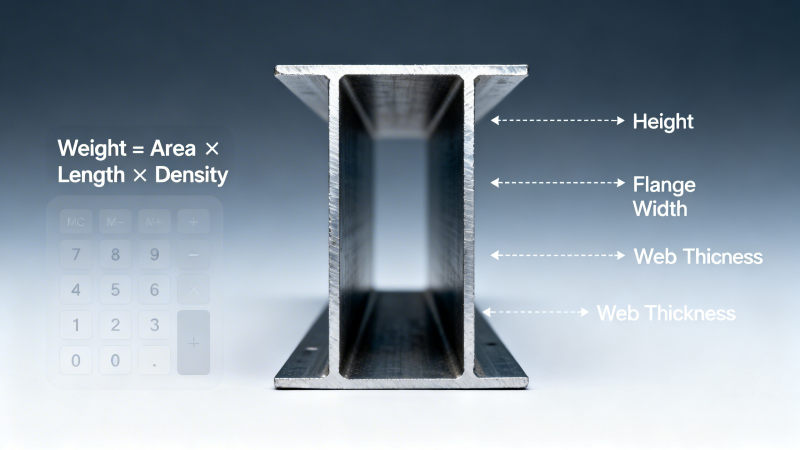
Understanding the I Beam Weight Formula
The weight of an I beam is calculated using its cross-sectional area multiplied by its length and material density. The universal formula is:
Weight (kg) = Cross-Sectional Area (cm²) × Length (m) × Density (kg/cm³)
For carbon steel — the most common material for structural applications — density is 0.00785 kg/cm³. Engineers often simplify this to Weight (kg/m) = Section Area (cm²) × 0.00785. This gives linear weight per meter — critical when estimating total load, crane capacity, or shipping volume. Note that section area must be derived from exact flange width, web thickness, height, and fillet radius — not nominal size alone.
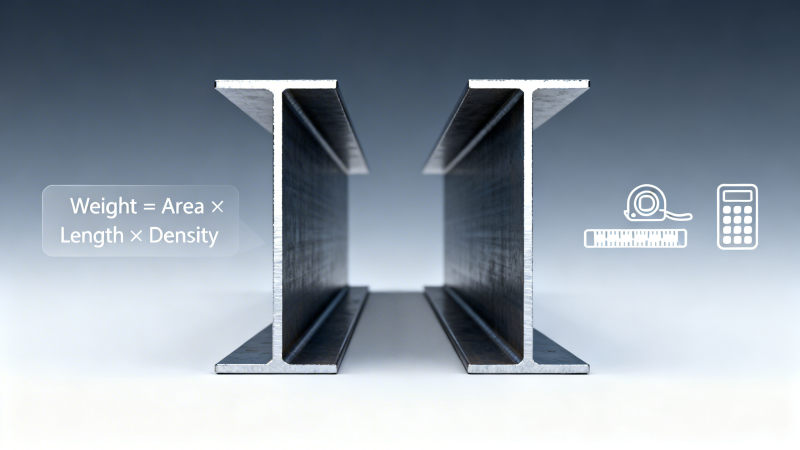
Manufacturers like Hongteng Fengda provide certified dimensional tolerances per ASTM A6/A6M or EN 10034, ensuring consistency across batches. When sourcing from China-based mills, always request mill test reports (MTRs) confirming actual dimensions — especially for projects where Wire Rod or supporting rebar must integrate seamlessly with primary beams.
Step-by-Step Calculation Example
Let’s calculate the weight of a standard ISMB 300 beam (Indian Standard Medium Beam), commonly used in Southeast Asian infrastructure:
- Height (h) = 300 mm
- Flange width (b) = 140 mm
- Web thickness (tw) = 7.8 mm
- Flange thickness (tf) = 13.1 mm
- Length = 12 m
First, compute cross-sectional area:
Area = 2 × (b × tf) + (h − 2tf) × tw = 2 × (14.0 × 1.31) + (30.0 − 2×1.31) × 0.78 ≈ 57.3 cm²
Then apply density: 57.3 cm² × 12 m × 0.00785 kg/cm³ = 53.9 kg/m × 12 m = 647 kg. Always round up for safety margins — especially when coordinating with local fabricators in Malaysia or the Middle East where steel beam factory price in Middle East may include handling surcharges for oversized loads.
Standard vs Custom Steel Lead Time for Industrial Buyers
Lead time directly impacts project scheduling and working capital. Below is a comparative overview based on Hongteng Fengda’s production data across 2023–2024:
I Beam vs H Beam for Residential Construction & Industrial Use
While both share similar geometry, their manufacturing methods and performance differ significantly:
- I Beams are hot-rolled with tapered flanges — ideal for bending resistance in single-axis loading (e.g., roof purlins).
- H Beams feature parallel flanges and thicker webs — better suited for bidirectional loading, seismic zones, and high-rise frames.
In residential construction across the Philippines or Malaysia, I beams remain preferred for cost-efficiency and ease of welding. However, for marine-grade structures requiring stainless steel bar for marine applications, engineers increasingly specify hybrid systems combining carbon I beams with corrosion-resistant cladding.
Hongteng Fengda supports dual-spec orders — such as pairing standard I beams with Wire Rod for on-site fabrication — reducing import duties and expediting delivery to ports like Port Klang or Jebel Ali.
Why Choose Hongteng Fengda as Your Structural Steel Partner?
As a certified structural steel manufacturer and exporter from China, Hongteng Fengda delivers more than products — we deliver predictability. Our ISO 9001-certified facilities produce angle steel, channel steel, cold-formed profiles, and precision-cut I beams compliant with ASTM, EN, JIS, and GB standards.
Whether you need Angle Steel price per ton Philippines for industrial use, steel beam factory price in Middle East, or support as a Steel I Beam supplier in Malaysia for infrastructure projects — our team provides technical documentation, logistics coordination, and bilingual engineering support. We help procurement officers navigate mill MOQ vs trader MOQ steel for industrial applications while maintaining full traceability from raw material to final shipment.
Contact us today for a customized quotation, dimensional verification service, or lead-time guarantee aligned with your project timeline.
- channel steel
- steel i
- h beams
- steel i beam supplier
- h beam
- angle steel
- wire rod
- structural steel
- Structural Steel
- Profile
- Rebar
- standard vs custom steel lead time
- mill MOQ vs trader MOQ steel
- Steel I Beam supplier in Malaysia
- Angle Steel price per ton Philippines
- I beam vs H beam
- steel beam factory price
- Steel Beam
- stainless steel bar
- carbon steel
- steel bar
- i beam weight
- stainless steel bar for marine applications
- steel beam factory price in Middle East
- I beam vs H beam for residential construction
- Angle Steel price per ton Philippines for industrial use
- Steel I Beam supplier in Malaysia for infrastructure projects
- mill MOQ vs trader MOQ steel for industrial applications
- standard vs custom steel lead time for industrial buyers
Related recommendations
 What is an H-Beam and How Does it Differ from an I-Beam?Discover what an H-beam is and how it differs from an I-beam. Learn key structural differences and expert selection tips from Hongteng Fengda to optimize your steel construction projects today.
 Hot Rolled vs. Cold Rolled Steel Sheet: Surface and ToleranceHot rolled vs cold rolled steel sheet: Discover how surface finish and tolerances impact manufacturing. Optimize material selection, reduce costs, and ensure quality. Read our expert guide today!
 Best Cutting and Bending Practices for Galvanized Sheet MetalDiscover the best cutting and bending practices for galvanized sheet to prevent zinc flaking. Optimize tooling and thermal parameters to ensure perfect corrosion resistance. Read the full guide!
 What is Galvanized Sheet and How Does the Zinc Coating Work?Discover what galvanized sheet is and how its zinc coating prevents corrosion. Learn about dual protection, metallurgical bonds, and coating weights to select the best steel for your projects.
Please give us a message


Please enter what you want to find