Choosing between I beam vs H beam for residential construction involves critical trade-offs in strength, cost, and installation efficiency—especially when balancing standard vs custom steel lead time for industrial buyers or evaluating mill MOQ vs trader MOQ steel for industrial applications. As a trusted Steel I Beam supplier in Malaysia for infrastructure projects and steel beam factory price in Middle East provider, Hongteng Fengda delivers ASTM/EN-compliant beams with optimized weight calculation support (how to calculate I beam weight for industrial projects) and competitive Angle Steel price per ton Philippines sourcing options.
Definition & Structural Identity: What Sets I Beams and H Beams Apart?
At first glance, I beams and H beams share a similar “I”-shaped cross-section—but their dimensional proportions, manufacturing standards, and structural behavior differ significantly. An I beam (also known as an S-beam or standard beam) follows legacy American or British profiles where flanges taper inward—narrower at the edges than at the web junction. In contrast, an H beam features parallel flanges of uniform thickness and width, resembling a true “H” shape. This distinction is codified across international standards: ASTM A6 governs I beams in North America; EN 10034 defines H beams in Europe; and GB/T 11263 classifies both types in China, with distinct subcategories (e.g., HW, HM, HN).
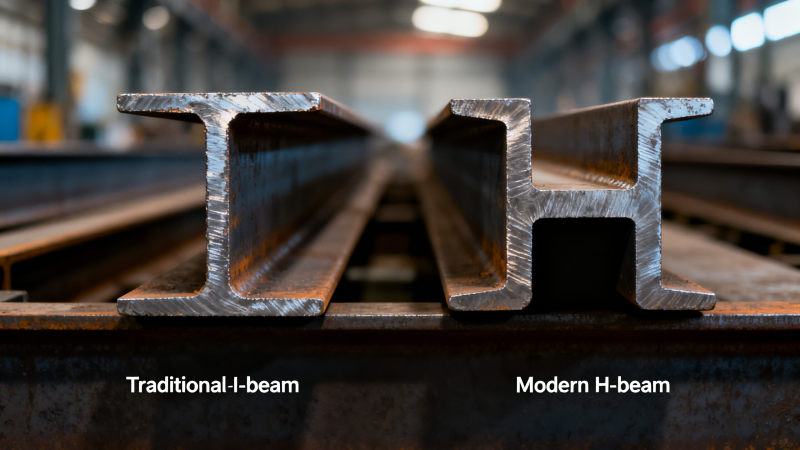
The naming convention often causes confusion among project managers and procurement personnel. For instance, many assume “H beam” is simply a regional synonym for “I beam.” In reality, H beams are engineered for higher moment resistance and axial load capacity due to their balanced geometry—making them increasingly preferred in multi-story residential framing, especially where column-to-beam continuity and seismic resilience matter. Meanwhile, traditional I beams remain widely used in roof trusses and light-duty floor systems where lateral torsional buckling risk is low.
Technical Performance Comparison: Strength, Stability & Load Response
Strength isn’t just about yield point—it’s about how geometry translates into real-world performance. Below is a comparative analysis of key mechanical behaviors under typical residential loading conditions (uniformly distributed live + dead loads up to 5 kN/m², span lengths 4–8 m):
Procurement Guide: Lead Times, MOQs & Regional Sourcing Realities
For project managers and procurement officers overseeing residential developments across Southeast Asia or the Middle East, supply chain agility directly impacts Gantt chart integrity. Mill MOQ vs trader MOQ steel for industrial applications represents more than volume—it reflects control over traceability, certification validity, and delivery predictability. At Hongteng Fengda, we maintain rolling production lines for hot-rolled I and H beams (sizes from 100×50 mm to 600×220 mm), enabling flexible order volumes starting at 5 metric tons—far below typical mill MOQs of 20+ tons. This flexibility supports phased construction schedules without overstocking risk.
Regarding standard vs custom steel lead time for industrial buyers, our in-house CNC profiling and cutting facilities reduce custom-order turnaround from 8–12 weeks (typical for overseas mills) to just 4–6 weeks—even for non-standard lengths or pre-drilled connection holes. Our Steel I Beam supplier in Malaysia for infrastructure projects network includes bonded warehouses in Port Klang, ensuring same-week dispatch for urgent residential retrofitting jobs. Likewise, our steel beam factory price in Middle East quotations include CIF Dubai or Dammam terms with ISO-certified mill test reports (MTRs) issued per heat number.
Cost & Installation Efficiency: Where H Beams Deliver ROI
While H beams carry a 7–12% premium per ton over equivalent I beams, total installed cost tells a different story. Field labor savings alone often offset material cost differences: fewer weld prep steps, faster bolt-up cycles, and reduced need for temporary bracing during erection. A recent case study in Johor Bahru showed a 22-unit terrace housing project cut structural steel installation time by 37% using EN 10034 H beams versus ASTM A6 I beams—translating to RM 142,000 in saved labor and crane rental fees.
Also consider long-term value: H beams’ symmetrical geometry allows reuse in future renovations or adaptive reuse scenarios—critical for developers targeting ESG-aligned asset longevity. For corrosion-prone environments like coastal Philippines or humid Malaysian suburbs, pairing H beams with galvanized coatings or even 304 Stainless Square steel rod for anchorage components adds durability without compromising structural logic.
Why Choose Hongteng Fengda for Your Residential Structural Steel?
As a certified structural steel manufacturer and exporter from China, Hongteng Fengda bridges global compliance and localized responsiveness. We don’t just ship steel—we co-engineer solutions. Our technical team provides free how to calculate I beam weight for industrial projects support, including downloadable Excel calculators aligned with ASTM A6 and EN 10034 section properties. Every shipment carries third-party inspection reports (SGS/BV), and all beams meet minimum Charpy V-notch impact requirements at –20°C—ensuring safety in variable climates.
Whether you’re a distributor seeking stable Angle Steel price per ton Philippines contracts, a project manager validating steel beam factory price in Middle East benchmarks, or a safety officer verifying weld procedure specifications—we deliver consistency, transparency, and speed. Contact us today for customized beam sizing, BIM-ready Revit families, or just-in-time logistics planning tailored to your next residential build.
- steel i
- h beams
- steel i beam supplier
- h beam
- angle steel
- structural steel
- Structural Steel
- Steel Rod
- Profile
- standard vs custom steel lead time
- mill MOQ vs trader MOQ steel
- Galvanized
- Steel I Beam supplier in Malaysia
- Angle Steel price per ton Philippines
- how to calculate i beam weight
- I beam vs H beam
- steel beam factory price
- Steel Beam
- i beam weight
- steel beam factory price in Middle East
- I beam vs H beam for residential construction
- how to calculate i beam weight for industrial projects
- Steel I Beam supplier in Malaysia for infrastructure projects
- mill MOQ vs trader MOQ steel for industrial applications
- standard vs custom steel lead time for industrial buyers
Related recommendations
 How much does 2 inch ss pipe price increase when upgrading from Schedule 40 to Schedule 80 for high-pressure systems?2 inch ss pipe price increases 18–35% when upgrading from Sch 40 to Sch 80—discover why, when it’s truly needed, and how to avoid overpaying.
 Which 304 stainless steel coil suppliers meet ISO 9001 and EN 10088-2 for food-grade fabrication?Discover verified 304 stainless steel coil suppliers meeting ISO 9001 & EN 10088-2 for food-grade fabrication—traceable, audited, and ready for regulatory validation.
 How does 2 inch ss pipe price compare between 304 and 316 grades for marine environments?2 inch ss pipe price varies significantly between 304 and 316 — but in marine environments, choosing 304 risks costly failures. Discover why 316 is the true value choice.
 Is 20 feet square pipe price affected more by raw material volatility or regional logistics costs?20 feet square pipe price is driven primarily by raw material volatility—not logistics. Discover why billet costs dominate pricing & how to forecast smarter with Hongteng Fengda.
Please give us a message


Please enter what you want to find