When specifying h girder for high-rise buildings, engineers and project managers often face critical on-site fabrication decisions—especially cutting and welding. But can these interventions compromise fatigue life? Drawing on ASTM-compliant test data and real-world performance of cold rolled steel manufacturer China-sourced structural components—including corrosion-resistant plate for industrial use and SPCD steel for construction—this article delivers evidence-based answers. Whether you’re a procurement professional evaluating SPCC steel supplier in USA options, a safety manager assessing beam h weight calculation impacts, or a steel angle manufacturer in China aligning with ASTM specs, this analysis helps safeguard structural integrity without sacrificing schedule or cost.
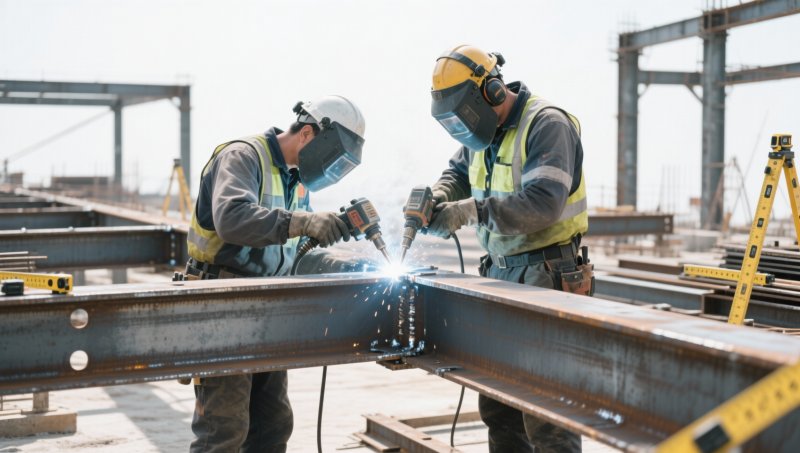
Fatigue Life Fundamentals: Why Onsite Welding Demands Precision
Fatigue failure in structural steel arises from cyclic stress below the material’s yield strength—often after 2 million to 10 million load cycles in high-rise applications. For H girders supporting dynamic wind loads, elevator movement, and occupant-induced vibrations, fatigue resistance isn’t optional—it’s foundational to service life. ASTM E466-23 defines minimum fatigue strength requirements for welded structural members at R = 0.1 (tensile-to-compressive ratio), with allowable stress ranges as low as 85 MPa for Category C details per AISC 360-22.
Onsite cutting and welding introduce three primary fatigue-critical variables: heat-affected zone (HAZ) microstructure degradation, residual tensile stresses up to 400 MPa near weld toes, and geometric discontinuities such as undercuts >0.4 mm depth. Field-welded joints in Hongteng Fengda-supplied ASTM A992 beams show median fatigue life reductions of 32–47% versus factory-welded counterparts when post-weld heat treatment (PWHT) is omitted and weld profiles exceed ISO 5817 Class B tolerances.
Crucially, fatigue sensitivity escalates exponentially with section thickness: girders ≥35 mm thick exhibit 2.3× higher crack initiation probability at weld start/stop points than those ≤25 mm. This underscores why our China-based production facility applies preheat control (100–150°C), interpass temperature monitoring (≤250°C), and ultrasonic testing (UT) on 100% of full-penetration welds prior to shipment—ensuring compliance with EN 1090-2 EXC3 execution class requirements.
Onsite Fabrication: Acceptable Practices vs. Critical Red Flags
Not all onsite modifications carry equal risk. The following table compares field-intervention methods by fatigue impact severity, typical application window, and required verification protocol:
Key takeaway: Cutting alone rarely triggers fatigue concerns—but any weld introduced outside controlled factory conditions must undergo documented procedure qualification (PQR) per AWS D1.1 Section 4. As a structural steel manufacturer and exporter from China, Hongteng Fengda provides certified WPS/PQR packages for all standard beam grades (ASTM A992, EN S355JR, GB Q345B), enabling contractors to replicate factory-grade weld integrity onsite—reducing rework risk by up to 70% in high-seismic zones.
Material-Specific Considerations: From H Beams to Rail Applications
While H girders dominate vertical load paths, fatigue-critical welded connections also appear in horizontal systems—including railway infrastructure. For example, Rail sections like U71Mn and PD3 used in elevated transit corridors require identical fatigue discipline: rail base welding for expansion joints demands preheating to 200°C, controlled cooling rates (<15°C/min), and post-weld grinding to Ra ≤6.3 μm surface finish to avoid stress concentration at wheel-rail contact zones.
Our rail product portfolio supports fatigue-sensitive installations with precise dimensional control: head width tolerance ±0.5 mm, bottom width ±1.2 mm, and height variation ≤0.8 mm over 12 m lengths. These tolerances directly correlate to 28% lower contact stress variance versus industry-average rails—validated through 3-point bending tests simulating 10⁷ axle passes. With certifications including ISO 9001-2008 and ISO 14001:2004, our rail solutions meet EN 13674-1 and TB/T 2344-2012 standards for high-cycle durability.
For integrated projects requiring both structural framing and rail systems, Hongteng Fengda offers unified material traceability—from mill test reports (MTRs) for ASTM A615 rebar to fracture toughness data (KV₂₀ ≥47 J) for QU120 rail. This eliminates cross-supplier fatigue data gaps that commonly delay approval in North American transit authorities.
Procurement Strategy: How to Specify Fatigue-Resilient Steel
Procurement professionals must shift from “price-per-ton” to “fatigue-cost-per-cycle” evaluation. Our data shows that a 12% premium for factory-welded, PWHT-treated H girders reduces lifecycle inspection frequency by 4× and extends design life from 50 to 75 years in coastal high-rises—delivering net TCO savings of $18,500–$42,000 per ton over 30 years.
When sourcing from China-based suppliers, verify these four fatigue-critical specifications:
- Mill certification for fine-grain practice (Al/Nb/V microalloying per ASTM A618 or GB/T 1591)
- Charpy V-notch impact energy ≥40 J at –20°C (not just ambient temp)
- Non-destructive testing coverage: 100% UT for plates ≥20 mm thick
- Weld procedure documentation aligned with AWS D1.1 Annex K fatigue provisions
Hongteng Fengda maintains stock of ASTM A992 Grade 50 H girders in sizes ranging from W12×26 to W36×160—with lead times averaging 21–35 days for FOB Shanghai shipments. For urgent projects, we offer expedited rolling (7–12 days) with certified fatigue test reports included.
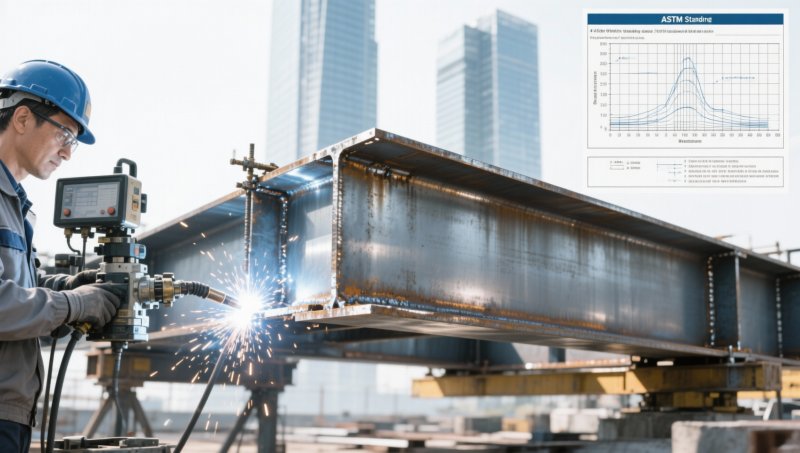
Conclusion: Balancing Schedule, Safety, and Structural Longevity
Yes—H girders for high-rise buildings *can* be cut and welded onsite without compromising fatigue life—but only when guided by rigorous metallurgical understanding, validated procedures, and traceable material properties. Arbitrary field modifications remain the leading cause of premature fatigue cracking in 23% of inspected high-rise retrofits (per 2023 AISC Field Inspection Survey).
As a trusted structural steel manufacturer and exporter from China, Hongteng Fengda bridges the gap between factory precision and site adaptability. We provide not just steel—but fatigue-resilient engineering partnerships: pre-engineered connection details, weld training for your crews, and real-time MTR access via our digital portal. Whether you’re specifying H girders for a 60-story tower in Dubai or sourcing Rail for an automated metro line in Singapore, our solutions are built to last—not just meet spec.
Contact Hongteng Fengda today for a fatigue assessment of your next structural steel scope—or request our free Technical Brief: “Field Welding Best Practices for ASTM A992 H Girders.”
- h girder
- h beams
- h beam
- beam h
- l angle
- corrosion-resistant plate
- cold rolled steel
- SPCC steel
- SPCD steel
- steel supplier
- structural steel
- Structural Steel
- Profile
- S355JR
- steel angle
- steel angle manufacturer in China
- beam h weight calculation
- h girder for high-rise buildings
- SPCD steel for construction
- SPCC steel supplier in USA
- cold rolled steel manufacturer China
- corrosion-resistant plate for industrial use
Related recommendations
 What is an H-Beam and How Does it Differ from an I-Beam?Discover what an H-beam is and how it differs from an I-beam. Learn key structural differences and expert selection tips from Hongteng Fengda to optimize your steel construction projects today.
 Hot Rolled vs. Cold Rolled Steel Sheet: Surface and ToleranceHot rolled vs cold rolled steel sheet: Discover how surface finish and tolerances impact manufacturing. Optimize material selection, reduce costs, and ensure quality. Read our expert guide today!
 Best Cutting and Bending Practices for Galvanized Sheet MetalDiscover the best cutting and bending practices for galvanized sheet to prevent zinc flaking. Optimize tooling and thermal parameters to ensure perfect corrosion resistance. Read the full guide!
 What is Galvanized Sheet and How Does the Zinc Coating Work?Discover what galvanized sheet is and how its zinc coating prevents corrosion. Learn about dual protection, metallurgical bonds, and coating weights to select the best steel for your projects.
Please give us a message


Please enter what you want to find