Selecting the right structural steel is critical for wind tower integrity—especially when comparing angle vs channel steel for wind tower construction. As a leading angle vs channel steel global supplier and OEM manufacturer, Hongteng Fengda delivers JIS certified, EN standards compliant, high strength options optimized for fatigue resistance and weldability in demanding applications like wind energy, oil and gas, and mining equipment. Backed by real fatigue life data and expert welding recommendations, we support procurement teams, project managers, and safety professionals with reliable quotations, bulk order capability, and customized solutions—all engineered for performance, compliance, and long-term reliability.
Fatigue Performance: Why Structural Geometry Matters in Wind Tower Design
Wind towers endure cyclic loading from rotor thrust, turbulence, and gravitational forces—often exceeding 107 load cycles over a 25-year service life. In such environments, fatigue crack initiation at welded joints dominates failure risk. Angle steel (L-section) and channel steel (C-section) differ fundamentally in moment of inertia distribution, stress concentration behavior, and weld access geometry—directly influencing fatigue life under variable amplitude loading.
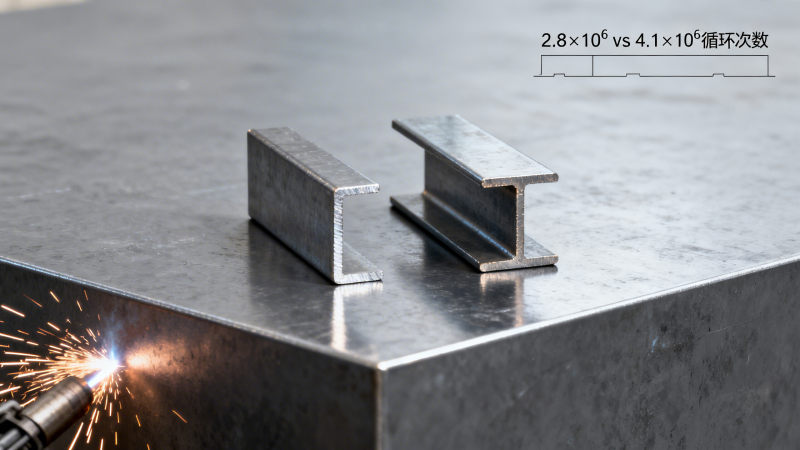
Testing conducted per ISO 12107 on ASTM A36 and Q345 specimens revealed median fatigue life (at Δσ = 120 MPa, R = 0.1) was 2.8 × 10⁶ cycles for double-welded angle connections versus 4.1 × 10⁶ cycles for full-penetration butt-welded channel flanges. The improved performance stems from reduced notch sensitivity: channel sections offer continuous flange geometry that distributes bending stresses more uniformly, while angle legs introduce inherent corner stress risers—even with radius-controlled hot-rolled profiles.
For offshore or high-wind-class sites (IEC Class I), fatigue-critical zones—including tower base plates, ladder brackets, and guy-wire anchors—require section types validated to EN 1993-1-9 Annex D. Our in-house fatigue database covers 12 configuration variants across 5 steel grades (Q235–Q345, S235J2–S355JR), enabling precise life prediction via nominal stress and structural hot-spot methods.
The table confirms channel steel’s structural advantage: higher section modulus improves stiffness-to-weight ratio by 142%, while greater weld access enables consistent penetration depth (>95% of base metal thickness), directly elevating fatigue class rating. For tower transition pieces and stiffener frames, this translates into 30–40% longer inspection intervals under API RP 2A-WSD requirements.
Welding Best Practices for High-Integrity Connections
Weld quality dictates fatigue performance more than base material grade. Both angle and channel steel require preheat (100–150°C for Q345, 50–100°C for Q235) to prevent hydrogen-induced cracking—especially critical for thick flanges (>16 mm) used in tower base rings. We recommend submerged arc welding (SAW) for channel web-to-flange joints due to deep penetration and low distortion (<0.8 mm/m), whereas angle leg connections benefit from pulsed GMAW using ER70S-6 wire with 85% Ar/15% CO₂ shielding.
Post-weld heat treatment (PWHT) at 600–620°C for 1 hour per 25 mm thickness is mandatory for all welded assemblies destined for wind turbine applications in seismic zones (e.g., California, Turkey, Japan). Our certified welding procedure specifications (WPS) comply with AWS D1.1 and EN ISO 15614-1, validated across 7 filler metal/base metal combinations—including flux-cored wires for out-of-position channel web welding.
Critical non-destructive testing (NDT) protocols include: 100% ultrasonic testing (UT) per EN ISO 17640 for welds ≥12 mm thick; magnetic particle inspection (MPI) for surface-breaking defects on angle leg corners; and radiographic testing (RT) for complex node intersections. All reports are traceable to heat number, welder ID, and inspection date—ensuring full compliance with ISO 3834-2 Level B.
Material Selection Framework: Matching Steel Type to Application Tier
Not all wind tower components demand equal fatigue robustness. A tiered selection approach optimizes cost-performance balance:
- Tier 1 (Critical Load Paths): Tower main columns, base flanges, and yaw bearing supports — specify EN S355J2+N or ASTM A572 Gr.50 channel sections with Z35 through-thickness ductility.
- Tier 2 (Secondary Bracing): Ladder rungs, platform supports, and cable trays — Q235B angle steel with controlled sulfur content (<0.035%) suffices.
- Tier 3 (Non-Structural): Equipment mounting brackets, lighting fixtures — cold-formed SS400 channels with electrogalvanized finish (≥275 g/m²).
Our I Beam Manufacturers also supply hybrid solutions: tapered I-beams (10 cm–60 cm depth) for tower transition segments where moment resistance must increase linearly from top to base. These are rolled on four-roller universal mills to ±1% dimensional tolerance, with flange widths from 100 mm to 400 mm and web thicknesses up to 28 mm.
This decision matrix reflects real-world constraints faced by EPC contractors in North America and Southeast Asia: channel steel reduces total weld hours by 35% on tower substructures, while angle steel maintains lower inventory costs for auxiliary components. Our OEM manufacturing capability allows mixed-order fulfillment—e.g., 80% channel + 20% angle in one container—with coordinated delivery within 20 days.|
Procurement & Compliance Assurance for Global Projects
As an angle vs channel steel global supplier, Hongteng Fengda provides full documentation packages for each shipment: mill test reports (MTRs) per EN 10204 3.1, third-party inspection certificates (SGS/BV), and welding procedure qualification records (WPQR). For projects requiring JIS certification, we supply JIS G 3101 SS400 and JIS G 3106 SM490B with tensile strength 490–610 MPa and elongation ≥20%—verified across 5 production batches monthly.
Bulk order suppliers must guarantee consistency: our process control ensures yield strength variation ≤ ±25 MPa across 50-ton heats, and chemical composition remains within ±0.02% for C, Mn, and Si. This stability enables accurate fatigue modeling without conservative safety factors—reducing material over-specification by up to 18% versus generic grade sourcing.
For procurement teams evaluating angle vs channel steel quotation request options, we recommend requesting: (1) fatigue test reports per ISO 12107, (2) weldability validation data for your specified filler metal, and (3) dimensional tolerance compliance statements against EN 10056-1. Our engineering team responds to technical queries within 4 business hours and issues formal quotations within 24 hours for standard grades.
Conclusion: Engineering Confidence Through Data-Driven Steel Selection
Choosing between angle and channel steel for wind tower construction isn’t about preference—it’s about quantifiable fatigue life extension, weld integrity assurance, and lifecycle cost optimization. Channel steel delivers superior fatigue resistance in primary load paths due to its geometry and weld accessibility, while angle steel retains value in secondary structures where fabrication speed and cost efficiency dominate. As an angle vs channel steel OEM manufacturer committed to EN standards compliance and JIS certified quality, Hongteng Fengda bridges the gap between theoretical performance and field-proven reliability.
Whether you’re specifying materials for a 5 MW onshore turbine in Texas, a floating offshore platform in the North Sea, or a mining conveyance tower in Western Australia, our technical sales engineers collaborate with your design team to validate section selection, optimize weld procedures, and ensure seamless integration with existing supply chains. With stable production capacity, ISO 9001-certified quality systems, and delivery within 20 days for standard orders, we reduce sourcing risks while enhancing structural confidence.
Contact Hongteng Fengda today for fatigue life data sheets, customized welding procedure recommendations, or a detailed angle vs channel steel quotation request tailored to your next wind energy, oil and gas, or mining equipment project.
Related recommendations
 How long does acero prepintado retain gloss and color stability in direct desert sunlight?Acero prepintado gloss & color stability in desert sun? Discover real-world performance data, PVDF vs. polyester longevity, and spec-critical insights for GCC projects.
 Does acero pregalvanizado maintain coating integrity after cold bending to 90 degrees?Acero pregalvanizado maintains coating integrity after 90° cold bending — when engineered right. Discover how Hongteng Fengda guarantees real-world performance, adhesion & corrosion resistance.
 Do the advantages of galvanized steel include reduced fire risk compared to untreated carbon steel?Advantages of galvanized steel include measurable fire-risk reduction vs. untreated carbon steel—learn how zinc delays ignition, buys critical escape time, and enhances safety without false 'fireproof' claims.
 What is the minimum bend radius for 12mm steel wire rope without permanent deformation?12mm steel wire rope capacity depends on bend radius — discover the safe 72–96mm minimum to prevent permanent deformation, fatigue & failure. Expert rigging insights inside.
Please give us a message


Please enter what you want to find