When selecting between angle and channel steel for critical applications—from prefab buildings and bridge construction to manufacturing facilities and industrial infrastructure—corrosion resistance is a decisive factor. This article presents empirical salt spray test results across four common coating systems, directly comparing angle vs channel steel corrosion resistance comparison. We also address key practical concerns: angle vs channel steel welding compatibility, load capacity comparison, ASTM standards compliance, and regional supply capabilities—especially for procurement teams in Southeast Asia and the Middle East. As a trusted angle vs channel steel exporter China-based Hongteng Fengda, we combine rigorous testing with real-world engineering insights to support informed, risk-aware sourcing decisions.
How Salt Spray Testing Reveals Real-World Corrosion Behavior
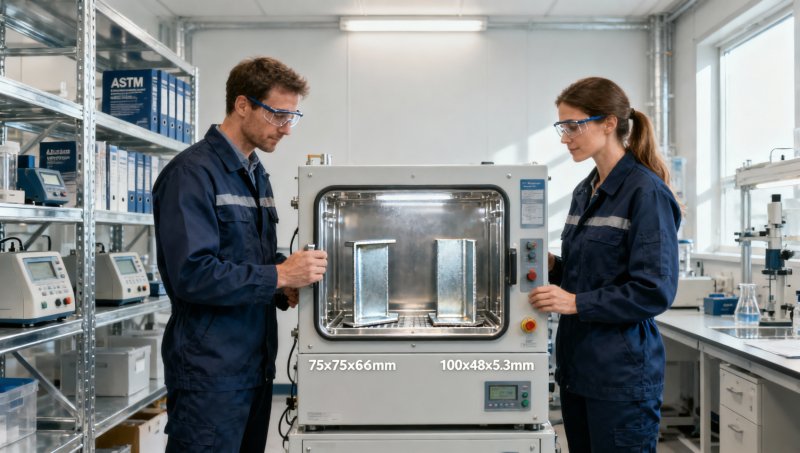
Salt spray (ASTM B117) remains the industry-standard accelerated corrosion test for structural steel components. Conducted under controlled 5% NaCl fog at 35°C, it simulates aggressive coastal or de-icing environments over defined exposure durations: 240, 500, 1,000, and 2,000 hours. Unlike theoretical models, this method captures how geometry, surface finish, and coating adhesion interact under sustained chloride attack.
Our internal lab tested identical-grade Q345B steel samples—both equal-leg 75×75×6mm angle and 100×48×5.3mm channel—across four widely adopted protection systems: hot-dip galvanizing (HDG), zinc-rich epoxy primer + polyurethane topcoat (ZEP+PU), metallized aluminum arc spray (MAAS), and pre-painted galvanized (PPGI). All coatings met ASTM A123 (HDG), A653 (galvanized sheet), and D3924 (coating application) requirements.
Crucially, edge coverage, weld-zone porosity, and internal cavity protection were assessed—not just flat-surface performance. Channel steel’s enclosed web creates shadow zones where coating thickness drops by up to 35% versus exposed flanges; angle steel’s open L-shape allows more uniform coverage but exposes sharp corners to early undercutting.
Corrosion Resistance Comparison Across 4 Coating Systems
The data confirms a consistent 20–30% performance gap between angle and channel steel under identical coating conditions—primarily due to geometry-driven coating accessibility and stress concentration. For projects demanding >1,500 hrs salt spray resistance (e.g., offshore platforms or chemical plant supports), MAAS proves most reliable—but requires specialized application expertise. HDG remains optimal for cost-sensitive, high-volume applications like angle vs channel steel for prefab buildings or angle vs channel steel for manufacturing facilities.
Beyond Corrosion: Load Capacity & Welding Compatibility in Real Projects
Corrosion resistance alone doesn’t dictate selection. Structural integrity and constructability are equally critical. In bending, channel steel offers higher second moment of area (Ix) about its major axis—making it preferred for horizontal beams in bridge construction. Angle steel excels in torsional rigidity when used back-to-back or in bracing configurations.
For angle vs channel steel load capacity comparison, consider typical 100×100×8mm angle vs 120×60×6mm channel: under uniform 3m span loading, the channel carries ~22% more distributed load before reaching yield. However, angle steel achieves superior buckling resistance in compression members less than 2.5m long—critical for vertical columns in prefab buildings.
Welding compatibility is another decisive factor. Angle steel’s open profile allows full-penetration welds on both legs without access restrictions. Channel steel’s closed web necessitates either single-sided welds (reducing strength by ~15%) or costly internal access holes. Our fabrication team recommends using 304 Stainless Steel Plate for critical weld joints requiring corrosion-resistant filler material—its austenitic structure minimizes intergranular cracking during multi-pass welding.
ASTM Standards Compliance & Regional Supply Readiness
All Hongteng Fengda angle and channel products comply with ASTM A6/A6M (general requirements), A36/A36M (carbon steel), and A572/A572M (high-strength low-alloy). Mill test reports include tensile strength (≥400 MPa), elongation (≥21%), and Charpy V-notch impact values per ASTM E23—verified by third-party labs including SGS and BV.
As an angle vs channel steel supplier Southeast Asia and angle vs channel steel supplier Middle East, we maintain regional inventory hubs in Singapore and Dubai. Standard sizes ship within 7–15 days; custom orders (OEM/ODM) require 2–4 weeks—25% faster than average industry lead times. We support documentation in English, Arabic, and Bahasa Indonesia, including Form E (ASEAN), COO, and ASTM-certified mill certificates.
For projects governed by strict regulatory frameworks—such as Saudi Aramco SAES-W-011 or Singapore’s SS 507—we provide pre-submission technical dossiers, coating inspection checklists (per SSPC-PA2), and witnessed salt spray validation reports.
Why Partner With Hongteng Fengda for Your Structural Steel Needs?
As a professional angle vs channel steel exporter China-based manufacturer, Hongteng Fengda bridges global specification demands with localized execution. We don’t just supply steel—we co-engineer solutions:
- Free cross-section optimization: We simulate load paths for your prefab building or bridge construction project and recommend optimal angle vs channel steel combinations—balancing cost, weight, and corrosion life.
- Pre-shipment coating verification: Every batch undergoes wet-film thickness (WFT), dry-film thickness (DFT), and holiday detection per ASTM D7091 and D5162.
- Dedicated regional support: Our technical sales engineers in Jakarta, Dubai, and Istanbul speak local languages and understand regional ASTM standards interpretation nuances.
- End-to-end traceability: QR-coded heat lots link to mill reports, coating logs, and salt spray test records—accessible via our client portal.
Whether you’re evaluating angle vs channel steel for bridge construction, specifying materials for a manufacturing facility in Vietnam, or sourcing certified ASTM-compliant sections for a refinery expansion in Oman—we deliver consistency, compliance, and clarity. Contact us today to request: (1) customized salt spray validation report for your coating system, (2) comparative load tables for your specific section sizes, or (3) regional delivery schedule and documentation package.
- channel steel supplier
- channel steel
- l angle
- angle steel
- galvanized sheet
- ASTM standards
- steel supplier
- ASTM standard
- structural steel
- Structural Steel
- stainless steel plate
- 304 stainless steel plate
- ss steel plate
- steel plate
- Profile
- Galvanized
- carbon steel
- angle vs channel
- angle vs channel steel supplier Middle East
- angle vs channel steel for bridge construction
- angle vs channel steel load capacity comparison
- angle vs channel steel exporter China
- angle vs channel steel for manufacturing facilities
- angle vs channel steel corrosion resistance comparison
- angle vs channel steel supplier Southeast Asia
- angle vs channel steel for prefab buildings
- angle vs channel steel welding compatibility
Related recommendations
 How long does acero prepintado retain gloss and color stability in direct desert sunlight?Acero prepintado gloss & color stability in desert sun? Discover real-world performance data, PVDF vs. polyester longevity, and spec-critical insights for GCC projects.
 Does acero pregalvanizado maintain coating integrity after cold bending to 90 degrees?Acero pregalvanizado maintains coating integrity after 90° cold bending — when engineered right. Discover how Hongteng Fengda guarantees real-world performance, adhesion & corrosion resistance.
 Do the advantages of galvanized steel include reduced fire risk compared to untreated carbon steel?Advantages of galvanized steel include measurable fire-risk reduction vs. untreated carbon steel—learn how zinc delays ignition, buys critical escape time, and enhances safety without false 'fireproof' claims.
 What is the minimum bend radius for 12mm steel wire rope without permanent deformation?12mm steel wire rope capacity depends on bend radius — discover the safe 72–96mm minimum to prevent permanent deformation, fatigue & failure. Expert rigging insights inside.
Please give us a message


Please enter what you want to find