Prefabricated steel girder for bridge construction is revolutionizing modern infrastructure by improving installation efficiency, structural stability, and cost control. As a leading structural steel manufacturer and exporter in China, Hongteng Fengda provides ASTM certified steel square rod, steel tube for industrial applications, and other customized steel components that meet international standards. Whether you need an angle vs channel steel comparison or reliable sourcing for large-scale projects, our prefabricated solutions ensure consistent quality and faster project completion worldwide.
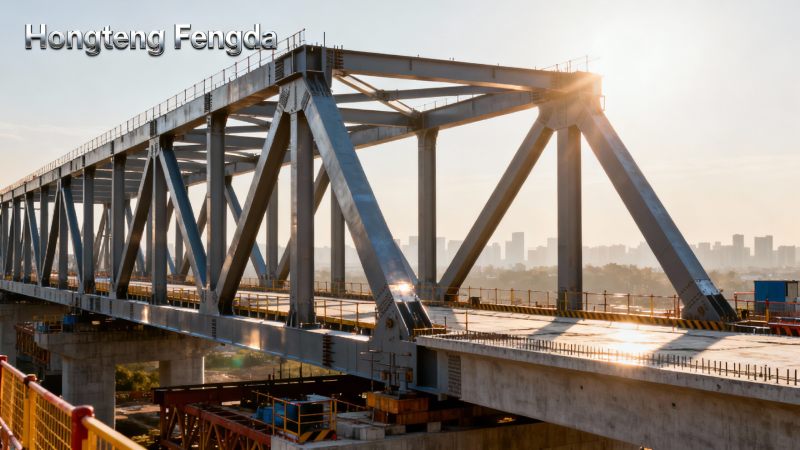
Definition and Structural Concept of Steel Girder for Bridge Construction
A steel girder for bridge construction refers to a large horizontal structural member designed to support loads and transfer forces to bridge piers and abutments. Prefabricated girders, made from high strength materials, are fabricated in controlled environments to ensure dimensional accuracy and consistent performance. Different profiles such as I-beam, H-beam, and box girder types serve a range of load-bearing and span requirements. The engineering philosophy behind prefabricated steel girders emphasizes modular construction, allowing segments to be transported easily, assembled quickly, and aligned precisely on-site. Compared with traditional in-situ fabrication, prefabrication ensures better weld quality, lower site labor needs, and reduced weather dependency during construction. As the global demand for sustainable infrastructure grows, bridge engineers increasingly rely on efficient prefabrication techniques to balance quality, cost, and environmental goals. Whether applied in highway overpasses, railway viaducts, or urban flyovers, modern steel girder technology embodies reliability, repeatability, and refined design computation supported by finite element analysis tools.
Market Overview and Global Demand Trends
The global structural steel market has evolved rapidly over the past decade, driven by rising public investments in transportation networks and smart city infrastructure. Bridge construction, one of the key application areas, requires components that meet stringent quality and performance benchmarks. Global procurement teams are now prioritizing suppliers that offer scalable production, traceable materials, and certifications such as ASTM, EN, JIS, and GB. As a professional structural steel manufacturer and exporter from China, Hongteng Fengda serves markets across North America, Europe, the Middle East, and Southeast Asia, combining stable output with flexible logistics. According to industry reports, the demand for prefabricated steel components grows by approximately 6–8% annually, fueled by government-backed bridge renovation projects and sustainable infrastructure policies. While many buyers compare angle vs channel steel configurations for structural framing, bridge contractors are increasingly requesting high strength steel girders integrated with customized surface treatment, corrosion protection, and precise tolerance control. This approach minimizes future maintenance, ensuring decades of reliable service life. Hongteng Fengda continues to strengthen global cooperation, providing not only prefabricated girders but also steel tube for industrial applications and steel conduit for electrical wiring, forming a full-spectrum steel solution for infrastructure investors.
Technical Performance and Prefabrication Efficiency
From a technical standpoint, the efficiency gains of prefabricated steel girder systems derive from their advanced fabrication technology and material optimization. High strength alloys, advanced welding lines, and precision machining ensure superior yield strength and fatigue resistance—key requirements in bridge design codes globally. Prefabrication allows sections to be pre-drilled, shot-blasted, galvanized, or coated with anti-corrosion layers before leaving the factory, significantly enhancing project efficiency. By employing intelligent modular design principles and CNC-controlled cutting, deviations in plate thickness, alignment, and camber can be kept within millimeter-level tolerances. For procurement professionals and project management officers, such precision translates directly into predictable assembly sequences and reduced risk of structural misalignment. Hongteng Fengda’s controlled production lines operate according to ISO9001 and SGS certification frameworks, providing a transparent quality traceability system. Additionally, integration with products such as High Carbon Steel Pipe demonstrates the company’s versatility: from simple beams to complex welded bridge girders with machined end plates and custom holes designed per API or ASTM standards. This cross-product consistency helps bridge builders complete installations faster while maintaining uniformity in material specifications, yielding higher return on investment across large-scale construction projects.
Comparison Analysis: Prefabrication vs Traditional Fabrication
The construction sector often compares prefabricated and traditional fabrication methods to evaluate efficiency and overall project quality. Traditional on-site fabrication requires extensive manpower, temporary welding setups, and large-scale scaffolding, often affected by weather and site logistics. Prefabricated steel girder systems, by contrast, transfer approximately 70% of total fabrication effort to the controlled factory environment—ensuring consistent heat treatment, surface quality, and inspection accuracy. When evaluating project total cost, prefabrication typically cuts on-site assembly time by 30–40%, reducing labor costs and safety risks. For quality assurance teams and safety management personnel, this shift is transformative, as fewer joints are welded on-site, decreasing potential weaknesses in the structure. Engineers conducting an angle vs channel steel comparison will find that prefabrication aligns well with either format, offering flexibility in geometry customization and enhanced repeatability. Additionally, pre-assembly testing ensures components meet ASTM and EN tolerances before shipment. The result is smoother installation, lighter logistic loads, and improved documentation of mechanical performance parameters, giving construction managers a clearer overview of project timelines and risk control.
Application Scenarios and Practical Implementation
Steel girders form the backbone of countless infrastructure projects—ranging from pedestrian overpasses and river crossings to large motorway bridges. In each of these cases, prefabricated solutions save contractors valuable installation time while ensuring alignment with safety and durability standards. When bridge spans extend beyond 80 meters, standardized girder sections are joined on-site with high-tensile bolts and field welds under protective conditions. Hongteng Fengda’s design team collaborates closely with contractors to define optimal girder shapes, stiffener layouts, and load-carrying capacities according to codes such as AISC 360 and Eurocode 3. Moreover, the integration of supplementary parts—such as ASTM certified steel square rod for reinforcing gusset areas or steel rail elements for deck alignment—simplifies the design-to-installation workflow. Prefabricated steel girders also support hybrid bridge systems that combine concrete decks with steel substructure, enabling even lighter yet durable bridge construction. The company’s manufacturing flexibility extends to other products like the High Carbon Steel Pipe, available in multiple grades such as A53 Gr.B or ST52, suited for global industrial applications requiring excellent mechanical properties and cost-effectiveness. Through these diversified applications, engineers and buyers benefit from an integrated suite of structural steel solutions that uphold global standards of reliability and performance.
Procurement Guide and Quality Control Considerations
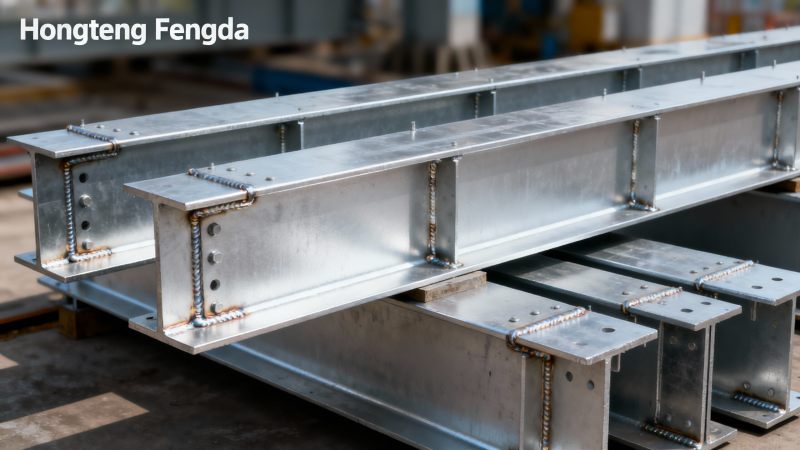
For procurement personnel and project decision-makers, choosing the right steel girder supplier demands more than price comparison—it involves evaluation of production capacity, certification compliance, delivery reliability, and customization capability. Hongteng Fengda’s structural steel solutions are grounded in traceable quality control systems aligning with ASTM, EN, JIS, and GB frameworks. Quality inspection at every stage, from raw material identification to ultrasonic testing of welds, ensures defect-free final products. Buyers should consider several aspects: mechanical property test certificates, third-party inspection options (e.g., SGS, BV, CCIC), and flexibility in OEM production. Furthermore, understanding the interrelation of different profiles—like angle steel versus channel steel—helps simplify procurement strategies for multiple bridge components. For instance, an angle vs channel steel comparison can illustrate load efficiency distinctions useful for selecting stiffeners within bridge girder assemblies. Procurement officers must also assess corrosion protection systems, typically black paint, varnish, or galvanized coatings based on environmental exposure levels. In long-span or coastal bridge projects, anti-corrosion coating combined with sealed weld sections delivers exceptional endurance. Hongteng Fengda’s global logistics capability supports stable lead times, allowing infrastructure developers to synchronize steel deliveries with project milestones seamlessly. These practices reduce procurement risk and reinforce trust between builders and suppliers worldwide.
Standards and Certification Compliance
Standards compliance is the cornerstone of international steel supply chains. ASTM A36, ASTM A572, EN 10025, and JIS G3101 are among the most widely referenced standards governing mechanical and chemical properties of construction steels. For bridge girders, certification ensures the steel’s yield strength, ductility, and weldability meet design expectations. Hongteng Fengda operates under multiple certification schemes, including ISO9001 quality management and material traceability protocols verified by third-party agencies like BV and SGS. Every prefabricated girder undergoes dimension verification, tensile testing, and impact testing to match client-specified grade requirements. Compliance is not limited to core materials—surface finishing processes also follow technical standards such as SSPC-SP10 for near-white blast cleaning. This rigorous quality adherence assures project owners and safety administrators that all delivered products meet regulatory and environmental benchmarks. The company further aligns with sustainable sourcing principles, ensuring minimal carbon footprint across its production network. With such alignment, infrastructure contractors partnering with Hongteng Fengda achieve both technical compliance and corporate sustainability objectives.
Cost, Alternatives, and Long-Term Project Benefits
Cost efficiency remains one of the major motivations for adopting prefabricated steel girder systems in bridge construction. Although initial fabrication costs may appear slightly higher than traditional methods, the overall project economics improve due to shorter construction cycles, reduced equipment rental costs, and minimized project delays. When factoring indirect savings—such as lower manpower and fewer corrective works—prefabrication becomes the more economical alternative. Engineers also explore mixed-material alternatives using high-performance steel in critical regions and conventional grades elsewhere, optimizing the material ratio. Similarly, integrating compatible structural members such as steel conduit for electrical wiring within the bridge deck simplifies design while maintaining performance integrity. Hongteng Fengda provides cross-category supply covering angle steel, channel sections, cold-formed profiles, and steel rail components, allowing buyers to consolidate sourcing under one certified vendor. Such consolidation streamlines logistics, improves specification control, and enhances after-sales service. The result is a lower total cost of ownership and a higher assurance of long-term structural reliability.
FAQ and Misconceptions
Several misconceptions persist in the market regarding prefabricated steel girders. One common misconception is that factory-fabricated girders are difficult to customize. In reality, modern CNC fabrication allows adjustments to dimensions, hole placement, and coating thickness as per individual project specifications. Another misunderstanding is the belief that prefabrication limits design creativity—however, advanced modeling tools and flexible section design enable a near-infinite range of architectural forms. For procurement teams, another frequent query involves comparing angle vs channel steel for auxiliary members; the answer lies in understanding that angle sections provide lateral bracing benefits, whereas channel sections offer higher bending stiffness. Buyers also sometimes assume that all Chinese steel exports lack international certification, but Hongteng Fengda consistently delivers ASTM-certified and EN-compliant products with full inspection documentation. Lastly, some safety officers express concern about transportation risks for long girders; with modular segmented fabrication, each piece is sized for containerized shipping or standard heavy haul logistics, greatly simplifying delivery and risk mitigation. Addressing these misconceptions ensures that project planners, distributors, and contractors can adopt prefabricated solutions confidently and effectively.
Trends and Future Insights
Future developments in steel girder design are heading toward digital integration, sustainability, and material innovation. The adoption of BIM and digital twin technologies allows engineers to visualize structural performance before fabrication, preventing costly errors. Meanwhile, the global industry is exploring hybrid approaches combining high strength steel with fiber-reinforced materials to extend service life under harsh environmental conditions. Sustainability goals are driving demand for recyclable and low-emission steel production processes, an area where Hongteng Fengda continues to invest in cleaner smelting and waste heat recovery systems. Furthermore, the continued growth of modular bridge construction in emerging regions is expected to catalyze greater adoption of prefabricated solutions. For global buyers and distributors managing large project portfolios, long-term collaboration with certified manufacturers enhances strategic supply stability. The convergence of digital fabrication, automated inspection, and global quality assurance frameworks will define the next decade of bridge construction efficiency, positioning prefabricated steel girders as a cornerstone of modern infrastructure development.
Why Choose Hongteng Fengda
Hongteng Fengda stands out as a trusted partner for bridge contractors and steel buyers worldwide. As a structural steel manufacturer and exporter from China, the company combines decades of production experience with continuous technological innovation. From high precision prefabricated steel girders to standardized industrial profiles, every product embodies strict adherence to ASTM, EN, JIS, and GB standards. The firm’s international clients benefit from competitive pricing, consistent quality, and proven reliability supported by ISO and SGS certification. Hongteng Fengda’s professional teams assist project managers, safety supervisors, and procurement officers in tailoring solutions based on structural load requirements, environmental factors, and project schedules. Through stable production capacity and transparent after-sales support, we minimize sourcing risks and strengthen client trust. To explore how prefabricated steel girder for bridge construction and diversified products such as steel tube for industrial applications can enhance your next infrastructure project, contact Hongteng Fengda today—your long-term structural steel partner for global construction excellence.
- channel steel
- steel i
- angle steel
- high carbon steel pipe
- carbon steel pipe
- ASTM A572
- construction steel
- ASTM standards
- ASTM standard
- steel pipe
- ASTM A36
- structural steel
- Structural Steel
- I-Beam
- Profile
- H-beam
- Galvanized
- carbon steel
- steel conduit
- steel tube
- steel rail
- steel girder
- steel square rod
- angle vs channel
- steel tube for industrial applications
- ASTM certified steel square rod
- steel girder for bridge construction
- steel conduit for electrical wiring
- angle vs channel steel comparison
Related recommendations
 What Affects the Cost of Galvanized Steel in Fabrication Projects?Galvanized steel costs vary far beyond raw material price. Learn how coating, steel grade, fabrication, logistics, and hidden quote items affect project budgets before you buy.
 Steel Wire Strand Applications in Lifting and Support: Key Load and Safety ConsiderationsSteel wire strand selection for lifting and support starts with real load, fatigue, corrosion, and anchoring conditions. Learn how to improve safety, service life, and structural reliability.
 Architectural Steel Angle in Facades, Edges, and Clean LinesArchitectural steel angle improves facade edges, clean lines, and structural precision. Discover how it supports durability, faster installation, and smarter project control.
 Where Cold Formed Steel Angle Works Best in Modern BuildsCold formed steel angle works best in modular builds, secondary framing, and utility supports. Learn where it adds value, what to verify, and how to choose the right profile with confidence.
Please give us a message


Please enter what you want to find