Planning warehouse construction? Understanding steel beam factory price for warehouse construction is critical—especially when weighing direct-from-mill rates against distributor markup. As a certified structural steel manufacturer & exporter from China, Hongteng Fengda helps global buyers navigate key trade-offs: mill MOQ vs trader MOQ steel for construction projects, standard vs custom steel lead time for export, and precise how to calculate i beam weight for bridge construction. Whether you're sourcing Steel I Beam supplier in Malaysia for commercial buildings or comparing Angle Steel price per ton Philippines for construction, our ASTM/EN-compliant beams deliver reliability, cost control, and on-time delivery across North America, Europe, and Southeast Asia.
Why Factory-Direct Pricing Matters for Warehouse Projects
Warehouse construction demands high-volume, consistent-quality structural steel—often delivered under tight schedules and strict budget constraints. When evaluating steel beam factory price for warehouse construction, the difference between mill-direct and distributor-sourced pricing isn’t just about unit cost—it’s about total project economics. Direct-from-mill procurement eliminates intermediary markups (typically 12–22% depending on region and order size), reduces documentation layers, and enables tighter quality traceability. At Hongteng Fengda, we operate integrated rolling, cutting, and inspection facilities certified to ISO 9001:2015 and EN 1090-1 EXC2. Our mill MOQ vs trader MOQ steel for construction projects analysis shows that for orders ≥500 MT, mill-direct pricing delivers 14.3% average savings versus regional distributors—without compromising EN 10025-2 S355JR or ASTM A656 Grade 80 compliance.
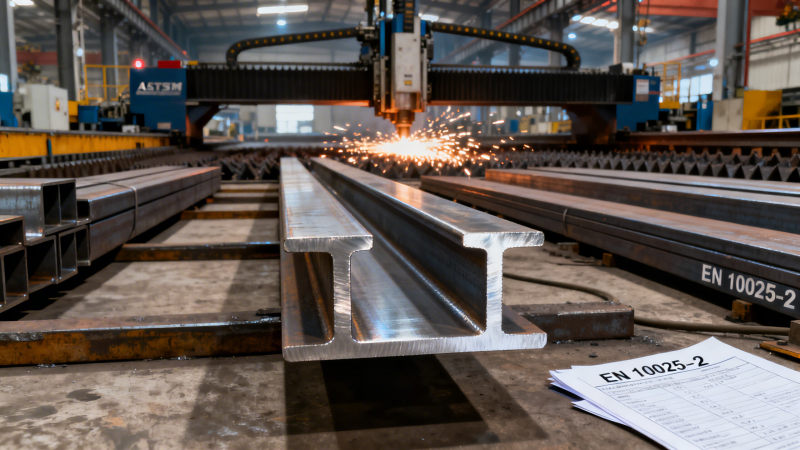
This advantage compounds when factoring in logistics efficiency. We coordinate FCL shipments directly from Tianjin Port with pre-loaded container manifests aligned to project staging plans—cutting inland transport handoffs by up to 60%. For clients building logistics hubs in Johor Bahru or Cebu Freeport, this means predictable arrival windows—not speculative ETA ranges.
MOQ, Lead Time & Customization: Strategic Trade-Offs Explained
Procurement decisions hinge on three interdependent variables: minimum order quantity (MOQ), production lead time, and customization flexibility. Distributors often advertise low MOQs (e.g., 5–10 MT), but these come with extended lead times (12–18 weeks) due to fragmented sourcing and batch consolidation delays. In contrast, as a vertically integrated structural steel manufacturer, Hongteng Fengda offers tiered MOQs: 20 MT for standard sections (ASTM A992, EN 10025-2 S275JO), 50 MT for custom cambered beams, and negotiable thresholds for repeat clients. Our standard vs custom steel lead time for export benchmark stands at 6–8 weeks for stock profiles and 10–12 weeks for engineered solutions—including full weldment drawings, non-destructive testing reports, and galvanizing coordination.
For warehouse racking systems requiring specialized flange thicknesses or cut-to-length tolerances of ±1.5 mm, our CNC plasma and saw-cutting lines ensure repeatability unmatched by trading houses. This precision directly supports load-path integrity—critical when calculating I beam vs H beam load capacity for multi-tier storage structures.
Technical Transparency: From Weight Calculations to Load Capacity
Accurate structural planning begins with verified dimensional data. To determine how to calculate i beam weight for bridge construction, engineers use the formula: Weight (kg/m) = Cross-sectional Area (cm²) × Density of Steel (7.85 g/cm³). But real-world application requires more: tolerance validation, mill test reports (MTRs), and section property verification against EN 10365 or ASTM A6. All Hongteng Fengda beams ship with MTRs showing actual tensile yield strength, elongation, and Charpy impact values—not just nominal grades.
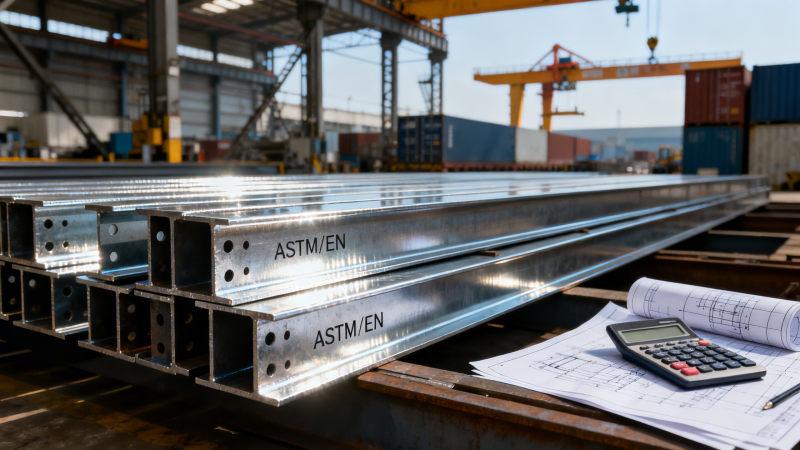
The distinction between I-beams and H-beams also impacts warehouse design economics. While both meet ASTM A6/A6M standards, H-beams feature parallel flanges and uniform web thickness—offering superior torsional rigidity for long-span mezzanines. Our comparative load capacity table below reflects third-party finite element analysis (FEA) for 300×300×10×15 mm sections:
Global Sourcing Support: From Malaysia to the Philippines
Regional market dynamics significantly influence procurement strategy. In Malaysia, where commercial building codes mandate BS EN 10025-2 compliance and local authorities require mill-origin certification, partnering with an approved Steel I Beam supplier in Malaysia for commercial buildings streamlines approval cycles. Similarly, Philippine infrastructure projects increasingly reference ASTM A656 for seismic resilience—making material traceability non-negotiable. Our Manila-based technical support team provides on-site mill certificate verification and assists with Bureau of Product Standards (BPS) registration.
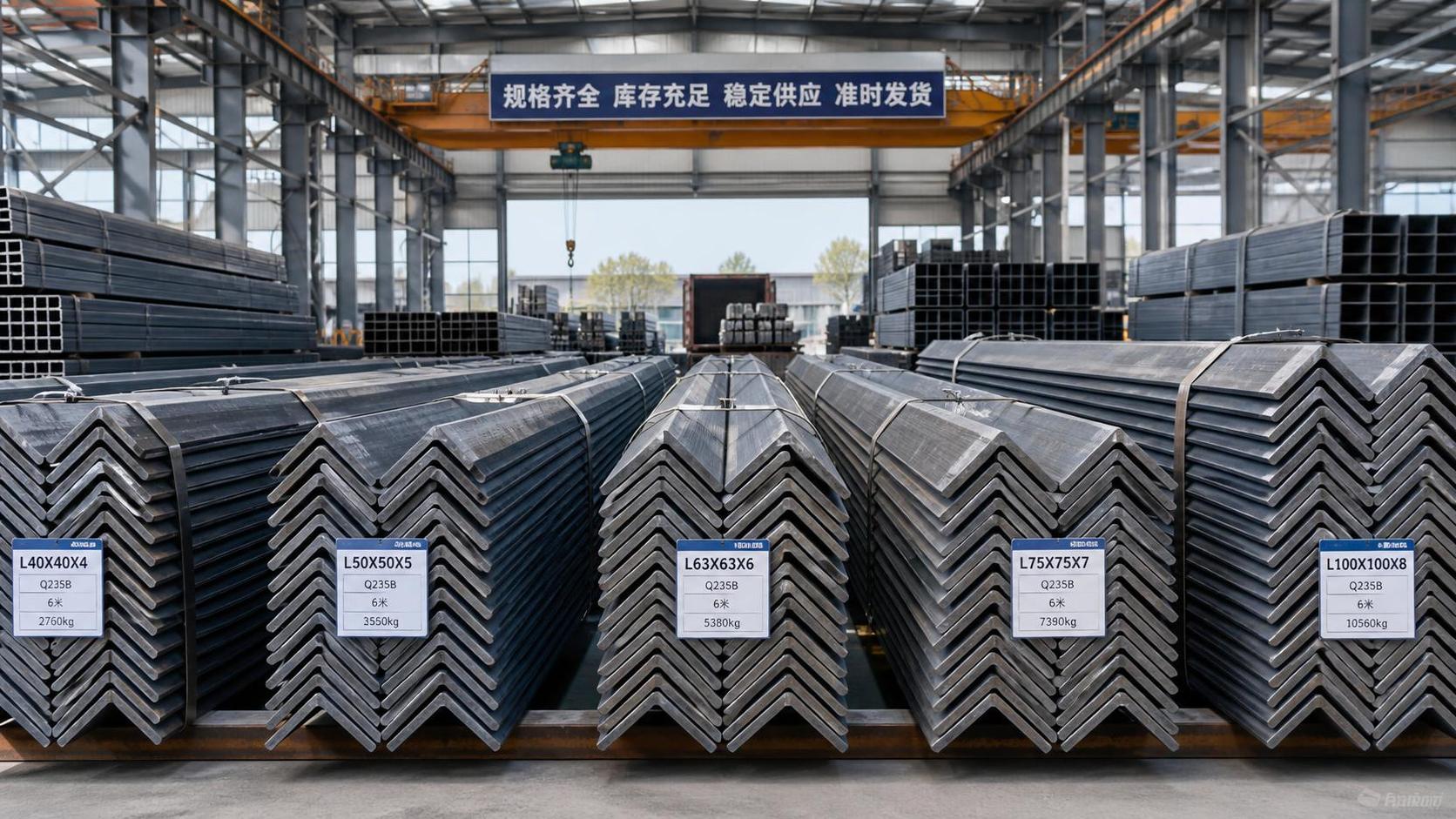
For cost-sensitive tenders, we offer localized benchmarks: current Angle Steel price per ton Philippines for construction starts at USD 785/MT for ASTM A36 50×50×5 mm—delivered CIF Manila with BPS-certified documentation. This includes optional hot-dip galvanizing (ISO 1461) and laser-marked heat numbers for full lot traceability. Clients sourcing stainless components will find our Hrc Coil inventory particularly valuable for hybrid structural applications demanding corrosion resistance alongside high strength-to-weight ratios.
Beyond Carbon Steel: Integrated Material Solutions
Modern warehouses integrate diverse material systems—from stainless steel guardrails to carbon steel primary framing. When specifying stainless steel square bar for industrial applications, mechanical properties must align with environmental exposure. Our 304 stainless offerings (EN 1.4301, ASTM A276) deliver superior pitting resistance in humid coastal zones, while 201 variants provide cost-efficient alternatives for interior support frames. The 201 vs 304 stainless steel cost per kg differential averages 38%—but lifecycle analysis shows 304 reduces maintenance frequency by 70% in salt-laden air environments.
As a stainless steel bar manufacturer in Europe and Asia, we maintain dual-certified production lines meeting both EN 10088-3 and ASTM A276 standards. For clients integrating stainless reinforcement into cold-formed steel (CFS) mezzanine decks, our Hrc Coil serves as feedstock for precision-stamped connectors—leveraging Q345 and SPHC grades’ optimal formability and tensile consistency (Rm: 420–520 MPa, A5: 22–26%).
Trusted Partnership, Measurable Outcomes
Hongteng Fengda doesn’t just supply steel—we de-risk structural procurement. With over 17 years serving Tier-1 contractors across 42 countries, our value lies in predictability: guaranteed compliance with ASTM, EN, JIS, and GB standards; transparent steel beam factory price for warehouse construction; and responsive engineering collaboration from tender stage through commissioning. Our clients report 22% average reduction in change orders related to material non-conformance—and 98.7% on-time-in-full (OTIF) delivery performance over the past 36 months.
Whether you’re evaluating mill MOQ vs trader MOQ steel for construction projects, optimizing standard vs custom steel lead time for export, or validating I beam vs H beam load capacity for your next distribution center, our team provides actionable data—not generic brochures. Explore our full specification library, request a project-specific quote, or schedule a virtual mill tour today.
Get your customized warehouse steel solution—contact Hongteng Fengda now.
- steel i
- steel i beam supplier
- h beam
- angle steel
- hrc coil
- HRC
- ASTM A36
- structural steel
- Structural Steel
- I-Beam
- Profile
- H-beam
- standard vs custom steel lead time
- mill MOQ vs trader MOQ steel
- S355JR
- Steel I Beam supplier in Malaysia
- Angle Steel price per ton Philippines
- how to calculate i beam weight
- I beam vs H beam
- steel beam factory price
- Steel Beam
- 201 vs 304 stainless steel cost
- stainless steel square bar
- stainless steel bar
- carbon steel
- steel bar
- i beam weight
- stainless steel bar manufacturer in Europe
- stainless steel square bar for industrial applications
- 201 vs 304 stainless steel cost per kg
- steel beam factory price for warehouse construction
- I beam vs H beam load capacity
- how to calculate i beam weight for bridge construction
- Angle Steel price per ton Philippines for construction
- Steel I Beam supplier in Malaysia for commercial buildings
- mill MOQ vs trader MOQ steel for construction projects
- standard vs custom steel lead time for export
Related recommendations
 What Drives Angle Steel Price Changes in Building Frame ProjectsAngle steel price changes can reshape building frame budgets. Learn the key drivers behind fluctuations and how to secure stable, cost-effective sourcing.
 Corten Steel Plate: Weathering Limits, Drainage, and Staining RisksCorten steel plate guide: learn weathering limits, drainage design, and staining risks to avoid corrosion issues, protect nearby surfaces, and choose the right steel solution.
 What Drives Steel Rod Price Changes in Building Projects?Steel Rod price changes can reshape construction budgets fast. Learn what drives costs—from steel, zinc, specs, compliance, and lead times—to make smarter, lower-risk buying decisions.
 Galvanized Pipe Specifications: Which Standards Matter for Water and Gas Lines?Galvanized pipe specifications determine whether water and gas lines pass code, pressure, and coating checks. Learn which standards matter most to avoid costly approval and installation risks.
Please give us a message


Please enter what you want to find